 |
| "THEY ARE ALL LIES, BUT THEY ARE FREE!" |
Tuesday, November 19, 2019

Monday, November 11, 2019
Recoger las redes
Por JUAN GABRIEL VÁSQUEZ
Abrí mi primera cuenta de correo electrónico en 1998. Por esos días el fenómeno era todavía reciente, pero ya mi tardanza había comenzado a parecer un acto de escepticismo y aun de terquedad. De manera que 12 años después, cuando empecé a sugerir en público que las redes sociales eran una pérdida de tiempo, que en ellas predominaban el narcisismo risible y el exhibicionismo pueril, y que además estaban estropeando la conversación política, tuve que aceptar la posibilidad de estar equivocándome otra vez: la posibilidad de que me encontrara arrepintiéndome de mis recelos a la vuelta de unos meses y abriendo, yo también, mi cuenta de Twitter, mi página de Facebook. Nunca lo hice, y ahora tengo una certeza: ha sido una de las decisiones más clarividentes que he tomado jamás. Pero pocas veces me ha parecido tan triste tener razón.
Lo pienso ahora que he comenzado a ver por todas partes la resaca de las redes sociales. No es que su popularidad haya decaído, ni su influencia; pero en el último año han aparecido resmas de páginas que prueban, con estudios sociológicos y datos concretos, lo que algunos nos atrevíamos a sugerir sin ellos hace poco menos de una década.
Jaron Lanier publicó el año pasado un libro-panfleto que lo dice con palabras suficientes: Diez razones para borrar tus redes sociales de inmediato. Lanier es un habitante de Silicon Valley: es uno de los inventores de la realidad virtual, por ejemplo, y en su momento hizo tanto como cualquiera por convertir Internet en un fenómeno ubicuo. Es por eso por lo que sus alegatos contra las redes sociales escuecen tanto entre los cautivos. Es alguien que habla desde dentro.
Lanier cree, por ejemplo, que las redes sociales nos están convirtiendo en cabrones (la palabra que usa es assholes, y en la traducción española pone “idiota”. Creo que se queda corta). Lo que quiere decir es que las redes son un ecosistema donde gana quien más atención reciba; y debido a una compleja relación entre los algoritmos y la naturaleza humana, quien más atención recibe es siempre quien insulta, quien agrede, quien matonea o calumnia. Esto sucede, en parte, por la facilidad que dan las redes al trol que todos llevamos dentro, pero también por la manera misteriosa en que las redes minan la empatía: los algoritmos diseñan una realidad a la medida del usuario, fabricada para cada uno de nosotros con nuestros prejuicios y aun nuestros odios; de manera que cada uno va perdiendo con el tiempo la capacidad para entender la realidad de los demás y va ganando, en cambio, cierta facilidad para considerar que todos los demás son sus enemigos. Y en esas condiciones, por supuesto, el ejercicio de la política, en algo imposible, pues las redes están diseñadas para dar un protagonismo inusitado a la paranoia y a la mentira: la verdad no da clics.
¿Cómo responder? Cerrando las redes. Lanier reconoce, por supuesto, las revoluciones pequeñas y grandes que sin las redes no habrían ocurrido. Por eso no dice que las eliminemos de nuestro futuro, sino que nos rebelemos contra las que existen, contra un modelo de negocio montado enteramente sobre la adicción y la manipulación, sobre la explotación económica de nuestros lados más deplorables. Es la única forma, dice, de forzar la invención de un mejor sistema. Lo único que lamento de no tener redes sociales es no darme el gusto, después de leer a Lanier, de cerrarlas para siempre. El País Semanal, 10.11.19
Monday, September 16, 2019
Devaluación continua
Por BERNA GONZÁLEZ HARBOUR
Andreu Navarra, profesor de Lengua y Literatura de Secundaria, retrata la incapacidad de concentrarse de la nueva generación de “ciberproletariado” o la ausencia de debate sobre el futuro al que esta sociedad quiere conducir a sus jóvenes. Navarra no es un teórico, pero sí un torrente de verdades que acaba de publicar Devaluación continua (Tusquets), un latigazo contra la ceguera, una llamada de emergencia ante la degradación del modelo educativo.
Andreu Navarra, profesor de Lengua y Literatura de Secundaria, retrata la incapacidad de concentrarse de la nueva generación de “ciberproletariado” o la ausencia de debate sobre el futuro al que esta sociedad quiere conducir a sus jóvenes. Navarra no es un teórico, pero sí un torrente de verdades que acaba de publicar Devaluación continua (Tusquets), un latigazo contra la ceguera, una llamada de emergencia ante la degradación del modelo educativo.
“Los profesores queremos crear ciudadanos autónomos y críticos, y en
su lugar estamos creando ciberproletariado, una generación sin datos, sin
conocimiento, sin léxico. Estamos viendo el triunfo de una religión tecnocrática
que evoluciona hacia menos contenidos y alumnos más idiotas. Estamos sirviendo
a la tecnología y no la tecnología a nosotros”, afirma Navarra. “El profesor está exhausto,
devorado por una burocracia para generar estadísticas, lo que le quita energía
mental para dar clase”.
El testimonio de Andreu Navarra (Barcelona, 1981), historiador, tiene
el valor de quien ha impartido clase durante seis años en colegios concertados
y públicos, en zonas ricas y castigadas, donde encuentra por igual “profesores
heroicos” en un sistema educativo estresado por la propia sociedad de la que es
espejo: hay padres ausentes porque trabajan demasiado; hay violencia; hay
chicos sin comer o desayunar; hay muchos problemas mentales; y hay una generación
ausente por su concentración en las redes y su identidad virtual.
“Lo audiovisual está creando una nueva Edad Media de personas
dependientes de satisfacer el placer aquí y ahora, cuando la vida es muy
diferente. En la vida hay que saber leer contratos, alquilar pisos, cuidar a
tus mayores, criar hijos. Pero el ciberproletariado se viene abajo ante
cualquier problema. Son personas que no serán capaces de trabajar porque tienen
la concentración secuestrada por las redes”, dice. No es que todos los jóvenes
encajen en su mirada crítica, pero sí ve el riesgo de exclusión de una cuarta
parte de los alumnos en una tormenta perfecta de precariedad y vida virtual.
El libro de Navarra recurre a Ortega y Gasset para apelar a un debate
necesario antes de todo lo demás: a dónde vamos. “Si sabes a dónde vas, si
abrimos un debate sobre el modelo de futuro al que queremos avanzar, después
regularás la tecnología, los horarios o lo que sea, pero antes de aumentar o
disminuir las horas tienes que pensar qué quieres hacer con ellas”, sostiene. Y
el modelo de sociedad que convierte en héroes carismáticos a Pablo Escobar o
Jesús Gil en series de televisión;
la falta de ejemplaridad de unos políticos “pillos, de ahora no te hablo, de
quién la tiene más larga”; la mentalidad Fraga de “turismo y populismo que
prosigue en Salou, en Magaluf, en que destrocen Barcelona” no ayuda. “Falta
reflexión sobre la sociedad que queremos, por qué no apostamos por un MIT español,
por exportar literatura, ingeniería patentada aquí y no exportar ingenieros”. Pero “el papel de ascensor social de la educación está fracasando y
estamos creando bolsas de guetos, de personas sin futuro”.
Menciona también el maquillaje de la ignorancia que practican los
colegios para mejorar la estadística. E insiste una y otra vez en la
incapacidad de fijar la atención, gran carencia de una nueva generación con
fotos en las redes, pero sin memoria. “Hemos conocido varios capitalismos y
ahora mismo estamos en el capitalismo de la atención, en una economía de
plataformas que mercantilizan tu atención. Si estás viendo unos mensajes,
alguien gana dinero y si ves otros, lo gana otro alguien. No podemos repensar
la educación si no pensamos cómo devolver la atención a las aulas, y regresamos
del mundo virtual. Ahora no podemos ensimismarnos, como defendía Ortega y
Gasset, porque todo es ruido, la política es gritos, eslóganes, nadie piensa,
nadie escribe, todo es tontería y eslogan y eso ha llegado a las aulas: lo
simplista, lo binario, el bien y el mal”. Los Steve Jobs o Zuckerberg,
recuerda, recibieron educación analógica. Y los gurúes tecnológicos
mandan a sus hijos a colegios analógicos. Es por ello por lo que,
concluye, “hasta que arreglemos la sociedad, no podremos arreglar el sistema
educativo”. (El País, 15 de septiembre de 2019)
Sunday, September 01, 2019
Boca Juniors: The Agony and the Ecstasy
By JAMIE LAFFERTY
n Magazine by Norwegian, December 2018

On a cool, clear evening in Buenos Aires, San Martín de San Juan, a small football team from western Argentina, arrives to face the music at La Bombonera. Home of Boca Juniors, the largest and most successful team in the country, the stadium is the beating blue-and-gold heart of the colourful, chaotic La Boca neighbourhood.
Indeed, it’s known as much for the noisy enthusiasm of its fans as for the skill of its players, who’ve counted Maradona among their number. Officially the Estadio Alberto J Armando, it’s known to everyone as “The Chocolate Box”, thanks to its unusual shape. But in reality, it’s more meat grinder than confectionery container – certainly for visiting teams who enjoy little success here. This is partly owing to a police ban on any travelling supporters, put in place in 2013, that ensures a wholly partisan atmosphere permeates.
The result is an intimidating frenzy reminiscent of the Two Minutes Hate in George Orwell’s 1984. “An ecstasy of fear and vindictiveness... [flowed] through the whole group like an electric current, turning one even against one’s will into a grimacing, screaming lunatic.” A game at La Bombonera is like that, only 45 times longer.
And yet, strange as it might sound to the nonfootball fan, this fury holds a certain appeal. In a sport where growing corporatisation has led to an increasingly bland and sanitised experience, Boca’s wild terraces are a throwback to a different era. For fans from around the world, this intensity is something to be sought out. Tickets are hard to come by, and it’s not an experience tourists can just wander into, but local tour company Tangol has begun to offer tickets to select foreigners who are accompanied by seasonticket-holding guides. As soon as I heard this was possible, I wanted to experience it. I’m from Glasgow, a city with a notorious footballing reputation of its own, but, even so, visiting La Bombonera seemed like it could be something above and beyond anything I had encountered at home.
A couple of hours before kick-off, I’m duly picked up by diehard Boca fan and Tangol guide Santiago Puerta. Inside the minibus, there’s an eclectic mix of tourists: two stern-looking Finns, a cheery American family and a lone Iranian backpacker. “You’re coming to my house now – it’s a privilege,” says Puerta to all of us as we board, and he makes sure no one is wearing any red or white clothing (the colours of middle-class rivals River Plate) before reassuring us that we’ll be in a section of the 49,000-seat stadium away from flares and trouble.
As the minibus moves through the city, it passes buses of hardcore Boca fans who have been touring the city for hours, shouting and singing out of the windows to let everyone know it’s game day. As we get closer to the stadium, Puerta gives us a potted history of the club, which was founded in 1905 by Italian immigrants for La Boca’s vociferous working class. Now the most popular team in the country, their jerseys are found across Argentina, but the reason for their famous colour scheme is surprisingly arbitrary. “The founders couldn’t agree on which colours to have, so because La Boca is close to the port, they decided to go down there and take them from the next ship that came in,” explains Puerta. “It was Swedish, thank God, because these colours are really pretty. This is what we have: blue and gold for life.”
As we climb high into La Bombonera for the start of the game, those same hues are on the back of every fan and draped from all four stands. The sun is setting so even the sky seems to pay tribute to the team, shifting from a powdery blue to a burnished gold. Puerta settles his guests before taking a seat on the stairs, making it easier for him to jump up and roar when Carlos Tévez gives his team the lead after just nine minutes. The collective roar sounds like an explosion. The atmosphere at La Bombonera is intensified in part because of the steepness and semi-circular shape of the terraces, which boost the acoustics.
From high in the main stand, we have a great view of the pitch, but also of La Doce (The Twelfth Man): the relentless fans behind the goal who move from one chant to the next, with just a quick breather at half time.
While there’s no doubting the commitment of any fans here – even we newcomers quickly lose our inhibitions when a goal is scored – La Doce sets the rhythm for the stadium, and perhaps the entire country. Season tickets at La Bombonera are generational and there are rarely vacancies in their manic stand. The section does have seats, but they’re only used as springboards, allowing fans to jump all the higher when shouting their heroes’ names. Even before scoring, Tévez was the most popular man in the stadium. A short, stocky striker, he first made his name here with Boca Juniors before making his fortune in the UK. Despite never learning English, he made a huge impression there, almost single-handedly saving West Ham from relegation, then winning titles with Manchester United, and their old rivals Man City.
Like many South American players, Tévez eventually opted to play out the final days of his career in his homeland, back with the team that gave him his break. He’s now the highest-paid player in the league, even though his wages are a fraction of what they were in England, Italy and during an ill-judged spell in China.
For Boca fans, the money is not important, though – what really matters is one of their most beloved sons choosing to return home. He grew up 20km from the stadium, in desperate poverty in the notorious Fuerte Apache barrio. While many footballers cover their bodies in patchworks of tattoos, Tévez came into the game scarred: as an infant he accidentally pulled a pan of boiling water off a table and onto himself. Despite his millions, he’s never had any surgery to diminish the scars that run down his neck and chest. At the end of games, he often removes his jersey, as though to remind everyone what it means for him to be here.
He still plays the game like that too, as if getting the ball is his only way to get out of Fuerte Apache. As he smashes through defences, a neutral fan might feel sorry for his opponents but that’s not the Boca way. “He’s really one of us,” says Puerta, nodding with approval as a San Martín defender lies prone on the pitch. “Of course, people talk about Maradona, but he was already finished when he came back here.”
If anything, Maradona is more beloved for what he achieved with the Argentinian national side than his single 1981/82 league title with Boca Juniors. In the Museo de la Pasión Boquense – the club museum in the bowels of La Bombonera – it’s clear that players such as Martín Palermo (236 goals and 13 trophies for Boca) or Juan Román Riquelme (11 trophies over two stints with the club) are held in higher regard than “El Diego”.
However, during the 90 minutes of the match, history seems irrelevant – all that matters is what’s happening on the pitch and the irresistible rhythm of the drums, the crowd’s communal heartbeat. As they chant, fans throw their arms out as though trying to shake something sticky from their hands. When they synchronise a sort of tomahawk chop, thousands of arms slicing through the air, the collective result is hypnotic and infectious. Around the stadium, the blue and gold shimmer as Boca take a 2-0 lead, and during every goal in their 4-2 victory.
Coming to see Boca Juniors feels like travelling back to see football as it might have been in the good old days. The tribalism is very real, the atmosphere supercharged. At half time, Santiago Puerta comes over to me, keen to talk more football, listing every Argentinian player who ever played for Rangers or Celtic in Glasgow. Puerta keeps an eye on that old Scottish war, just as I like to know who wins each Boca Juniors-River Plate match, the infamous Superclásico. The battle lines in Glasgow are religious, so what about here? Why the major rivalry between La Boca and River Plate? “It’s class,” replies Puerta quickly. “Those guys, you know,” he pushes his nose back, seeming to indicate snobbery, “but this year they’re so bad it’s almost no fun to beat them... Almost.” I start to tell him that in the Europe’s top leagues, much has been lost as money has flooded the game. Season tickets are extraordinarily expensive and not enough fans support their home sides; the players are richer, but the sport is arguably impoverished. I think he’s listening, but then La Doce restarts the drums, his eyes seem to go just a little vacant and a moment later, my guide is leaning over the safety barrier, howling with 50,000 others: “When I die, I don’t want flowers/ I want a coffin that has these colours.”
n Magazine by Norwegian, December 2018
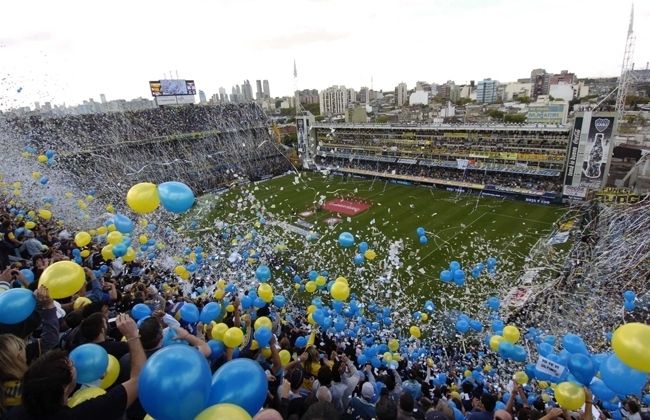
On a cool, clear evening in Buenos Aires, San Martín de San Juan, a small football team from western Argentina, arrives to face the music at La Bombonera. Home of Boca Juniors, the largest and most successful team in the country, the stadium is the beating blue-and-gold heart of the colourful, chaotic La Boca neighbourhood.
Indeed, it’s known as much for the noisy enthusiasm of its fans as for the skill of its players, who’ve counted Maradona among their number. Officially the Estadio Alberto J Armando, it’s known to everyone as “The Chocolate Box”, thanks to its unusual shape. But in reality, it’s more meat grinder than confectionery container – certainly for visiting teams who enjoy little success here. This is partly owing to a police ban on any travelling supporters, put in place in 2013, that ensures a wholly partisan atmosphere permeates.
The result is an intimidating frenzy reminiscent of the Two Minutes Hate in George Orwell’s 1984. “An ecstasy of fear and vindictiveness... [flowed] through the whole group like an electric current, turning one even against one’s will into a grimacing, screaming lunatic.” A game at La Bombonera is like that, only 45 times longer.
And yet, strange as it might sound to the nonfootball fan, this fury holds a certain appeal. In a sport where growing corporatisation has led to an increasingly bland and sanitised experience, Boca’s wild terraces are a throwback to a different era. For fans from around the world, this intensity is something to be sought out. Tickets are hard to come by, and it’s not an experience tourists can just wander into, but local tour company Tangol has begun to offer tickets to select foreigners who are accompanied by seasonticket-holding guides. As soon as I heard this was possible, I wanted to experience it. I’m from Glasgow, a city with a notorious footballing reputation of its own, but, even so, visiting La Bombonera seemed like it could be something above and beyond anything I had encountered at home.
A couple of hours before kick-off, I’m duly picked up by diehard Boca fan and Tangol guide Santiago Puerta. Inside the minibus, there’s an eclectic mix of tourists: two stern-looking Finns, a cheery American family and a lone Iranian backpacker. “You’re coming to my house now – it’s a privilege,” says Puerta to all of us as we board, and he makes sure no one is wearing any red or white clothing (the colours of middle-class rivals River Plate) before reassuring us that we’ll be in a section of the 49,000-seat stadium away from flares and trouble.
As the minibus moves through the city, it passes buses of hardcore Boca fans who have been touring the city for hours, shouting and singing out of the windows to let everyone know it’s game day. As we get closer to the stadium, Puerta gives us a potted history of the club, which was founded in 1905 by Italian immigrants for La Boca’s vociferous working class. Now the most popular team in the country, their jerseys are found across Argentina, but the reason for their famous colour scheme is surprisingly arbitrary. “The founders couldn’t agree on which colours to have, so because La Boca is close to the port, they decided to go down there and take them from the next ship that came in,” explains Puerta. “It was Swedish, thank God, because these colours are really pretty. This is what we have: blue and gold for life.”
As we climb high into La Bombonera for the start of the game, those same hues are on the back of every fan and draped from all four stands. The sun is setting so even the sky seems to pay tribute to the team, shifting from a powdery blue to a burnished gold. Puerta settles his guests before taking a seat on the stairs, making it easier for him to jump up and roar when Carlos Tévez gives his team the lead after just nine minutes. The collective roar sounds like an explosion. The atmosphere at La Bombonera is intensified in part because of the steepness and semi-circular shape of the terraces, which boost the acoustics.
From high in the main stand, we have a great view of the pitch, but also of La Doce (The Twelfth Man): the relentless fans behind the goal who move from one chant to the next, with just a quick breather at half time.
While there’s no doubting the commitment of any fans here – even we newcomers quickly lose our inhibitions when a goal is scored – La Doce sets the rhythm for the stadium, and perhaps the entire country. Season tickets at La Bombonera are generational and there are rarely vacancies in their manic stand. The section does have seats, but they’re only used as springboards, allowing fans to jump all the higher when shouting their heroes’ names. Even before scoring, Tévez was the most popular man in the stadium. A short, stocky striker, he first made his name here with Boca Juniors before making his fortune in the UK. Despite never learning English, he made a huge impression there, almost single-handedly saving West Ham from relegation, then winning titles with Manchester United, and their old rivals Man City.
Like many South American players, Tévez eventually opted to play out the final days of his career in his homeland, back with the team that gave him his break. He’s now the highest-paid player in the league, even though his wages are a fraction of what they were in England, Italy and during an ill-judged spell in China.
For Boca fans, the money is not important, though – what really matters is one of their most beloved sons choosing to return home. He grew up 20km from the stadium, in desperate poverty in the notorious Fuerte Apache barrio. While many footballers cover their bodies in patchworks of tattoos, Tévez came into the game scarred: as an infant he accidentally pulled a pan of boiling water off a table and onto himself. Despite his millions, he’s never had any surgery to diminish the scars that run down his neck and chest. At the end of games, he often removes his jersey, as though to remind everyone what it means for him to be here.
He still plays the game like that too, as if getting the ball is his only way to get out of Fuerte Apache. As he smashes through defences, a neutral fan might feel sorry for his opponents but that’s not the Boca way. “He’s really one of us,” says Puerta, nodding with approval as a San Martín defender lies prone on the pitch. “Of course, people talk about Maradona, but he was already finished when he came back here.”
If anything, Maradona is more beloved for what he achieved with the Argentinian national side than his single 1981/82 league title with Boca Juniors. In the Museo de la Pasión Boquense – the club museum in the bowels of La Bombonera – it’s clear that players such as Martín Palermo (236 goals and 13 trophies for Boca) or Juan Román Riquelme (11 trophies over two stints with the club) are held in higher regard than “El Diego”.
However, during the 90 minutes of the match, history seems irrelevant – all that matters is what’s happening on the pitch and the irresistible rhythm of the drums, the crowd’s communal heartbeat. As they chant, fans throw their arms out as though trying to shake something sticky from their hands. When they synchronise a sort of tomahawk chop, thousands of arms slicing through the air, the collective result is hypnotic and infectious. Around the stadium, the blue and gold shimmer as Boca take a 2-0 lead, and during every goal in their 4-2 victory.
Coming to see Boca Juniors feels like travelling back to see football as it might have been in the good old days. The tribalism is very real, the atmosphere supercharged. At half time, Santiago Puerta comes over to me, keen to talk more football, listing every Argentinian player who ever played for Rangers or Celtic in Glasgow. Puerta keeps an eye on that old Scottish war, just as I like to know who wins each Boca Juniors-River Plate match, the infamous Superclásico. The battle lines in Glasgow are religious, so what about here? Why the major rivalry between La Boca and River Plate? “It’s class,” replies Puerta quickly. “Those guys, you know,” he pushes his nose back, seeming to indicate snobbery, “but this year they’re so bad it’s almost no fun to beat them... Almost.” I start to tell him that in the Europe’s top leagues, much has been lost as money has flooded the game. Season tickets are extraordinarily expensive and not enough fans support their home sides; the players are richer, but the sport is arguably impoverished. I think he’s listening, but then La Doce restarts the drums, his eyes seem to go just a little vacant and a moment later, my guide is leaning over the safety barrier, howling with 50,000 others: “When I die, I don’t want flowers/ I want a coffin that has these colours.”
Saturday, August 10, 2019
Economic growth poses threat to the environment
By PHILIP O'NEILL
Irish Independent, August 10, 2019
The Celtic Tiger did much to sustain the myth that if the economy grows it will benefit all. This same ill-grounded confidence is peddled by Britain's Brexiteers, although it is generally agreed by many economists that the benefits of growth do not trickle downwards; on the contrary, a form of osmosis known as greed tends to facilitate a relentless upwards trickle. Even hardcore economists find it difficult to say "trickle down" with a straight face.
The economic divide between the beneficiaries of the fruits of economic growth and those who just observe it, has generated a political divide that reinforces the advantage over the poor of the better-off.
What is becoming evident is the fragility of democratic institutions as divisions between competing views of wealth creation and distribution vie with one another. This is significant in relation to the persistent insensitivity to the impact of the misuse of the earth's resources, where again the poor of the earth are but hapless spectators.
One of the legacies of the heady Celtic Tiger years was an emerging awareness of the significant long-term threat to the environment that rapid growth and development pose. This includes the threat of irreversible damage to ecosystems, land degradation, deforestation and loss of biodiversity.
In Ireland, our future was hijacked and forfeited to powerful companies who ministered to various forms of rogue capitalism. The housing bubble resulted from reckless gambling; our country was securely in the hands of a powerful elite who had no thought for tomorrow. The rest of us were nurtured by the rhetoric of orthodoxy and resignation.
For some economists, poverty is assumed to be the price we have to pay if our economy is to thrive. The religious minded may be content to pray for the poor. However, there is little sense in praying for them while the rest of the world preys on them. As the poet Yeats would say: "The poor have only their dreams."
Friday, August 09, 2019
Localismos y aprendizaje de idiomas
Por CARLOS MARTÍN GAEBLER
La curiosidad por conocer al otro, la cultura del otro, la lengua del otro es requisito imprescindible para el aprendizaje de un idioma diferente al nuestro materno. Una visión cosmopolita de nuestro entorno facilita la adquisición de habilidades idiomáticas diferentes de las propias. A la inversa, sucede que cuanto mayor sea el apego por la cultura local menor será el interés por conocer una lengua extranjera. Tras tres décadas dedicado a la enseñanza de idiomas, he podido constatar que, cuando un individuo está involucrado únicamente en su cultura autóctona, éste se ve incapaz de adquirir destreza en el uso de una lengua extranjera. Se trata de una relación causa efecto. Sin embargo, aquellos individuos que viajan a otros lugares, ven y escuchan películas de otras partes del mundo, o leen sobre otros asuntos además de sobre su cultura local, muestran una disposición natural al aprendizaje de una lengua extranjera, pues consideran que ésta les enriquece como personas y les hace sentirse ciudadanos del mundo, sentimiento que no ansían quienes, en su obsesión identitaria, sólo se enorgullecen de una cultura autóctona que, por su riqueza y omnipresencia en la vida colectiva, perciben como autosuficiente.
Por lo general, quienes simplemente se conforman con sus tradiciones, con la foto fija de liturgias locales, siempre idénticas y periódicas, carecen de la curiosidad por ver, a través de la ventana del cine, imágenes en movimiento de historias multiculturales localizadas en otras latitudes de la sociedad global. En su narcisismo no son capaces de apreciar otros acentos, otros idiomas, ni sienten la necesidad de aprenderlos. Dice Antonio Muñoz Molina que una cultura personal se adquiere con mucho tesón y esfuerzo a lo largo de la vida, igual que se adquiere la destreza para hablar un idioma extranjero; una cultura autóctona se posee tan solo por nacer en ella. Sentirse exageradamente orgulloso de haber nacido en tal o cual sitio es un acto empobrecedor y ridículo, como lo es también creerse el ombligo del mundo. El localismo es una forma primigenia de nacionalismo o, como dijo Karl Popper, una regresión a la tribu.
Estudiar y escuchar un idioma extranjero requiere un esfuerzo intelectual que es incompatible con la práctica de cualquier forma de fanatismo. Algunos se ven incapaces de abandonar su zona de confort, fascinados de por vida por la contemplación de la patrona local, una pequeña estatua articulada de madera a la que adoran, entre otros motivos, porque representa a una mujer que, dicen, "engendró" sin sexo previo.
Una vez conocí a un universitario de una ciudad del sur de España, narcisista como ninguna otra, que confesaba que sólo le interesaban los arquitectos nacidos en su ciudad y no entendía el entusiasmo que sus compañeros de la Escuela de Arquitectura sentían tras anunciarse un taller que iba a ser impartido por dos reputados arquitectos portugueses. A quienes durante gran parte del año ocupan su pensamiento en perpetuar las tradiciones locales o nacionales poco tiempo les queda para ocuparse de estudiar una lengua extranjera que ven ajena a su propio grupo social, no creen necesitar y consideran una asignatura maría. Un estudiante de secundaria me confesó en cierta ocasión que, en lugar de irse de crucero cultural en el viaje de fin de curso con sus compañeros para conocer el Mediterráneo esa primavera, había preferido peregrinar al Rocío, ¡por décimo año consecutivo! Ninguno de los dos habla una segunda lengua. cmg2014
Por lo general, quienes simplemente se conforman con sus tradiciones, con la foto fija de liturgias locales, siempre idénticas y periódicas, carecen de la curiosidad por ver, a través de la ventana del cine, imágenes en movimiento de historias multiculturales localizadas en otras latitudes de la sociedad global. En su narcisismo no son capaces de apreciar otros acentos, otros idiomas, ni sienten la necesidad de aprenderlos. Dice Antonio Muñoz Molina que una cultura personal se adquiere con mucho tesón y esfuerzo a lo largo de la vida, igual que se adquiere la destreza para hablar un idioma extranjero; una cultura autóctona se posee tan solo por nacer en ella. Sentirse exageradamente orgulloso de haber nacido en tal o cual sitio es un acto empobrecedor y ridículo, como lo es también creerse el ombligo del mundo. El localismo es una forma primigenia de nacionalismo o, como dijo Karl Popper, una regresión a la tribu.
Estudiar y escuchar un idioma extranjero requiere un esfuerzo intelectual que es incompatible con la práctica de cualquier forma de fanatismo. Algunos se ven incapaces de abandonar su zona de confort, fascinados de por vida por la contemplación de la patrona local, una pequeña estatua articulada de madera a la que adoran, entre otros motivos, porque representa a una mujer que, dicen, "engendró" sin sexo previo.
Una vez conocí a un universitario de una ciudad del sur de España, narcisista como ninguna otra, que confesaba que sólo le interesaban los arquitectos nacidos en su ciudad y no entendía el entusiasmo que sus compañeros de la Escuela de Arquitectura sentían tras anunciarse un taller que iba a ser impartido por dos reputados arquitectos portugueses. A quienes durante gran parte del año ocupan su pensamiento en perpetuar las tradiciones locales o nacionales poco tiempo les queda para ocuparse de estudiar una lengua extranjera que ven ajena a su propio grupo social, no creen necesitar y consideran una asignatura maría. Un estudiante de secundaria me confesó en cierta ocasión que, en lugar de irse de crucero cultural en el viaje de fin de curso con sus compañeros para conocer el Mediterráneo esa primavera, había preferido peregrinar al Rocío, ¡por décimo año consecutivo! Ninguno de los dos habla una segunda lengua. cmg2014

Wednesday, August 07, 2019
Mass Shootings Are Terrorism
The New York Times, August 7, 2019
If one of the perpetrators of this weekend’s two mass shootings had adhered to the ideology of radical Islam, the resources of the American government and its international allies would mobilize without delay.
The awesome power of the state would work tirelessly to deny future terrorists access to weaponry, money and forums to spread their ideology. The movement would be infiltrated by spies and informants. Its financiers would face sanctions. Places of congregation would be surveilled. Those who gave aid or comfort to terrorists would be prosecuted. Programs would be established to de-radicalize former adherents.
No American would settle for “thoughts and prayers” as a counterterrorism strategy. No American would accept laying the blame for such an attack on video games, like the Texas lieutenant governor, Dan Patrick, did in an interview on Sunday when discussing the mass shooting in El Paso that took 20 lives and left 27 people wounded.
In predictable corners, moderate Muslims would be excoriated for not speaking out more forcefully against the extremists in their midst. Foreign nations would be hit with sanctions for not doing enough to help the cause. Politicians might go so far as to call for a total ban on Muslims entering the United States “until our country’s representatives can figure out what the hell is going on.”
Even a casual observer today can figure out what is going on. The world, and the West in particular, has a serious white nationalist terrorist problem that has been ignored or excused for far too long. As President George W. Bush declared in the wake of the 9/11 attacks, we must be a country “awakened to danger and called to defend freedom. Our grief has turned to anger, and anger to resolution.”
There are serious questions about how the United States has approached Islamic extremism, but if even a degree of that vigilance and unity of effort was put toward white nationalism, we’d be safer.
White nationalist terror attacks are local, but the ideology is global. On Saturday, a terrorist who, according to a federal law enforcement official, wrote that he feared a “Hispanic invasion of Texas” was replacing white Americans opened fire in a Walmart in El Paso. In a manifesto, the gunman wrote that he drew some inspiration from the white nationalist terrorist attack in Christchurch, New Zealand, that left 51 people dead. The F.B.I. is investigating the El Paso mass shooting as a possible act of domestic terrorism. The motive behind another mass shooting in Dayton, Ohio, is under investigation.
In April, another terrorist who opened fire at a synagogue in Poway, Calif., echoed the words of the Christchurch suspect, too, and appeared to draw inspiration from a massacre at a synagogue in Pittsburgh last fall. The alleged Christchurch terrorist, for his part, wrote that he drew inspiration from white supremacist attacks in Norway, the United States, Italy, Sweden and the United Kingdom.
An investigation by The Times earlier this year found that “at least a third of white extremist killers since 2011 were inspired by others who perpetrated similar attacks, professed a reverence for them or showed an interest in their tactics.”
White supremacy, in other words, is a violent, interconnected transnational ideology. Its adherents are gathering in anonymous, online forums to spread their ideas, plotting attacks and cheering on acts of terrorism.
The result is an evolving brand of social media-fueled bloodshed. Online communities like 4chan and 8chan have become hotbeds of white nationalist activity. Anonymous users flood the site’s “politics” board with racist, sexist and homophobic content designed to spread across the web. Users share old fascist fiction, Nazi propaganda and pseudoscientific texts about race and I.Q. and replacement theory, geared to radicalize their peers.
While its modern roots predate the Trump administration by many decades, white nationalism has attained a new mainstream legitimacy during Mr. Trump’s time in office.
Far more Americans have died at the hands of domestic terrorists than at the hands of Islamic extremists since 2001, according to the F.B.I. The agency’s resources, however, are still overwhelmingly weighted toward thwarting international terrorism.
The nation owed a debt to the victims of the 9/11 attacks, to take action against the vile infrastructure that allowed the terrorists to achieve their goals that horrible Tuesday. We owe no less of a debt to the victims in El Paso and to the hundreds of other victims of white nationalist terrorism around the nation.
American law enforcement needs to target white nationalists with the same zeal that they have targeted radical Islamic terrorists. Ensuring the security of the homeland demands it.
There can be no middle ground when it comes to white nationalism and the terrorism it inspires. You’re either for it or against it.
If one of the perpetrators of this weekend’s two mass shootings had adhered to the ideology of radical Islam, the resources of the American government and its international allies would mobilize without delay.
The awesome power of the state would work tirelessly to deny future terrorists access to weaponry, money and forums to spread their ideology. The movement would be infiltrated by spies and informants. Its financiers would face sanctions. Places of congregation would be surveilled. Those who gave aid or comfort to terrorists would be prosecuted. Programs would be established to de-radicalize former adherents.
No American would settle for “thoughts and prayers” as a counterterrorism strategy. No American would accept laying the blame for such an attack on video games, like the Texas lieutenant governor, Dan Patrick, did in an interview on Sunday when discussing the mass shooting in El Paso that took 20 lives and left 27 people wounded.
In predictable corners, moderate Muslims would be excoriated for not speaking out more forcefully against the extremists in their midst. Foreign nations would be hit with sanctions for not doing enough to help the cause. Politicians might go so far as to call for a total ban on Muslims entering the United States “until our country’s representatives can figure out what the hell is going on.”
Even a casual observer today can figure out what is going on. The world, and the West in particular, has a serious white nationalist terrorist problem that has been ignored or excused for far too long. As President George W. Bush declared in the wake of the 9/11 attacks, we must be a country “awakened to danger and called to defend freedom. Our grief has turned to anger, and anger to resolution.”
There are serious questions about how the United States has approached Islamic extremism, but if even a degree of that vigilance and unity of effort was put toward white nationalism, we’d be safer.
White nationalist terror attacks are local, but the ideology is global. On Saturday, a terrorist who, according to a federal law enforcement official, wrote that he feared a “Hispanic invasion of Texas” was replacing white Americans opened fire in a Walmart in El Paso. In a manifesto, the gunman wrote that he drew some inspiration from the white nationalist terrorist attack in Christchurch, New Zealand, that left 51 people dead. The F.B.I. is investigating the El Paso mass shooting as a possible act of domestic terrorism. The motive behind another mass shooting in Dayton, Ohio, is under investigation.
In April, another terrorist who opened fire at a synagogue in Poway, Calif., echoed the words of the Christchurch suspect, too, and appeared to draw inspiration from a massacre at a synagogue in Pittsburgh last fall. The alleged Christchurch terrorist, for his part, wrote that he drew inspiration from white supremacist attacks in Norway, the United States, Italy, Sweden and the United Kingdom.
An investigation by The Times earlier this year found that “at least a third of white extremist killers since 2011 were inspired by others who perpetrated similar attacks, professed a reverence for them or showed an interest in their tactics.”
White supremacy, in other words, is a violent, interconnected transnational ideology. Its adherents are gathering in anonymous, online forums to spread their ideas, plotting attacks and cheering on acts of terrorism.
The result is an evolving brand of social media-fueled bloodshed. Online communities like 4chan and 8chan have become hotbeds of white nationalist activity. Anonymous users flood the site’s “politics” board with racist, sexist and homophobic content designed to spread across the web. Users share old fascist fiction, Nazi propaganda and pseudoscientific texts about race and I.Q. and replacement theory, geared to radicalize their peers.
While its modern roots predate the Trump administration by many decades, white nationalism has attained a new mainstream legitimacy during Mr. Trump’s time in office.
Far more Americans have died at the hands of domestic terrorists than at the hands of Islamic extremists since 2001, according to the F.B.I. The agency’s resources, however, are still overwhelmingly weighted toward thwarting international terrorism.
The nation owed a debt to the victims of the 9/11 attacks, to take action against the vile infrastructure that allowed the terrorists to achieve their goals that horrible Tuesday. We owe no less of a debt to the victims in El Paso and to the hundreds of other victims of white nationalist terrorism around the nation.
American law enforcement needs to target white nationalists with the same zeal that they have targeted radical Islamic terrorists. Ensuring the security of the homeland demands it.
There can be no middle ground when it comes to white nationalism and the terrorism it inspires. You’re either for it or against it.
Sunday, July 28, 2019
CHAMPS D'AMOURS: 100 Years of Rainbow Cinema
CHAMPS
D'AMOURS 100 Ans de Cinéma Arc-en-ciel is a free
exhibition at Paris' Hôtel de Ville. In collaboration with La Cinématèque Française. From June 25 to September 28, 2019 Chief curator: Alain Burosse

1919
ORIGINS. The first allusions to gay and lesbian characters and
storylines to hit movie screens took the form of relatively ridiculous
transvestite caricatures in playful burlesque comedies. At one time or another,
every comic star of the 1910s (Buster Keaton, Stan Laurel, Fatty Arbuckle, Max
Linder and Charles Chaplin) adorned themselves in the opposite gender’s
finery to act out a storyline or a misunderstanding. The transvestite tradition
is still very much alive today and comedy remains one of the genres that
regularly welcomes LGBT characters. Other more serious work surfaced in the
subsequent decades, including tragedies (The
Wings, Mauritz Stiller, 1916; Michael,
Cari T. Dreyer, 1923; and Pandora’s Box,
Georg W. Pabst, 1928). These films created new hard-life stereotypes of gay
love that was doomed by its very nature to calamity and death. These forays
were quickly stifled and banned during the period that followed –a time marked
by the rise of fascism in Europe and the strict censorship rules of the Hays
Code, introduced in the United States in 1934. While French cinema remained an
exception to the rule, gay people almost vanished from the movies. Rare portrayals
were coded or hostile, and came from the fringes of an experimental, emerging
form of cinema. At long last, in the 1960s in Great Britain, where
homosexuality was still illegal, this situation was contested by the film Victim (Basil Dearden, 1961) and by Dirk
Bogard, who played the lead role and had the original idea for the film.
1969
STONEWALL: THE TIPPING POINT
On June 28th 1969, the same day
as Judy Garland’s funeral (the singer of the gay anthem Over the Rainbow) the
Stonewall riots broke out when a police raid sparked a rebellion from the
regulars of a gay bar in New York City, marking the beginning of a worldwide
militant gay movement. However, cinema had begun its transformation much
earlier: in Hollywood, the Hays Code had slowly crumbled away, and in Germany
angry young directors (Reiner Werner Fassbinder, Peter Fleishmann, and Rosa
von Praunheim) had begun to use gay themes to shake up movies made by the overly-conventional
middle-class Federal Republic from 1966 onwards. This period –which coincided with the sexual liberation
resulting from May 1968– led to the emergence of major works by great
moviemakers who no longer feared tackling gay issuse in their films, as
typified by the three masterful Italian directors: Pier Paolo Passolini (Teorema, 1968), Federico Fellini (Satyricon, 1969), Luchino Visconti (Death in Venice, 1971). The
post-Stonewall period also saw the first films emerge from directors who mixed
feminist and lesbian themes (eg. Chantal Akerman, Barbara Hammer and Ulrike
Ottinger). In mainstream cinema, there was a rise in the number of gay and
lesbian characters and they were often treated sympathetically. Famous
directors also affirmed their own sexuality (eg. Patrice Chéreau with L’Homme blessé, 1983, or André Techiné,
with Les roseaux sauvages, 1994) and
new plots tackled hitherto unexplored themes (bisexuality, adolescence, romance
and couples, etc.). New types of film-making opened up to portraying LGBT
lives: in Spain with la Movida movement and Pedro Almodóvar in the 1980s, in
Israel, South America, and several countries in Asia.
2019
THRIVING CONTEMPORARY SCENE
The burgeoning number of characters
and LGBT themes in film has grown continually over the last twenty years. As a
result, ground-breaking portrayals of gay and lesbian lives have flourished
across all genres and in almost all areas thanks to new approaches, in
particular those representing the queer viewpoint. The work and directors
belonging to this movement have received unprecedented recognition from the
general public and movie critics alike. This was clearly demonstrated in France
and abroad by the popular acclaim of La vie
d’Adèle (Abdellatif Kechiche, 2014), 120
battements par minute (Robin Campillo, 2017), and Una mujer fantástica, Sebastián Leili, 2017), and by the number of
prestigious awards those films have collected (Palm d’Or, César awards, Oscar
Award for best Foreign Film, etc.). Furthermore, a film with a gay theme –and
since the young man at the heart of the story was black he had double minority
status– was awarded with the Oscar for Best Picture in 2017: Moonlight, by Barry Jenkins. All this
goes to show just how far we have come in terms of recognition and visibility
since Different from the Others
(Richard Oswald, Germany) made its own, very solitary, militant contribution a
century ago.
CUT! Hollywood’s censors were not content
with merely thrusting gay and lesbian characters into the closet. They also
tried outright to eliminate any storylines deemed to portray same-sex desire
too blatantly. Thus, an overtly lesbian dance scene was retrospectively removed
from the epic The Sign of the Cross
(Cecil B. DeMille, 1932), while a suggestive dialogue between a senator and his
slave was cut out from Stanley Kubrick’s Spartacus
(1960). All around the world, censors have clamped down in more ruthless ways,
imprisoning directors they deem scandalous in some places (Sergei Paradjanov in
the Soviet Union) and banning films elsewhere (Rafiki, Wanuri Kahui, 2018, in Kenya). In India, the film Fire (Deepa Metha, 1966), which tells a
lesbian love story was not suppressed by State censorship, instead nationalist
Hindus ransacked cinemas and forced the government to order the film to be
temporarily withdrawn from cinemas. In France itself, Zero for Conduct, by Jean
Vigo (1933), was banned from cinemas for twelve years because of its anarchist
leanings and the ambivalent relationship between the two students. Lionel
Soukaz toyed with the limits of censorship in Ixe (1982), a collage film that brings together an erect penis and
the pope in a whirlwind of images. But censorship often strikes in unexpected
forms: through family pressure (Mishima,
a Life in Four Chapters, Paul Schrader, 1984), through the rejection of
topics producers consider “too gay” (Behind
the Candelabra, Steven Soderbergh, 2010), and through fear of displeasing a
political regime. A very recent example of this is the American film Boy Erased (Joël Edgerton, 2018), which tackles
the subject of “conversion therapies” –its producers decided not to distribute
the film in president Bolsonaro’s Brazil, where such practices are encouraged!
MASK! How can you show what you are banned
from portraying? Hollywood directors who wanted to include gay and lesbian
characters in their storylines faced this quandary from 1934 to the beginning
of the 1960s because the Hays Code that had been adopted by the major
production companies banned “sexual perversion” (amongst other things) from the
big screen. In 1981, Vito Russo’s seminal book and eponymous documentary The Celluloid Closet (Rob Epstein and
Jeffrey Friedman, 1995) revealed the multitude of ruses that had been employed
to recycle codes and stereotypes entrenched in the collective subconscious:
mannered, overly-elegant characters with no sentimental attachment,
double-entendres, potent friendships, lingering glances, etc. It reveals traces
of comedy (the Laurel and Hardy “couple”), film noir, Western and epics. It was
about making the invisible visible, but often also involved using the images to
imply that these different characters, always inhabiting a shady world and
rubbing shoulders with criminals, posed a potential threat to the American
family and society. Alfred Hitchcock was a master of the art of blurring the
lines and managed to introduce intriguing, unsettling and seductive characters
to many of his plots, including Rebecca
(1940), North by Northwest (1958), Rope (1948) and Strangers on a Train (1951).
EVERY KIND OF LOVE
IN THE WORLD To Western cinema’s portrayal of gay, lesbian and trans people we
must add portrayals from other places, where long-silenced stories are now
finally emerging in increasing numbers of countries year on year: Kenya, Iran,
Guatemala, Nigeria, Chile, South Africa, South Korea, Guinea, India, China,
Taiwan, Cuba, Israel, Brazil, Mexico, Senegal, Japan, Argentina, the
Philippines, Egypt, etc. Even in the most hostile political contexts, LGBT
characters are being created and storylines with gay content are being written
in all languages, all around the globe. Ambitious films made by movie makers
residing at the heart of the system, such as Chinese director Chan Kaige (Farewell, my Concubine) or Israeli Eytan
Fox (The Bubble), are coexisting
alongside films produced secretly by activists who want their minority voices
to be heard. Far from contending themselves with simple on-screen portrayals
and a quest for visibility, these film directors from all corners of the world
are bringing us dissident representations, making no concessions, braving bans
and refusing self-censure to expand our field of vision. Is it just a
coincidence that one of the few films about intersex people came out of
Argentina: XXY (Lucía Puenzo, 2007)? Movies from around the world take all
forms and cover all angles: the denunciation of ambient homophobia, the comic
re-use of stereotypes, tragedies and, above all, romance. These love stories,
which may be light or dark, and do not always have an unhappy ending, tell
audiences that LGBT love is possible, even if it is difficult under regimes
that discriminate against or repress gay, lesbian and trans people. Cinema
offers role models, and gay and transgender people’s need to see portrayals of
themselves and of their love stories and sexual adventures are key in every
part of the globe. In the same way, it is still essential that we fight
prejudice by showing girls kissing girls and boys making out with boys (and
vice versa) on the big screen and that we broadcast these images to the broadest
possible audience as a way of asserting that minority love is part of every
kind of love in the world.
Sunday, July 21, 2019
Tuesday, June 25, 2019
El inglés impreso en el pecho
Por ÁLEX GRIJELMO

El buen tiempo atrae a las camisetas de manga corta y cuello redondo. Gente de todas las edades las compra en los mercadillos pero también en las tiendas de lujo, es de suponer que con distintos precios. Los días de sol constante arrojan a las calles españolas esas prendas desenfadadas a las que suele acompañar un atuendo más bien deportivo.
Rara vez se repiten en ellas el diseño o la combinación de colores, cuando se trata de tejidos policromados; ni las imágenes que llevan estampadas por delante o por detrás. Cada cual elige el modelo que más le gusta, así como el mensaje que desea transmitir a quienes se crucen en su camino y no circulen mirando al suelo o hablando por teléfono, o las dos cosas.
La disparidad estética de las camisetas alegra estos primeros días de calor. Pero esa variedad de tonos, dibujos, fotografías y frases que se ven sobre la prenda confluyen en una cierta homogeneidad cuando uno intenta leer lo que llevan escrito: casi todos los mensajes están expresados en inglés.
Solamente el 27,7% de los españoles sabe hablar, leer y escribir en esa lengua, si nos fiamos de las respuestas que los encuestados le dieron al Centro de Investigaciones Sociológicas (CIS) a finales de 2016. Sin embargo, nos encanta simular que todos lo hacemos. La publicidad se llena de términos en inglés, las revistas de moda disfrutan con inundar sus páginas de anglicismos, los diarios se olvidan a menudo de traducir los suyos, los comercios de las ciudades eligen nombres y rótulos en aquella lengua. Y qué contentos nos quedamos.
Últimamente se han sumado las camisetas veraniegas a esa general fascinación que nos hace parecer políglotas. En ellas leemos: “All power to the people”, “Air needed”, “Better than yesterday”, “Keep calm and happy goat”, “Big smile, deep breathe”, “Good music, dark chocolate”, “Happy hour”, “Future important woman”, “Everythink I like is either expensive, illegal or won’t text me back”… La vicepresidenta del Gobierno, Carmen Calvo, lució hace poco en público este lema, más deducible: “Yes, I’m a feminist”.
Ninguno de ustedes necesita la traducción de esa selección de frases, porque todos saben inglés, igual que quienes visten esas camisetas, pero el apartado 2.23 del Libro de estilo de este periódico obliga a aclarar las citas expresadas en otras lenguas. Así que ahí van unas equivalencias: “Todo el poder para la gente”, “Se necesita aire”, “Mejor que ayer”, “Mantén la calma y feliz cabra” (yo tampoco lo entiendo), “Gran sonrisa, respira hondo”, “Buena música, chocolate negro”, “Hora feliz”, “Futura mujer importante”, “Todo lo que me gusta es caro, ilegal o no me devolverá el mensaje de texto”... y “Sí, soy feminista”.
Están en su libertad quienes portan tales carteles ambulantes, claro. Ante ello, uno apenas puede preguntarse si en realidad desearán comunicar algo, o simplemente les gustará la estética de la tipografía estampada en la camiseta. Imagino que más bien lo segundo, pues en el primer caso se toparán con que gran parte de los transeúntes con quienes se cruzan no saben qué significan las palabras impresas. Y como generalmente transmiten buen humor, se perderán el chiste y seguirán en su tristeza.

Monday, June 10, 2019

Sunday, May 19, 2019
EU launches free Interrail tickets for 18-year-olds

This summer, 15,000 young Europeans will get free train tickets to travel within the EU. The DiscoverEU program seeks to counter populism and promote Europe by making cultural exchanges more accessible.
The EU on Thursday launched its project to grant free Interrail tickets to European youths. The initiative hopes to help deepen young people's European identity by providing accessible travel between countries.
Some 30,000 European 18-year-olds will be eligible this summer to travel for up to 30 days to up to four different countries within the EU at no cost. The DiscoverEU project provides only the free rail access; young people would have to pay for accommodation, food and other expenses on their own.
The initiative was approved in March, when the EU's executive branch earmarked €12 million ($14.7 million) for the project. The idea was originally proposed the European People's Party Group (EPP) leader Manfred Weber, who introduced it in the European Parliament.
Fostering a European identity
DiscoverEU sees the free rail passes as an investment in European cultural identity. The project conceives the idea of Europe to be "above all, about people connecting and sharing emotions." By providing free rail tickets, the EU would be helping enable Europeans to connect and share with people across the Union at a very early age.
The advocates at DiscoverEU also believe that the program can help "counter the current growth of populism" by helping young people experience the advantages of free movement, see the reality of neighboring countries firsthand and explore what it is that unites Europeans.
Application required
Since the earmarked funds are only able to fund 15,000 tickets, young Europeans must submit an application through theEU's website for youth programs to win. Those interested would need to apply in June during a period of two weeks.
A quota system and a quiz on EU heritage, culture and current affairs will be used to select the first 15,000 ticket recipients.
If selected, participants would have to carry out their travel between the months of July and September of 2018. The tickets would be distributed by the already-existing Interrail program, which has been providing discounted tickets to European youths since its inception in 1972. (Source: Deutsche Welle)

Related article: Los primeros del Interrail gratis vuelven a casa

Related article: Los primeros del Interrail gratis vuelven a casa
Saturday, May 18, 2019
ERASMUS Programme 30th Anniversary
30 Aniversario Erasmus+

De Erasmus a Erasmus+
Treinta años enriqueciendo vidas y abriendo mentesErasmus+ es el Programa integrado de la Unión Europea para la Educación, Formación, Juventud y Deporte.
El Programa original ERASMUS (European Region Action Scheme for the Mobility of University Students) comenzó en 1987 como un programa de intercambio que ofrecía a estudiantes universitarios la posibilidad de aprender y enriquecerse estudiando en el extranjero. A lo largo de los últimos 30 años ha ampliado su alcance y envergadura. Hoy Erasmus+ ofrece un mayor número de oportunidades tanto a personas como a organizaciones, como por ejemplo ir de voluntario o aprendiz a países extranjeros y cooperar en proyectos conjuntos. El Deporte también se ha convertido en una parte importante de Erasmus+ y, además, actualmente el Programa se extiende a países de fuera de Europa.
De hecho, desde el lanzamiento del programa Erasmus+ en 2014, dos millones de personas de todos los ámbitos se han beneficiado de las oportunidades que ofrece, tales como periodos de estudios, de prácticas o voluntariado, adquiriendo experiencia en el extranjero. Y durante estos últimos 30 años ya han participado un total de cinco millones de jóvenes.
Entre 2017 y 2020, Erasmus+ brindará oportunidades a más de dos millones de personas en toda Europa y resto del mundo.

Friday, May 17, 2019
Youth Strikes For Climate
ROSES ARE RED, VIOLETS ARE BLUE.
THE EARTH IS DYING BECAUSE OF YOU.

Here’s how to argue with a Brexiter – and win

Details of a tortured Brussels deal are not crucial when the fate of both Europe and the UK is at stake
By TIMOTHY GARTON ASH
The Guardian, Saturday 20th, February 2016
A new battle of Britain has begun. On its outcome will depend the fate of two unions: the United Kingdom and the European Union. If the English vote to leave the EU, the Scots will vote to leave the UK. There will then be no Britain. Meanwhile, the shock of Brexit to a continent already staggering under many crises could spell the beginning of the end of the European Union.
So if you care about Britain or Europe, and even more if you care about Britain and Europe, please join this good fight. The final negotiation in Brussels was bruising, and certainly not the kick-off anyone would want, but there is still everything to play for. Continental Europeans often assume that England is, in its heart of oak, incorrigibly hostile to Europe. This is not true. For decades now, the best pollsters have found that on the EU there is a large undecided middle which can go either way. That was the case in the run-up to the 1975 referendum, which saw a large swing from out to in, and it’s true today: 42% of those who tell ComRes they will vote in or out also say they could still change their minds.
I know, from many hostile online comments, that the Guardian has some fiercely Eurosceptic followers, but I’m now mainly addressing the majority of our readers, whether British or not, who want Britain to stay in the EU. It’s a peculiarity of this referendum that Commonwealth citizens may vote in it, whereas French, Italians and Germans who have lived here for many years, and are much more directly affected, may not. But whether or not you have a vote, you still have a voice. Raise it, please, in the pub, in the office or in the friend’s living room.
Here are just a few of the arguments you could make. First of all, the details of the deal are not the crucial issue. Months ago, when David Cameron revealed his renegotiation agenda, it was already clear that this was not going to be a fundamental redefinition of Britain’s relationship with the EU. Nor would we suddenly find ourselves in “a reformed Europe”. On this, Eurosceptics are right: Cameron’s demands were less than he pumped them up to be, and inevitably, given that 27 other European countries had to be satisfied, what he achieved is even more modest. But it would be madness to let a decision about the economic and political future of Britain for decades ahead hinge on the detail of an “emergency brake” on in-work benefits for migrants.
The negotiation of Brexit would be long and bloody. Nigel Lawson blithely suggests that it would be easy: we just repeal the 1972 European Communities Act and with one bound John Bull is free. Our continental partners would give us generous access to the single market through a free trade agreement “that they need far more than we do”. In your dreams. Read the careful analysis by the longtime legal chief of the EU, Jean-Claude Piris, to see what a nightmare of legal unravelling it would be. Talk to continental politicians. What we just saw in Brussels was the most that they are prepared to do to keep us in. They would do us no favours if we were leaving.
Many of our European partners privately envy us the position of being outside the Schengen area and the ill-designed eurozone, but in all the parts that we want to be in. The Brussels deal shows that our European partners have accepted that for the foreseeable future Britain wishes to stop at roughly its current stage of integration. If there is a “best of both worlds”, it is this – and not Brexit.
It is cold outside. The more you look at Norway or Switzerland, the less attractive their position appears, and a clear majority of business and union leaders don’t want to take this gamble. The EU has used the attraction of its single market of 500 million consumers to secure favourable free-trade deals with much of the world. It defies logic to think that Britain would get better deals on its own. Michael B Froman, the United States trade representative, said last year that no free trade agreement would exist with Britain if it left the EU, and the US would have no interest in negotiating one.
Being in the EU helps keep us safe from terrorism and international crime. Don’t listen to me, listen to the Conservative home secretary, Theresa May. This is why she has kept Britain in the most important European networks for police and judicial cooperation, and will argue for Britain to stay in the EU.
It’s also vital to national security. Our highest-ranking soldier, Field Marshal Lord Bramall – no starry-eyed Europhile – warns that if we left, “a broken and demoralised Europe just across the Channel” would imperil our security. If we stay, we can be one of the leaders of a European foreign policy that addresses the root causes of problems such as Middle East refugee flows. Vladimir Putin and Marine Le Pen want us to leave. Barack Obama, Angela Merkel and all our traditional friends, in Europe, North America and the Commonwealth, want us to stay. Need I say more?
Brexit would be disastrous for Ireland. The former Irish prime minister John Bruton says it would “undo much of the work of the peace process and create huge questions over borders and labour market access”. There are more than 380,000 Irish citizens living in Britain, who do have a vote in this referendum, and millions of Brits (including me) with Irish ancestry. If you care about Ireland, vote to remain.
The EU can be changed. While the reforms Cameron has secured are modest, there’s a swelling chorus of voices in countries like Germany saying not just “We must do this, reluctantly, to keep Britain in”, but “We really do need to reform the EU”. If Britain remains, the reform lobby is strong; if it leaves, much weaker.
Most of these arguments are from prudence, not visionary optimism – and none the worse for that. Eurosceptics will decry them as “scaremongering”. Well, I suppose you might call it scaremongering if someone asks you not to jump off the deck of an ocean liner, without a lifebelt, in a force nine storm. Actually, it’s common sense.
This is the link to the Spanish translation
This is the link to the Spanish translation
Subscribe to:
Posts (Atom)