Friday, September 18, 2015

Dímelo en inglés … si sabes.

Un reportaje de MARIA CRESPO 
El Mundo, 22 de mayo de 2015

Seguro que conocen esa anécdota según la cual Miguel de Unamuno mencionó a William Shakespeare durante una conferencia y pronunció el apellido inglés más famoso del mundo leyéndolo en español. Cuál fue su sorpresa cuando un oyente le corrigió -por ejemplo: "eso no se dice exactamente así, caballero"- y el genio de la literatura decidió, dicho y hecho (said and done), continuar la exposición en un perfecto, británico -y para la mayoría del público, incomprensible- inglés.
Aunque la exactitud de la anécdota no ha sido científicamente probada -entonces no existían mecanismos para grabarlo todo, incluso lo importante- sirve para explicar uno de los problemas de España con el inglés. Por un lado, el sentido del ridículo que se apodera de todo aquel que quiere expresarse en la lengua de Shakespeare pero teme hacerlo mal. Por otro, explica cómo, en la práctica, la mayor parte del público, es decir, de la población, es incapaz de seguir un discurso o una simple conversación en inglés. Según el CIS de 2014 (últimos datos disponibles), un 61,4% de los españoles ni habla, ni escribe, ni lee en inglés.

POLÍTICOS QUE ¿HABLAN? INGLÉS

Sin embargo, hay un grupo de población que, por su trabajo y por su papel ejemplarizante, debería poder desenvolverse en inglés fuera de España. Para algo nos representan. No me refiero a los candidatos eurovisivos, sino a los políticos españoles que, según la Unión Europea va ganando competencias a los estados miembros, gobiernan, cada vez más, desde una políglota Bruselas.
Pero, del 'it's very difficult todo esto' (Mariano Rajoy, 2012) al 'relaxing cup of café con leche in Plaza Mayor' (Ana Botella, 2013), el inglés de los políticos españoles es, prácticamente, un oxímoron. Sólo uno de los cinco presidentes que han gobernado España desde 1975 dominaba el inglés: Leopoldo Calvo-Sotelo.
"Es un fiel reflejo del nivel de inglés de los españoles en general. Cuando critican a un político que está intentando hablar inglés es porque consuela ver que un político lo está pasando mal. Es muy importante que la futura clase política tenga un dominio del idioma porque es frustrante codearse con gente importante en la toma de decisiones y no poder influir en ellos usando matices y sin estar pendiente de un intérprete", considera Richard Vaughan.
Este tejano perfeccionista y sonriente llegó a España en 1972, su último año universitario. Empezó a dar clases de inglés por necesidad, en una academia madrileña, primero, y en una central nuclear, después, hasta que en 1977 fundó Vaughan Systems, el primer proveedor en España de formación del inglés para directivos. "Si el presidente dirige bien, lidera bien, le perdono la falta de inglés", bromea, algo sarcástico.
Pero, ¿son todos los representantes igual de 'torpes'? "Lo importante es que entienda a la persona que le está hablando. Que la comunicación fluya", opina Zac Tobias, profesor y autor del blog hablamejoringles y que, a petición de este periódico, va examinando el inglés de distintos políticos. "Les recomendaría que se fijasen en las palabras que tienen que ver con su campo, con la política o con la economía", dice Tobias. Además, hay excepciones: el Rey Felipe VI -"habla bien en cualquier contexto", Esperanza Aguirre - "domina el idioma"- o Artur Mas.
GEOGRAFÍA DEL INGLÉS EN EL MAPA MUNDIAL
La mayoría de las razones están en la Historia. También las que explican la diferencia del nivel de idiomas entre España y, por ejemplo, los países nórdicos. Según el ranking anual EF-EPI que mide el dominio del inglés en 63 países, España ocupa el puesto número 20. En los primeros puestos, Dinamarca, Holanda, Suecia, Finlandia, Noruega y Polonia.
Para Vaughan, uno de los motivos que explica que los países nórdicos tengan siempre mayor puntuación se debe a que éstos, "históricamente pequeños en extensión y población han tenido una dependencia muy fuerte del exterior para su riqueza", lo que ha facilitado que adquirieran "un código genético hacia el bilingüismo o el multilingüismo".
Sara de la Rica, catedrática de Economía que participó en el Estudio Europeo de Competencia Lingüística (2012), también apunta en esta dirección: "España ha estado tradicionalmente poco expuesta al sector exterior. Pero esto es lo que a partir de ahora cambia radicalmente. El sector exterior es el único que ha aguantado la crisis y en el mundo digitalizado actual el mercado al que vendes tu producto o servicio es el mundo. Y en este mundo el inglés domina".
Otro índice, esta vez de la Comisión Europea, secunda esta idea. Solo un 18% de la población española es capaz de mantener una conversación en dos o más lenguas, frente al 77% de Holanda o el 58% en Dinamarca. (Vea aquí los gráficos)
"España, Alemania, Rusia, Japón o Argentina son países con grandes mercados interiores que no han tenido la necesidad histórica de ser bilingües. Pero ahora todo gira en torno al inglés en todos los ámbitos, desde los más tecnológico a lo más cultural. Es conveniente que los sistemas educativos se vuelquen buscando cómo resolver este tema", continúa Vaughan. De nuevo, otro ranking lo refrenda. El BEI (Business English Index) mide el inglés que se habla entre no nativos en el mundo de los negocios. En una escala del 0 al 10, España, con una nota del 4,43, suspende. El nivel más alto lo tienen países como Noruega (7,06), Holanda(7,03), Bélgica (6,45) o Finlandia (6,39).

SABER INGLÉS TE BENEFICIA EN EL TRABAJO

El índice BEI antes citado, basado en encuestas a 212.000 trabajadores, llega a conclusiones como que, de media, el tiempo que se ahorra por tener un conocimiento alto del inglés es de dos horas o más por semana. Segundo, que son cada vez más las empresas que proporcionan formación en idiomas a sus empleados (de cualquier rango salarial). Tercero, el nivel de conocimiento de este idioma varía según la industria.(Vea aquí los gráficos) Así, el sector aeronáutico, tecnológico y financiero son aquellos en los que mejor inglés se habla. A la cola, los medios de comunicación, el sector inmobiliario y los funcionarios públicos y representantes gubernamentales. (¿Le suena de algo?)
Dominio del inglés(entre no nativos) por países. La nota media del mundo es un 4,75/10, que equivale a un nivel básico. Según este indicador los países que reiteradamente puntúan alto en inglés son: Filipinas, Noruega, Holanda, Reino Unido y Australia. Puntúan, sistemáticamente, bajo: Honduras, Colombia, Arabia Saudi, México, Salvador y Chile. España obtiene un 4,43. Respecto a ediciones anteriores, el porcentaje de trabajadores que tienen un nivel principiante baja de un 38% a un 30%.
Según un estudio realizado por ABA English (academia online) entre más de tres millones de alumnos, el 59% de los españoles que estudia inglés lo hace para buscar un nuevo trabajo o para promocionarse en el que tiene. Además, el 26% de los encuestados confiesa que el no saber inglés le ha cerrado puertas en el ámbito laboral. Otro estudio, realizado por 'The Economist' (en concreto, por 'Economist Intelligence Unit) subraya que el tener fluidez en, al menos, una lengua extranjera, es indispensable para el 39% de los directivos que deciden contratar a nuevos empleados.
"En el mundo de los negocios se interactúa con clientes internacionales. Las empresas son cada vez más globales y necesitan un idioma común que sepa enfrentarse a problemas cada vez más transversales", defiende Martin Boehm, decano de Programas de IE Business School, una de las escuelas de negocios más prestigiosas de España y de Europa. El 80% de sus programas de postgrado se imparten en inglés. Exactamente el doble que hace 10 años. Sus alumnos proceden de 106 países distintos.
Según la primera Encuesta sobre Movilidad Internacional de los Estudiantes (publicada hace algunos meses con datos de 2014), el principal país de destino de los estudiantes españoles -de los 18 a los 34 años- es Reino Unido (81,7% de los desplazamientos). "Hay una demanda innegable", explica Boehm, al tiempo que subraya que "un conocimiento muy técnico del idioma se queda obsoleto cada vez más rápido. Se impone una visión generalista del inglés".

¿CÓMO SE ENSEÑA INGLÉS EN ESPAÑA?

Si usted tiene unos 30 años recordará a aquel entrañable extraterrestre verde que se alimentaba de relojes. Nuestro amigo Muzzy. Desde aquella popular serie de la BBC al 'That's English', pasando por las clases de inglés que se limitaban a aprender la lista de los 'false friends' (que no son los amigos que te critican por la espalda, sino las palabras que, por escribirse de forma parecida en inglés y en español, a menudo empleamos mal), la metodología de la enseñanza del inglés ha cambiado mucho.
En términos muy generales, podría decirse que, de estar centrada en la gramática y la memorización ha evolucionado para enfocarse en la comunicación oral, o, simplemente y de forma más natural, en la exposición e inmersión en la lengua extranjera."La gramática es árida y provoca que a muchos chavales el inglés no les guste. Se debe comenzar por aprender a hablar y a entender. Aprovechar y enseñar con juegos y, por tanto, que los niños, desde muy pequeños, muestren actitudes positivas frente a una lengua que es fundamental dominar. No basta con conocerla más o menos, será preciso dominarla", ejemplifica De la Rica.
En el Estudio Europeo de Competencia Lingüística Sara de la Rica estudia las limitaciones en materia lingüística que existen en nuestro país. Para ello, compara los resultados de los alumnos de secundaria españoles y los suecos -uno de los países que mejor se desenvuelve con este idioma-.
Consejos para aprender inglés (por Guy Heath, teaching centre manager del Centro de Adultos del British Council)
  • "Prefiero no hablar en inglés y callarme, antes que hacer el ridículo"" La única forma de mejorar tu fluidez es practicar, así que si te niegas a hablar en inglés es muy difícil que llegues a tener un buen nivel nunca.
  • "Me cuesta hablar correctamente , cometo muchos fallos gramaticales": Lo importante es que te entiendan, no que hables perfectamente. Primero, ten en cuenta que muchas veces hablarás inglés con gente que no es angloparlante. Segundo, si quieres mejorar tu nivel de inglés, hay que pasar por dos fases: la primera, saber distinguir entre lo correcto y lo que no lo es y, la segunda, lograr subsanar tus errores a la hora de hablar. Y, sobre todo, no hay que desanimarse.
  • "No tengo una buena pronunciación": No pasa nada si se te nota el acento, salvo que cueste mucho a la gente entenderte. Además, el inglés es más complicado fonéticamente que el español y la relación entre el idioma escrito y la pronunciación es mucho menos exacta. Consejos: exponer el oído al máximo al inglés hablado y tener metas realistas. Si estás obsesionado con una pronunciación perfecta, difícilmente apreciarás tus mejoras.
Observa que los alumnos suecos tienen menos deberes y horas de inglés a la semana que los españoles lo que, en contra de lo que cabría pensar, mejora sus competencias en el idioma. También, que los padres suecos tienen mejor nivel de inglés que los españoles, que no es otra cosa que decir que sus hijos hablan mejor que usted y los futuros hijos de sus hijos mejor todavía .(Cosas de la evolución)
Pero ¿qué se podría hacer mejor? Según De la Rica: "que los programas de televisión no se tradujeran al castellano. Cuanta mayor exposición de los niños al idioma mayor es el aprendizaje y su calidad. Es importante la actitud de los progenitores, ellos marcan claramente las prioridades y las pautas cuando los chicos son menores. El otro factor es la escuela: Y aquí sí creo que hay mucho en lo que mejorar. Es preciso hacer más uso de las TICS e insistir más en la comunicación que en la gramática al menos al principio".
Vaughan es mucho más drástico. Apuesta por oír, oír, oír. "Desde los 3 años hasta los 13 años no se vería la palabra escrita. Todo sería auditivo". Defiende que, puesto que el objetivo es que nuestro mejor inglés lo alcancemos cuando entramos en el mercado laboral (20-25 años), no hay que pretender ni obsesionarse con que "un niño de 11 años sepa inglés muy bien. En los primeros años, oído. Y en la pubertad, cuando la mente es más analitica, más juiciosa, entonces introducimos la palabra escrita y empezamos a estructurar el idioma".

Tuesday, September 15, 2015

All it takes is 10 mindful minutes


When is the last time you did absolutely nothing for 10 whole minutes? Not texting, talking or even thinking? Mindfulness expert Andy Puddicombe describes the transformative power of doing just that: Refreshing your mind for 10 minutes a day, simply by being mindful and experiencing the present moment. (No need for incense or sitting in uncomfortable positions.)

Tuesday, September 01, 2015

The Truth About the Harry Quebert Affair_novel

A masterpiece I couldn't put down this summer! A must-read!

Dnt Txt N Drv


The New York Times, April 24, 2010


WHEN I started out as a TV reporter in Nashville in 1973, a death from drunken driving was big news. One person killed by a drunken driver would lead our local broadcast. Then, as the number of drunken driving deaths across the country continued to rise, the stakes for coverage got even higher. One death wasn’t good enough anymore. Two deaths — that would warrant a report. Then a whole family had to die before the news would merit mention at the top of the broadcast. The country, all of us, had gotten used to the idea of drunken driving. I just kept thinking: How many people have to die before we “get it”?

Fortunately, we did get it, and since 1980, the number of annual traffic fatalities due to drunken driving has decreased to under 15,500 from more than 30,000. But in recent years, another kind of tragic story has begun to emerge with ever greater frequency. This time, we are mourning the deaths of those killed by people talking or sending text messages on their cellphones while they drive.

Earlier this month, I visited Shelley and Daren Forney, a couple in Fort Collins, Colo., whose 9-year-old daughter, Erica, was on her bicycle, just 15 pedals from her front door, when she was struck and killed by a driver who was distracted by a cellphone. I think about Erica’s death and how senseless and stupid it was — caused by a driver distracted by a phone call that just couldn’t wait.


Sadly, there are far too many stories like hers. At least 6,000 people were killed by distracted drivers in 2008, according to the National Highway Traffic Safety Administration, and the number is rising. A lot of good work already is happening to try to change this. President Obama signed an executive order banning texting while driving on federal business. Transportation Secretary Ray LaHood is pushing for tougher laws and more enforcement. States are passing laws, too. Local groups are gaining strength, spurred by too many deaths close to home.

But we are hesitant to change. I saw this firsthand when I instituted a policy at my company that forbids employees from using their phones for company business while driving. I heard countless stories about how hard it was for people to stop talking and texting while driving. Everyone is busy. Everyone feels she needs to use time in the car to get things done. But what happened to just driving?

It was difficult for my employees to adjust, but they have. Life is more precious than taking a call or answering an e-mail message. Because even though we think we can handle using our cellphone in the car, the loss of thousands of lives has shown we can’t.

So many issues that we have to deal with seem beyond our control: natural disasters, child predators, traffic jams. Over the years, I’ve done shows on just about all of them. But this is a real problem we can do something about and get immediate results. All we have to do is hang up or switch off. It really is that simple. Once we do that, not another son or daughter will have to die because someone was on the phone and behind the wheel — and just not paying attention.

So starting from the moment you finish this article, and in the days, weeks and years that follow, give it up. Please. And to those who feel like this is asking too much, think about your own child just 15 pedals from your front door. Struck down.

Oprah Winfrey is the chairman of Harpo Studios and the host of “The Oprah Winfrey Show.”

The Lie We Live_video


Friday, July 31, 2015

The Moon crossing the Earth

This is another breathtaking image from NASA. The moon was crossing the Earth with the illumination of Sun.
A NASA camera aboard the Deep Space Climate Observatory (DSCOVR) satellite captured a unique view of the moon as it moved in front of the sunlit side of Earth last month.
In the image we can see the fully illuminated  “dark side” of the moon which is never able to be seen on the Earth.

Thursday, July 30, 2015

The Martian

I’m stranded on Mars.
I have no way to communicate with Earth.
I’m in a Habitat designed to last 31 days.
If the Oxygenator breaks down, I’ll suffocate. If the Water Reclaimer breaks down, I’ll die of thirst. If the Hab breaches, I’ll just kind of explode. If none of those things happen, I’ll eventually run out of food and starve to death.
So yeah. I’m screwed.

The Martian is one of the best thrillers I've read in a long time. The technology is beautifully researched and based on what is currently envisioned for a manned flight to Mars. It feels so real it could almost be non fiction, and yet it has the narrative drive and power of a rocket launch. This is Apollo 13 times ten. It's Robinson Crusoe on Mars, 21st century style. I simply couldn't put down this book. Engineers and scientifically-minded readers will love this suspenseful story of technological survival. Read the text before the film version is released later in the year.


Most of Ridley Scott’s film The Martian takes place on Mars, but don’t expect to see any xenomorphs during this space adventure. “Just geology,” the Alien director said to PEOPLE of his new film, which focuses on an astronaut named Mark Watney (played by Matt Damon), who gets stranded on the Red Planet following a mishap. “The last thing Mark’s thinking about is life on Mars. He’s thinking about how to save his life on Mars.”

Based on the book by Andy Weir (mentioned above), Scott’s The Martian features an all-star cast that includes Jessica Chastain, Kate Mara, Kristen Wiig, Sebastian Stan, Chiwetel Ejiofor, Jeff Daniels, Sean Bean and Donald Glover. But it’s Damon who stands at the front, playing a man with only a finite amount of time to figure out how to survive after a storm leaves him behind on Mars and presumed dead by his crew.“He finds he has a problem, and instead of him collapsing into terror—because he’s got 28 days to live – and that’s if everything goes well for him – he knuckles down and actually starts to work it out,” Scott said.

The Martian is the second movie in a year to feature Damon lost in space, following Interstellar. Both of those movies share another connection, too: Chastain, who stayed earthbound in Christopher Nolan’s space drama but plays an astronaut in The Martian.“I need to do another film with Matt, because we have very little scenes together in this film, and he is a pleasure to work with,” Chastain said. “I have been a fan of his work for so long – everything from Good Will Hunting to The Informant. He is just brilliant, and I think his performance in The Martian is going to blow people away, to see him as they have never seen him. It is exciting for me to watch.” (Entertainment Weekly)

Wednesday, July 08, 2015

Put a Bench in Edinburgh

By CARLOS CARBAÑA


When you're walking around Edinburgh and decide to sit down on a bench for a rest, it's very likely that you'll find a commemorative plaque attached to it. Personal, like In Memory of René Laurener, who liked sitting down, or from a society, such as the Contemplative Pensioners' Association - In memory of our comrades, street seating tends to come with an inscription. It's a custom that the city council uses to finance these urban furnishings, indispensable in an ageing city such as the Scottish capital.

Depending on whether they're made of wood or steel, and in view of the seat's location, the cost of putting a bench in the city varies. In Princess Street Gardens, although it's impossible to find an empty spot, the estimated price would be around £3,000, while in other areas you could have a commemorative bench for just £850. For this amount, the generous donor pays for the object in itself, a plaque and engraving, transport and installation, as well as administrative fees. The city council is responsible for maintenance and the agreement lasts 20 years, unless the bench suffers terribly serious damage. When this time frame expires, the family or organisation that financed the bench are contacted and offered the chance to repeat the deal. This tradition is defined by journalist Stephen Emms in the Scottish newspaper, The Herald, as "a British institution." In his article, Emms argues that it's difficult to trace the origins of this custom as the city has no records of benches erected prior to the mid-twentieth century. His father, the historian Richard Emms, believes that the practice may date back to the Great Exhibition of 1851 in London or the open-air movement led by the National Trust in the late 19th century, with "Darwin, Huxley or Bernard Shaw adopting the outer memorial as a secular retreat from churches."

The stories behind some of these benches are moving, to say the least. In his article, Emms narrates that of Malcolm and Jessie. In the much sought-after Princes Street Gardens, there's a bench commemorating the love between this couple, who first met in Edinburgh at the turn of the 20th century. Shortly after marrying, they emigrated to the United States where they made a new life for themselves. When the couple died, their children brought their ashes to Scotland to be scattered in their hometown. On arriving to the city, they discovered this initiative and decided to create a permeant memorial to their parents in the shape of two wooden benches.

Surprisingly, this system doesn't only serve to fund park benches. Working through council departments, the funds can be used, for example, to finance a nursery school garden, furnish a new building, or provide a notice board. In Spain, when you achieve the impossible, you're said to have "put a pike in Flanders." The Scottish equivalent, then, must be to have a bench in Edinburgh.
Ling Magazine, July 2015

Wednesday, June 10, 2015

Pedro Zerolo, in memoriam

Pedro Zerolo, a Socialist politician and gay rights activist who helped get same-sex marriage approved in Spain, died in his Madrid home on Tuesday morning after a year-and-a-half battle with pancreatic cancer. He was 55 years old.
Born in the Venezuelan capital of Caracas in 1960, Zerolo had been a Madrid city councilor since 2007 and went on to become head of the Madrid Socialist Party (PSM) in February of this year.
But his public reputation had been cemented earlier, as president of the Spanish Federation of Lesbians, Gays, Transsexuals and Bisexuals (FELGTB), an influential advocacy group that he headed between 1998 and 2003.
It was at this time that he worked to help get same-sex marriage passed in Spain’s parliament – a personal dream that came true in 2005, under the Socialist administration of José Luis Rodríguez Zapatero.
Revolutionary in Spain, the new law also had a great impact in Latin America. For the first time, a nation recognized the full equality of same-sex and heterosexual marriages. Before this, the Netherlands and Scandinavian countries had passed legislation recognizing some rights for same-sex couples.
Zerolo – a lawyer by trade who gave up his profession to enter politics – was one of the people in charge of reviewing Spain’s legislative system to change all mentions of “husband and wife” to “spouses.” The Spanish law also made no difference between heterosexual and same-sex couples for adoption purposes, forcing a change from “mother and father” to “parents.”
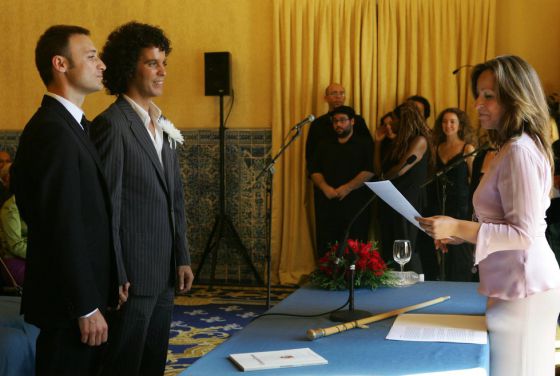
Pedro Zerolo (right) married Jesús Santos in 2005. / ULY MARTÍN
The same year it was passed, Zerolo made use of the legislation to marry his partner Jesús Santos, who was with him to the end. Soon after, he also contributed to the sexual identity law that recognized many rights for transsexual individuals.
Then-Prime Minister José Luis Rodríguez Zapatero convinced Zerolo to join the Socialist executive as head of non-profit groups and social movements, a topic with which he was very familiar.
A Madrid city councilor since 2003, he continued to fight for the gay community but became increasingly involved in politics. Zerolo tried to get himself appointed as the Socialist mayoral candidate for the 2007 elections, but failed to garner enough support within the party, which instead backed Miguel Sebastián – who ultimately lost to conservative Popular Party candidate Alberto Ruiz-Gallardón. Party sources said his open homosexuality played against him.
In January 2014, Pedro Zerolo announced that he had pancreatic cancer. That was the first year that he failed to take part in the Madrid Gay Pride march. It was one of his few signs of weakness. Always one to keep a high profile, he regularly updated the picture he used on social networking sites to reflect his changing appearance. Chemotherapy caused him to lose his trademark mop of curly hair, but his bald head became a new symbol of the man.
In the last interview he granted to EL PAÍS, Zerolo said that he was still feeling full of life despite his illness.“I am ill, you know that,” he said. “Illness has taught me that you reap what you sow. I have been surprised at all the sympathy I’ve been getting from strangers. I think that, in order to beat this, you cannot be afraid. Fear is defeated through calm, by being calm with yourself. Without fear, you feel that life is on your side
The attitude went down well with cancer patient groups, who, like the gay community, found in Zerolo a visible symbol. But the publicity also had its negative side. A Roman Catholic priest, Jesús Calvo, stated that his illness was punishment from God.
Zerolo spent his last months going to the movies in Madrid in the company of his husband, sister and friends, and taking strolls around Chueca, the city’s gay neighborhood. A self-declared atheist, republican, gay man, feminist and socialist, he decided to die at home. On Monday, his closest friends were called in to say goodbye one last time. Madrid City Hall will hold a wake on Tuesday afternoon. (El País in English)
This is the last image he posted on his Twitter @Perdo_Zerolo:

Wednesday, June 03, 2015

Ice Lake on Mars

On this day in 2003, Europe launched its first voyage to another planet, Mars. The European Space Agency’s Mars Express began its six-month journey from the Baikonur space center in Kazakhstan. To celebrate the 12th anniversary of the Mars Express mission, we have gathered together some of our favorite images of this fascinating planet taken by the Mars Express’ camera. You can enjoy all the images on the European Space Agency and German Aerospace Center Flickr pages.


The Mars Express is so called because of the speed with which it was built. The lander, called Beagle 2, was named after the ship in which Charles Darwin sailed when formulating his ideas about evolution. With the Mars Express mission, Europe hopes to gain knowledge about the Martian surface and search for life or hints about the evolutionary processes on Earth.

Sunday, May 31, 2015

Celebración de la lectura y elogio de la lentitud

Por JOSE ANDRÉS ROJO
Tienen razón todos los que se lamentan. El negocio del libro no va bien. Cada vez resulta más difícil agotar las tiradas de las ediciones, y eso que se han reducido considerablemente. En estos tiempos de penurias económicas, además, no está entre las prioridades de nadie acercarse a una librería para gastar unos euros en esos cachivaches de papel que, para tantos, forman ya parte del pasado. También está lo de la piratería y la competencia desleal de las nuevas tecnologías. Más cosas: ¿quién tiene tiempo hoy para zambullirse en una novela o para liarse en los vericuetos de un ensayo o para andarse con un montón de versos que tratan de vanos amoríos o del desastre de vivir? Claro que hay razones para lamentarse. Alguna más: ¿qué pinta un libro si con el móvil se puede recorrer el mundo en un instante, recibir la mejor información, acceder a los análisis más sesudos, encargar las mejores viandas o establecer vínculos con las damas y los caballeros más competentes, guapos e inteligentes?
(…) George Steiner, unos de los maestros de la crítica literaria, se ocupó en su ensayo Pasión intacta de una obra de Chardin, el fínísimo artista francés del siglo XVIII, en la que retrata a un filósofo leyendo. Paso a paso, va reflexionando sobre cada uno de los elementos que aparecen en el cuadro e intenta de ese modo explicar lo que significa la honda felicidad de leer. Es verdad que se refiere a un filósofo y, por tanto, a alguien familiarizado de sobra con los libros.
Sea como sea, hay un detalle que hoy resulta particularmente significativo. Steiner llama la atención sobre lo bien vestido que va el personaje del cuadro y observa que, cuando Chardin pintaba, la lectura se entendía como “un encuentro cortés”. Una oportunidad que no podía dejarse al azar, por tanto, y a la que convenía presentarse de manera impecable. Luego entra en otras consideraciones y apunta que, para Chardin, leer “es un acto silencioso y solitario”.
Y es verdad. Con demasiada frecuencia se pretende disfrazar el acto de leer con la fórmula que pueda estar más de moda: el entretenimiento, el suspense, la utilidad, la excitación, cualquier suerte de refinamiento especial. Pero al final de todo, leer no es más que eso: apartarse del ruido y entrar en otro mundo habitado por palabras. Siempre toca hacerlo solo y con tiempo, eligiendo la lentitud frente a la velocidad de nuestras circuntancias.
Merece la pena. Ese “acto silencioso y solitario” está tan lleno de riquezas y placeres que quizá tenían razón aquellos antiguos cuando se esforzaban en arreglarse para vivir un momento tan especial. (El País, 30 de mayo de 2015)

Friday, May 22, 2015

#hometovote: Irish abroad return to vote in gay marriage referendum

Irish people living overseas have been tweeting news of their journeys home to vote in same-sex marriage poll.


Irish citizens have been sharing photographs and stories on social media as they travel home to vote in the gay marriage referendum.
Ireland could become the first country to legalise same-sex marriage through a referendum. More than 3 million people are eligible to vote, including 60,000 expats. Those who have left the country less than 18 months ago are able to vote in the referendum, but need to show up at a polling station in person.
Before the vote on Friday, Twitter was filled with pictures of people returning home to have their say on gay marriage, with some decorating their trains accordingly. Others, upon their return, found their parents had decorated for them. 
The account @gettheboat2vote Twitter account has been encouraging Irish citizens overseas to travel home and has also been sharing their stories. According to these tweets, Irish expats have been travelling from far and wide to vote. Some who were unable to vote because they could not get back to Ireland have been encouraging others to vote yes with the hashtag #BeMyYes
The referendum result is expected to be announced on Saturday afternoon. The Guardian


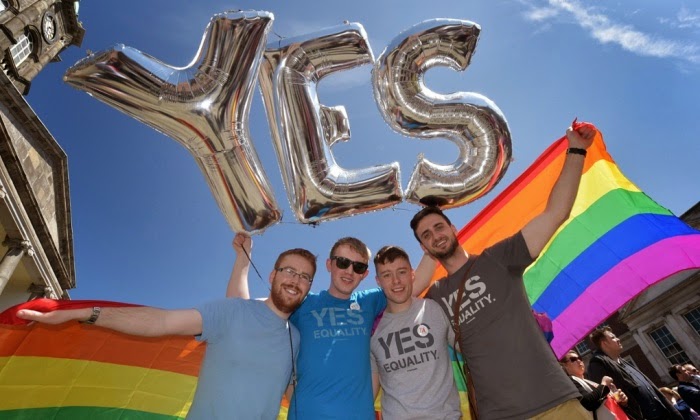
Yes supporters gather in Dublin Castle square as the referendum on same-sex marriage has been massively approved by Irish voters. Photograph: Charles McQuillan/Getty Images

Ireland becomes first country to legalise same-sex marriage by popular vote

Irish voters have decisively voted in favour of marriage equality, making Ireland the first country to do so through the ballot box. Only one of the 43 constituencies voted against the proposal – Roscommon-South Leitrim – while the yes vote exceeded 70% in many parts of Dublin. The no campaigners have paid tribute to their opponents, and the archbishop of Dublin has said the result should be a wake-up call for the Catholic church in Ireland.
All the results are in, and the returning officer, Ríona Ní Fhlanghaile, has declared that Ireland has passed the same-sex marriage referendum by 1,201,607 votes to 734,300. That’s 62.1% yes to 37.9% no. The total turnout was 60.5%. The Guardian

+Ireland says yes to same-sex marriage -in pictures

Sunday, May 17, 2015

Digital Censorship on Fox Channel

'Sexually sick' Fox News covers up breasts and genitals in Pablo Picasso's Women of Algiers

Painting sold for record $179 million (€161 million) at Christie's in New York

ADAM WITHNALL, The Independent, Thursday 14th May 2015

Art experts have become the latest group to be offended by Fox News, after the US broadcaster covered up the depiction of women’s breasts and genitals in a report on the sale of a Pablo Picasso masterpiece. The Women of Algiers (Version O) became the most expensive painting sold at auction on Monday when it went for $179 million (£114 million) at Christie’s in New York.
But in reporting on the setting of this new world record, someone in the Fox newsroom apparently decided that life painting was in fact offensive or sexual rather than simply artistic.
Three sets of breasts were blurred out in the report, while other bits deemed too rude by Fox were covered by the strategically-placed Fox News strap line.
Jerry Saltz, a senior critic at the New York magazine, wrote on Twitter that the decision to blur parts of the masterpiece betrayed the “sick minds” of those reporting. “How sexually sick are conservatives and Fox News?” he said.
The artist and author Gonzalo W Benard said it was “pathetic”, while art writer Aruna D’Souza said sarcastically: “Glad Fox News is protecting its audience from Picasso’s smutty mind.” Another Twitter user commented with the hashtag “#FreeTheNipple”.

Thursday, May 07, 2015

Top British Athlete Tom Daley Comes Out


Traditionally, celebrity coming-out announcements have been carefully stage-managed, dramatic and definitive. But Tom Daley's YouTube video, in which he reveals that he is in a relationship with another man, represents a new, more nuanced, way of coming out. It was a personal, heartfelt statement that said: My life has changed. I've met someone. I've fallen in love. Oh, and it's a man! He has been praised for his courage and hailed as a role model. Tom Daley's video is definetely touching (and hopefully inspiring for others). Daley responded to the positive feedback from fans and celebrities with a Twitter post on Monday afternoon: "Overwhelmed by all the support! Means the world! Thanks so much, guys." 
Congratulations, Tom! Well done for sharing it. It takes guts.
Related full article on The Guardian  
+Tom Daley praised as role model...

Saturday, May 02, 2015

GLASS ANIMALS_Gooey (audio + live)


Think of this wonderful song as simple back-n-forth talk between two lovers, comfortable with each other as they are with themselves.... smiling, laughing and joking as they share emotions, feelings and are aware of every little thing. The meaning of the song's lyrics? Who knows exactly? Yet, somehow, two lovers perfectly attuned always know each other's thoughts.