Thursday, February 29, 2024

Cinema Paradiso: Learning English with Moving Images

By CARLOS MARTÍN GAEBLER

It is often said that Spaniards have a longstanding idiomatic deficit when it comes to speaking a foreign language. This is partly due to a very simple fact: hardly ever are they exposed to hearing foreign languages spoken on TV or at the cinema, since all of the films they watch and hear are dubbed into their native language. Naturally, they are not well prepared to develop an ear for English. They find learning it much more difficult than, for instance, their Portuguese neighbours, who are used to hearing English-speaking films or series on a regular basis. This same pattern occurs in other EU countries, such as The Netherlands, Denmark or Sweden, which, together with a more efficient bilingual education system, accounts for the high standard of English of their citizens.

The rich variety of highly-acclaimed English-speaking films and series produced in Britain, Ireland, the United States, Canada, Australia or New Zealand provide you with the opportunity of enjoying a vast diversity of actors’ accents: Ralph Fiennes in The English Patient; Emma Thompson and Anthony Hopkins in The Remains of the Day; Helen Mirren in The Queen; Nicole Kidman in Dogville; Meryl Streep and Clint Eastwood in Bridges of Madison County; Hugh Grant in Love Actually; Heath Ledger in Brokeback Mountain, or all the different American accents in Crash. Therefore, using moving images to improve your English is of utmost importance in an increasingly multilingual global society.

Here are some tips aimed at helping advanced learners of English (living in Seville) to obtain a better understanding of today’s lingua franca. Current releases with Spanish subtitles can be seen at the AvenidaMetromar or Nervión Plaza cinemas (discount day is Wednesday). Another option is seeing films with English subtitles from the Speak Up dvd series (you can check out some of them at the self-learning section of the Engineering School library on the Cartuja campus), which come with a helpful glossary, or enjoying the digital technology of DVDs, which also allows you to watch and read a film at the same time. Besides, seeing an English-speaking film with English subtitles online is strongly recommended because you experience the film directly in English from beginning to end without having to read a Spanish translation of it.

If you happen to be a television fan, TV platforms nowadays offer you the possibility of watching films and series in their original version. Finally, the legendary Metrópolis from La 2 screens subtitled short films or advertising selections from time to time. (See TV listings.)

In short, remember that hearing a dubbed film is like experiencing only half of it because the voices of actors and actresses who star in films are essential to fully enjoy cinema. Somebody once said, “Watch a hundred films and you’ll find the meaning of life. Ultimately, watching foreign films and series in the original version is just another way of broadening your cultural horizons.

Meet "Generation Mute"

By NONA WALIA
Times of India, April 8th, 2018


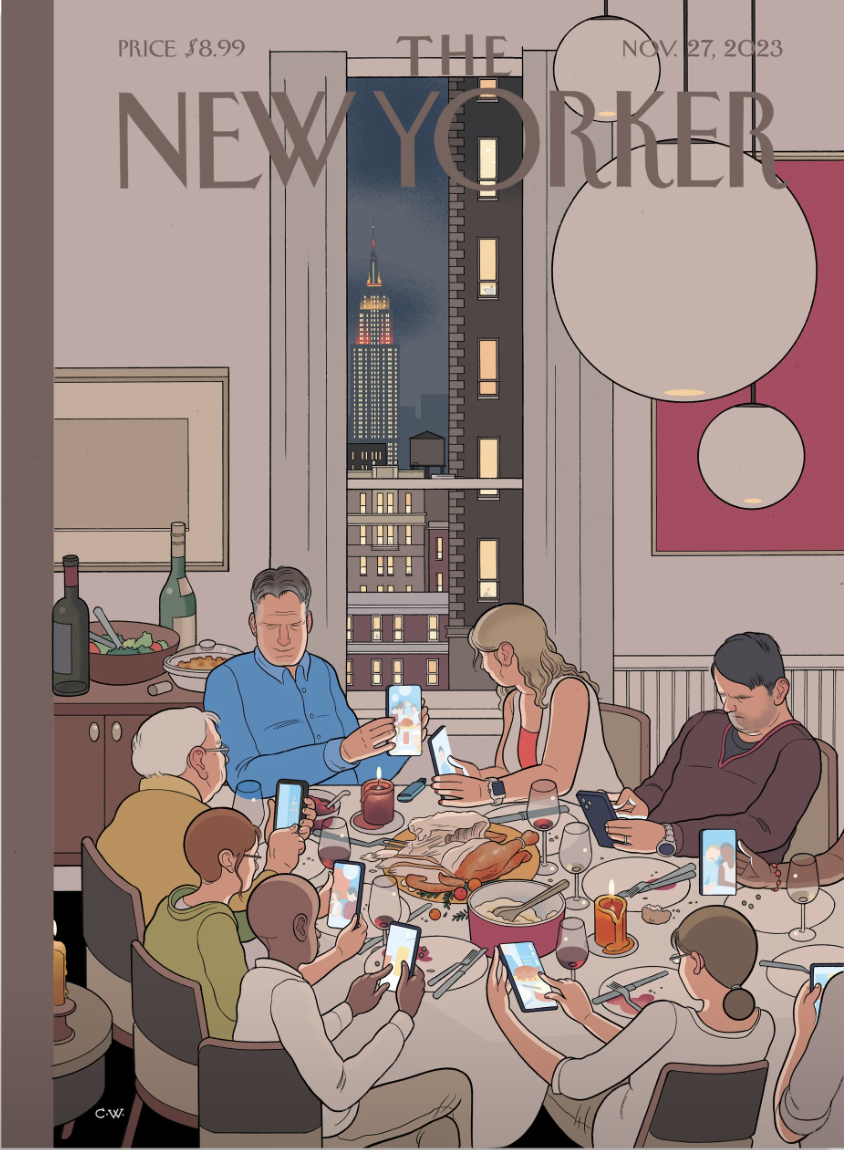
Remember when teachers scolded us for talking too much in class? When “talkative” was a part of our report cards sent to our parents at the end of the year? Well, if talking was an object, it would be a relic right now. Tales of talking would probably make for good fairytales. Because if recent studies are to be believed, this generation is falling silent.

Youngsters simply don’t like talking anymore. Texting or using social media is fine. Even an pair of earphones will do, as long as speaking to someone can be avoided. Here’s what a survey from British communications regulator Ofcom revealed. About 15 per cent of 16-24-year-olds don’t want to use their phone to speak to people. They would rather use instant messengers. The same research also said that teenagers would even message people sitting in the same room, at times, next to each other; but not talk to them.

Why we have talking anxiety...
A part of this problem could be because we do not have any shared experience of sound in our digital world. Says Sunaina Mathew, engineer, “We have moved into a noiseless and soundless world, where we hear only our voices and the sound through our earphones buzzing.”

There is a private world of sounds in public spaces. For example, we can sit anywhere, even amid people, but just listen to our favourite playlist. Earlier, we were familiar and accustomed to sounds around us – people talking, the radio playing, children screaming, dogs barking, clang of kitchen utensils, etc. Now, the only sound we hear is the one we choose to, through our earphones. We go to silent discos, listen to music on earphones, have conversations on earphones, listen to movies with our headphones on; we have internalised our relationship with sound and made it a very private affair.

Etiquette expert Pria Warrick says for this generation the most natural and casual communication mode is texting, and phone calls are viewed as an ordeal. “Social media have changed how we communicate privately. There was a time when everyone talked for hours on the landline, and that was considered as a relaxation technique at the end of the day — between friends, lovers, parents-children — but now we think twice about violating someone’s space by calling them on the phone,” she says.

There was also a time when birthdays were special occasions when you expected people to call you. But even that has become a textual affair these days. Maira Khanna, 36, doctor, didn’t get any calls on her birthday, but was flooded with text messages. “I missed the sound of people’s voices and the laughter along with the wishes,” she rues. MIT psychologist Sherry Turkle, one of the leading researchers looking into the effects of texting on interpersonal relationships, feels the onslaught of information and time spent with screens is another reason why people are talking less. 

Emotional fallout
Psychologist Rachna Khanna Singh tries to throw some light on this phenomenal change in human behaviour in this century that, she says, will have far-reaching consequences on our emotional stratum. “We are conditioned to go for what’s easy because the innumerable choices and distractions in our lives — social media interactions throughout the day, work correspondence, traffic noise et al — have made our minds exhausted and we are seeking silence with a vengeance now,” she says. 

On public transport, we have our earphones on, lest someone should look our way, smile, or worse... talk to us. While out socialising, we are more bothered about interacting with people on the virtual world from our smartphones than the ones right in front of us. Digital expert Chetan Deshpande finds this quite funny and gives an interesting pointer. He says, “Being used to smartphones and social media for a while now, we also love editing our thoughts and expressions. Thanks to courtesy readily-available dictionaries and emojis, we have become accustomed to reducing our mistakes, editing every thought and expression, which isn’t possible while talking on the phone. This freaks people out.” 

It’s also a scientific fact that anxious people become tongue tied. Now, think about an anxiety-ridden generation, multi-tasking 24x7. No wonder even the thought of picking up a phone to talk has become a terror.

Sound stats

About 15 per cent of 16-24-year-olds don’t want to use their phones to speak to people. They’d rather text. In TIME magazine’s mobility poll, 32 per cent of all respondents said they’d rather communicate by text than phone, even with people they know quite well. This is truer still in the workplace, where communication is between colleagues who are often not friends.


In Praise of Rugby


Tackles, collisions, players running into each other at full speed... rugby is a combat sport. There is certainly more contact than in football, although according to the old English saying: While football is a game for gentlemen played by ruffians, rugby is a game for ruffians played by gentlemen. If there is something that distinguishes rugby, it is the attitude of respect in the sport. You can see a referee who measures maybe a metre seventy telling this guy who is nearly two metres tall and weighs more than a hundred kilos "you've committed a foul, retreat ten metres" and the other man never complains. This attitude also exists between any two sets of fans, something that is related to the sport's concern with values. This can also be seen on the stands. When you go into a rugby stadium, there is a very warm atmosphere and there are never any insults; it's a very healthy feeling. [Adapted from a text by Jorge Valdano]


Related articles: 
Rugby vs fútbol, by John Carlin
Perder, por Bruno López


Breaking Bad, a masterpiece now, and a masterpiece a hundred years from now


Everything stands out, from the subtle details, to the unmatched writing and the perfect cast, to the very beautifully shot scenes. Breaking Bad, created by Vince Gillian, may very well be the best TV series out there. The story, even with some creative liberties, is well grounded, believable and feels very real. The show, unlike others, ages like fine wine. The more you watch and the longer you sink in, the better it gets. I can think of few series which grow stronger and better every season. It's not only worth sinking your teeth into, it's worth eating. Breaking Bad is a timeless piece and it will stand even long into the future, and will forever be one of the best TV shows to ever come out.

Definitely one of the greatest series ever. It just gets better as it goes along. The journeys of Walter White and Jesse Pinkman are something I will never forget. These are some of the best written characters to ever come from a pen hitting a paper. My praises for the acting and cinematography are unending. Some of the shots are intricate works of art, and in general the performances are just excellent. This makes all but the best movies look like utter dribble, and in terms of tone, every intense moment is executed with excellence, and always has the impact it's going for.

The plot of the series in the early seasons lacks a certain level of complexity, and the start is a bit slow paced, but nevertheless, this is an absolute must-watch, preferably one episode a day. If you have mixed feelings about Season 1, trust me, it's only uphill from there. If you want a series to call perfect; I think this might be it.

Sunday, January 21, 2024

Living a longer, healthier life

The Seven Keys to Longevity

Here are seven steps that can help you counter the effects of aging. By Dana G. Smith,  The New York Times, January 19th, 2024

An illustration of a person standing in a yoga pose with leaves emanating from different parts of the body; on either side of the person is an infinity loop with various vignettes; the vignettes are a couple on a couch, a person sleeping, a bowl of fruit and a person running.

Humans have searched for the secret to immortality for thousands of years. For some, that quest now means sleeping in hyperbaric chambers, experimenting with cryotherapy or blasting oneself with infrared light.
Most aging experts doubt that these actions will meaningfully extend the upper limits of the upper human life span. What they do believe is that by practicing a few simple behaviors, many people can live more healthily and longer, reaching 80, 90, and even 100 in good physical and mental shape. The interventions just aren't as exotic as transfusing yourself with a young person's blood. 
"People are looking for the magic pill," said Dr. Luigi Ferrucci, the scientific Director of the National Institute on Aging, and the magic pill is already here." 
Below are seven tips from geriatricians on how to add more good years to your life. 

MOVE MORE
The No. 1 thing experts recommend was to keep your body active. Study after study has shown that exercise reduces the risk of premature death.
Physical activity keeps the heart and circulatory system health and provides protection against chronic diseases that affect the boy and mind. It also strengthens muscles, which can reduce older people's risk of falls.
"If we spend some of our adult years building up our muscle mass, our strength, our balance, our cardiovascular endurance, then, as the body ages, you're starting from a stronger place for whatever is to come," said Dr. Anna Chang, a professor of medicine specializing in geriatrics at the University of California, San Francisco.
The best exercise is any activity that you enjoy doing and will stick with. You don't have to do a lot, either --the American Heart Association recommends 150 minutes of moderate-intensity exercise per week, meaning just walking a little more that 20 minutes a day is beneficial.

EAT MOR FRUITS AND VEGETABLES
The experts did't recommend one specific diet over another, but the generally advise eating in moderation and aiming for more fruits and vegetables and fewer processed foods.
The Mediterranean diet --which emphasizes fresh product in addition to whole grains, legumes, nuts, fish and olive oil-- is a good model for healthy eating, and it's been shown to lower the risk of heart disease, cancer, diabetes and dementia.
Some experts say that maintaining a healthy weight is important for longevity, but to Dr. John Rowe, a professor of health policy and aging at Columbia University, that's less of a concern, especially as people enter old age. "I was always more worried about my patients who lost weight that my patients who lost weight," Dr. Rowe said.

GET ENOUHG SLEEP
Sleep is sometimes overlooked, but it plays a major role in healthy aging. Research has found that the amount of sleep a person averages each night is correlated with the risk of death from any cause and that consistently getting good quality sleep can add several years to a person's life. Sleep appears to be especially important to brain health: A 2021 study found that people who slept less than five hours a night had twice the risk of developing dementia. 
"As people get older, they need more sleep, rather than less," said Dr. Alison Moore, a professor of medicine and the chief of geriatrics, gerontology and palliative care at the University of California, San Diego. Seven to nine hours is generally recommended, she added.

DON'T SMOKE OR DRINK TOO MUCH
This goes without saying, but smoking cigarettes raises your risk for all kinds of deadly diseases. "There is no dose of cigarette smoke that is good for you, Dr. Rowe said.
We are starting to understand how bad excessive alcohol use is, too. More than one drink per day for women and two for men --and possibly even less than that-- raises the risk of heart disease and atrial fibrillation, liver disease and seven types of cancer.

MANAGE YOUR CHRONIC CONDITIONS
Nearly half of American adults have hypertension , 40 per cent have high cholesterol and more than one third have pre-diabetes. All the healthy behaviors mentioned above will help manage these conditions and prevent them from developing into even more serious diseases, but sometimes lifetime interventions aren'r enough. That's why experts say it's critical to follow your doctor's advice to keep things under control. 
"It's not fin to take the medications; it's not fun to check your blood pressure and check your blood sugar," Dr. Chang said. "But when we optimize all those things in a whole package, they also help us live longer, healthier and better lives."

PRIORITIZE YOUR RELATIONSHIPS
Psychological health often takes a back seat to physical health, Dr. Chang said it's just as important. "Isolation and loneliness is a big a detriment to our health as smoking," she said, adding that it puts us "at a higher risk of dementia, heart disease, stroke."
Relationships are key to not only living more healthily, but also more happily. According to the Harvard Study of Adult Development, strong relationships are the biggest predictor of well-being.
Dr. Rowe tells the medical students  he teaches that one of the best indicators of how well an elderly patient will be faring in six months is to ask him "how many friends or family he's seen in the last week."

CULTIVATE A POSITIVE MIND-SET
Even thinking positively can help you live longer. Several studies have found that optimism is associated with a lower risk of heart disease, and people who score high on tests of optimism live 5 percent to 15 percent longer that people who are more pessimistic.
That may be because optimists tend to have healthier habits and lower rates of some chronic diseases, but even when accounting for those factors, the research shows that people who think positively still live longer. 
If you had to pick one healthy practice for longevity, "do some version of physical activity," Dr. Moore said. "If you can't do that, then focus on being positive."

Wednesday, January 10, 2024

Tourism ruined my city. Tourism is saving my city.

NPR, January 9, 2024


SEVILLE, Spain — There was an old house in a very narrow street in central Seville, Spain that I used to stop and look at when I was a teenager in the early '90s. I dreamt of owning it one day, or at least one similar in the neighborhood that back then had a decent number of locals.

I say "back then" because today that area, Barrio de Santa Cruz, has lost its soul. It's not me saying this — it's what you hear from nearly anyone who lives or works in the neighborhood.

Many longtime residents have left, saying they were pushed by a wave of tourism that, after the pandemic, has come back in full force.

It's good news for the city and its economy. But it's mixed news for nearly anyone whose memories are attached to those narrow streets, now filled with souvenir shops, boutique hotels and restaurants where locals don't quite feel welcome anymore.

This is the story of how a city tries to honor its past while ensuring its future.

Students replaced by selfies

In the heart of Barrio de Santa Cruz you can still find a public school. It almost seems like a relic of a different time, when this neighborhood had not turned into a museum of sorts.

Ana Palacio is the principal of the San Isidoro school. She joined seven years ago, when admission for students was competitive. "When we'd start receiving applications for admission, people would camp out at the door and spend the night to grab a spot for their kids," she tells me.

Now, she has open spots in her classrooms, and the reason is simple. Palacio looks up and points at the beautiful old houses in front of the school, on Mateos Gago street. "All those houses, where families used to live and send their kids to our school – all those houses are now apartments for tourists," she says.

For Palacio, this is not just a small inconvenience. "I have real issues here. When kids enter and exit the school, I have a crowd of tourists at the door," she says. "Since the school building is a beautiful old convent, tourists want to take pictures and shoot videos."

She says it's affecting the way locals enjoy the city, and that in areas where tourists flock, locals sometimes don't even feel welcome at tapas bars and restaurants. "In Seville, you order the first beer at the bar. Then you sit down and chat with your friends. Then maybe you order a tapa. And after a while, you order another one. And before you realize it, it's 5 or 6 in the evening," she says.

That would be the Sevillian way. But many restaurants are no longer locally owned, or simply prefer to cater to tourists, who sit for an hour, order fast and copiously, and then move on. These days it's not unusual to see restaurants that don't serve tapas anymore and won't let you sit at a table if you're not ready to order a meal.

There are those who benefit

There are some restaurants, however, that are still locally owned, and try to maintain a balance between benefitting from the tourism boom and serving local customers.

On Mateos Gago street, just a short walk from the San Isidoro school, I stand in front of a small restaurant called La Azotea. I know this place well; it used to be called Campanario more than two decades ago. I used to work here when I was in my early twenties.

I meet Juan Antonio Gómez, the chef and owner of La Azotea, outside his restaurant, where the view from the tables is simply astonishing. The tower of the cathedral of Seville, La Giralda, is the most iconic monument of the city. If you come to Seville, chances are you will walk down this street and visit it.

When Gómez opened his first location, his clients were mostly locals. "But soon — as in, like, three months — we started to receive our first tourists. And a year later, we have, every day, lines at the door at the opening time for 30 people, mostly tourists," Gómez says. His story reinforces a truth now widely known in Seville: if a restaurant is good, tourists will find it.

Gómez says he wishes he could see more locals around Mateos Gago street — an area he has known since he was a child attending the same San Isidoro School that is now struggling to find students.

Tourism is an engine of the Spanish economy. In 2022, it represented more than 11% of the national GDP. It's even more acute in Seville, where tourism provides an estimated 20% of the city's economy.

This southern region of Spain where Seville is located has long been mired by unemployment as well, which currently sits at just over 18% — about 5 points above the national average. So you can appreciate how jobs in the service sector provide a lifeline for the city that welcomed nearly 2 million visitors in just the first eight months of 2023 — up 14% from the previous year.

Gómez benefits from this tourism boom, obviously, but he has mixed feelings: "What I'm seeing right now in Seville I've never seen before. It's massive. And I think, in one way or another, we have to stop a little bit."

The year everything changed

Sevillians point to 1992 as a transformative time for the city. It was the year Seville hosted the International Expo 92, which became a presentation party of sorts, celebrating the 500th anniversary of Christopher Columbus' arrival in the Americas.

Seville was pitching itself to the world as a place of beauty and historic landmarks. Hundreds of acres of unutilized land was transformed into a type of international theme park, with more than 100 nations represented in pavilions.

Tens of millions of people visited Seville that year. Billions of dollars were invested in the city: bridges were built over the Guadalquivir River; dozens of new hotels were opened; a high-speed train connecting Madrid and Seville was inaugurated; and the city looked at the historic center as its crown jewel. A jewel that needed urgent care.

Miguel López was 10 years old then, and lived in the neighborhood of Alameda – a huge open space now filled with restaurants. Like the city center back then, his neighborhood was falling apart, he tells me, with many houses needing drastic rehabilitation.

Crime was common in central areas, and it wasn't unusual to turn to a street and find yourself alone and vulnerable to theft or worse.

Before the wave of Expo investment, the region of Andalucía had a staggering 30% unemployment rate, which skyrocketed to more than 50% for young people.

López was enchanted with the Expo as a child, with all its promise of change and progress, and visited the site many times that year. On his way home, he would have to cross the Alameda, an area that was known for drugs, crime and sex workers back then."Now my son, who is 12, plays soccer in the Alameda," López says. "The only issue he runs into is the complaints of patrons at restaurants who might be hit by a soccer ball here and there."

Investment meant growing crowds of tourists, which led to gentrification and beautiful new pedestrian avenues and well-maintained buildings. It also meant high — and still rising — rent prices. López still lives in the neighborhood today, and has tried to get access to subsidized housing in the area, but with no luck.

Recently, while looking at Airbnb properties in his neighborhood, he ran into a surprise: a subsidized duplex in the area was listed on the site. "I was livid. So much so that I notified the city hall," López says.

It's not unusual to see locals trying to make a buck out of the tourism demand for accommodation, but for López, this was crossing the line. Someone lucky enough to have been awarded a house in the city center was turning around and listing it as a tourist apartment.

And yet, López also admits to having rented his apartment on Airbnb for a few months while he was out of town. "When I've done it, it was more about surviving, not a business," López says. "We need to resort to sharing our apartments to be able to afford them. We'll get to the end of our lives having to share an apartment."

Housing becomes the hot topic

In December, the city hall assembly voted down a proposed "tourist tax" that would have charged a fee to visitors spending the night in Seville, after mayor José Luis Sanz and his conservative party opposed it.

The mayor has previously said there is an oversaturation of accommodation for tourists in some areas of the city, such as Barrio de Santa Cruz, and that local residents are beginning to experience a certain tourism-phobia.

Yet he also says tourists have brought economic gains to the city that shouldn't be overlooked. "Many belong to Sevillian companies and have brought wealth and contributed to the economic growth of the city," he says. "If it weren't for them, many blocks and old houses would have disappeared."

A 2022 study found that more than 60% of properties in Barrio de Santa Cruz are used to house tourists. For other neighborhoods inside the historic center it's more than 20%, and overall the concentration of hotels and housing for tourists in central Seville is the highest of any city in Spain.

Just outside Barrio de Santa Cruz you can find another centric area, the San Bartolomé neighborhood, where Ana Álvarez-Ossorio was born and raised. She lives there now with her husband, and her daughter, who attends the San Isidoro school.

She tells a familiar story: when she was little, the neighborhood wasn't necessarily a desired place for locals to live in. Many houses needed urgent renovation or outright demolition. It's one of the reasons her parents were able to afford an entire house in what today is a prime location.

"It was a working class neighborhood back then. Families did not have a lot of money," Álvarez-Ossorio says. The expo in 1992 changed that.

"There was an urban plan implemented for the entire historic center to be brought back to life. Wealthy people moved in, started to buy property. Prices rose and working class people left the center of the city," Álvarez-Ossorio says.

Today, the center is going through another time of deep change. And this time the target is not wealthy locals, but tourists.

"Seville is hosting anything from the Latin Grammys to international soccer events. Anything to attract tourists," Álvarez-Ossorio says. "And so, all this housing gets fully booked. The historic center is turning into a theme park."

Álvarez-Ossorio represents the tension playing out — she feels unease at the change, but is also benefiting from it by becoming an Airbnb host herself. After she and her sister moved out of the family house, they decided to renovate it and rent the bigger part to tourists. Ana's father still lives in the building, in a smaller apartment they kept for his use.

When I ask her about possibly limiting the use of apartments for tourists, she has mixed feelings. "What worries me the most is that long-term rental units are disappearing in the city center. Because anyone who has an apartment available wonders: Do I rent for 600 euros a month, or do I turn it into an apartment for tourists and make 3,500 euros? But we need some limits because our city center is going to turn into one massive hotel."

As for me, my dream of owning a house in the city center is long gone. Instead, I now live just around the corner from a small construction site where my new house is being built. The neighborhood is just outside of the city center. Many consider this area the "new center" of Seville, where locals live and where businesses still survive off of them. But things can change fast.

I've been noticing more groups of tourists walking around. They stay here in apartments that are more affordable than those inside the walls of the old town. And I can't help but wonder: How long will it take for my neighborhood to change?