Today is Punctuation Day, apparently, so here's a poem called "Slow Puncture," by Brian Bilston.

Today is Punctuation Day, apparently, so here's a poem called "Slow Puncture," by Brian Bilston.
Our basic assumptions about photos capturing reality are about to go up in smoke.
By Sarah Jeong, The Verge, August 22, 2024 (excerpts)
An explosion from the side of an old brick building. A crashed bicycle in a city intersection. A cockroach in a box of takeout. It took less than 10 seconds to create each of these images with the Reimagine tool in the Pixel 9’s Magic Editor. They are crisp. They are in full color. They are high-fidelity. There is no suspicious background blur, no tell-tale sixth finger. These photographs are extraordinarily convincing, and they are all extremely fucking fake.
Anyone who buys a Pixel 9 — the latest model of Google’s flagship phone, available starting this week — will have access to the easiest, breeziest user interface for top-tier lies, built right into their mobile device. This is all but certain to become the norm, with similar features already available on competing devices and rolling out on others in the near future. When a smartphone “just works,” it’s usually a good thing; here, it’s the entire problem in the first place.
Photography has been used in the service of deception for as long as it has existed. (Consider Victorian spirit photos, the infamous Loch Ness monster photograph, or Stalin’s photographic purges of IRL-purged comrades.) But it would be disingenuous to say that photographs have never been considered reliable evidence. Everyone who is reading this article in 2024 grew up in an era where a photograph was, by default, a representation of the truth. A staged scene with movie effects, a digital photo manipulation, or more recently, a deepfake — these were potential deceptions to take into account, but they were outliers in the realm of possibility. It took specialized knowledge and specialized tools to sabotage the intuitive trust in a photograph. Fake was the exception, not the rule.
If I say Tiananmen Square, you will, most likely, envision the same photograph I do. This also goes for Abu Ghraib or napalm girl. These images have defined wars and revolutions; they have encapsulated truth to a degree that is impossible to fully express. There was no reason to express why these photos matter, why they are so pivotal, why we put so much value in them.
Our trust in photography was so deep that when we spent time discussing veracity in images, it was more important to belabor the point that it was possible for photographs to be fake, sometimes. This is all about to flip — the default assumption about a photo is about to become that it’s faked, because creating realistic and believable fake photos is now trivial to do. We are not prepared for what happens after...
No one on Earth today has ever lived in a world where photographs were not the linchpin of social consensus — for as long as any of us has been here, photographs proved something happened. Consider all the ways in which the assumed veracity of a photograph has, previously, validated the truth of your experiences. The preexisting ding in the fender of your rental car. The leak in your ceiling. The arrival of a package. An actual, non-AI-generated cockroach in your takeout. When wildfires encroach upon your residential neighborhood, how do you communicate to friends and acquaintances the thickness of the smoke outside?
We briefly lived in an era in which the photograph was a shortcut to reality, to knowing things, to having a smoking gun. It was an extraordinarily useful tool for navigating the world around us. We are now leaping headfirst into a future in which reality is simply less knowable. The lost Library of Alexandria could have fit onto the microSD card in my Nintendo Switch, and yet the cutting edge of technology is a handheld telephone that spews lies as a fun little bonus feature.
We are fucked!
Since the Olympic Games in Paris began, the French president, Emmanuel Macron, has posted the statement “This is France!” several times on his social media platforms.
Macron has been implicitly asserting that he is delivering on his personal vision of the event, and of France. Since his election in 2017, he has sought to project a diverse, cosmopolitan and outward-facing France while at the same time strengthening existing preconceptions of its style, culture and history.
The opening ceremony was therefore the embodiment of Macron’s ambitions. It combined landmarks like the Eiffel Tower and key figures from French history, such as Marie Antoinette, with cultural, musical and fashion representations of modern France. These included surfers, rappers and members of LGBTQ+ communities.
Since the Olympic Games in Paris began, the French president, Emmanuel Macron, has posted the statement “This is France!” several times on his social media platforms.
Macron has been implicitly asserting that he is delivering on his personal vision of the event, and of France. Since his election in 2017, he has sought to project a diverse, cosmopolitan and outward-facing France while at the same time strengthening existing preconceptions of its style, culture and history.
The opening ceremony was therefore the embodiment of Macron’s ambitions. It combined landmarks like the Eiffel Tower and key figures from French history, such as Marie Antoinette, with cultural, musical and fashion representations of modern France. These included surfers, rappers and members of LGBTQ+ communities.
Meanwhile, those from the extreme right have long resented and resisted Macron’s Parisian-centric and urban-led vision of diversity and modernity. This was evident in reactions to the opening ceremony’s depiction of Leonardo da Vinci’s painting, The Last Supper, in which drag queens, a transgender model and a naked singer appeared. France’s Catholic church condemned the sketch as a “mockery of Christianity”.
Paris Olympic organisers have since issued an apology, though this is unlikely to have placated Muslim communities around the world. Some among them labelled parts of the opening ceremony “absurd”, “disgusting” and a “promotion of satanic forms”. Others saw it as an attempt by the west to impose its values on them.
This sentiment was apparently shared by the Chinese state broadcaster, China Central Television, whose event commentators went quiet during the segments in which members of LGBTQ+ communities appeared. China has a record of seeking to suppress these communities.
For some French Muslims, there may also have been dismay at the depiction of a religious scene at an event being staged by a French state entity. After all, it was announced late last year that Muslim women would not be allowed to wear their hijabs when competing for France at the Olympics. The justification for this decision was that it would breach the country’s secularist principles, which create a clear separation between religion and state.
That decision came at an especially sensitive time, following the Hamas-led October 7 attacks and Macron’s invitation to France’s chief Rabbi to light Hannukah candles at the Élysée Palace. The war in Gaza continues to cast a shadow over the Games. Indeed, there are rumours of some athletes being prepared to withdraw from the event if they are required to compete directly against an Israeli athlete.
The simmering threat of such direct action has already manifested itself at the Games. During a football match between Mali and Israel on July 24, members of the crowd unfurled banners condemning the latter country and waved flags in support of Palestine. The vast majority (95%) of Malians are Muslim, and there are 120,000 people from Mali living in France.
Israel is not the only country where there is some disquiet. Following recent doping scandals and the invasion of Ukraine, most Russian and Belarusian athletes are banned from participating in Paris. A few athletes are competing as neutrals, but national flags, anthems and other national symbols are banned, and no government or state officials have been invited.
The exclusion of Russia has led to speculation that its agents may have been responsible for a series of railway sabotages that caused significant travel disruption on the opening day of the Games. Though nobody was hurt or killed, such attacks undermine public confidence, impose economic and social costs on people, and were clearly an attempt to tarnish the image of France.
France has a long-held reputation for successfully delivering numerous major events each year. However, there was also disruption at the Uefa Champions League final in 2022, which was being staged at the Stade de France (the main Olympic venue this summer). Many Liverpool supporters were put through a traumatising experience when entering the stadium, and riot police teargassed spectators while failing to protect them from being attacked by local thugs.
This followed Paris quickly stepping in to stage the match after Uefa removed St Petersburg’s right to host the game following Russia’s invasion of Ukraine. Whether these events were another deliberate attempt to diminish France or just a coincidence remains debatable.
Some have suggested that Russia’s president, Vladimir Putin, has wanted to undermine the IOC for much of the past decade. He sees it as a western institution governed by values and rules that maintain a dominance he resents.
As such, Russia has been planning to host the World Friendship Games a little more than a month after the Paris Olympics finishes. While there is some confusion over whether the event will be postponed to 2025, there are claims that more than 100 nations have already committed to participating in what may ultimately come to pose an existential threat to the modern Olympic movement.
The IOC normally does its utmost to control the places and spaces that it selects to host Olympic events, whether that means suppressing displays of activism, preventing acts of terrorism, or even minimising the commercial intrusion of brands that have no legal right to associate with the event.
However, such is the currently fractious nature of local and global geopolitics that we should expect more controversy before the Olympic flame in Paris is finally extinguished.

 |
| Photo/Brad Bowie/The Times-Picayune/The New Orleans Advocate via the AP / Louisiana Gov. Jeff Landry signs bills related to his education plan on Wednesday, June 19, 2024, at Our Lady of Fatima Catholic School in Lafayette, La. Louisiana has become the first state to require that the Ten Commandments be displayed in every public school classroom, the latest move from a GOP-dominated Legislature pushing a conservative agenda under a new governor. |
By St. Louis Post-Dispatch Editorial Board (TNS), June 24, 2024
Do Americans have the right to not practice religion?
When the question is phrased like that, even most fervent religious believers out there would likely concede that, yes, non-belief (like belief itself) must qualify as a fundamental American right.
Yet that right is under frontal attack, from a religiously driven political movement operating under the premise that if government doesn't promote religion, it is by definition attacking it.
That premise is not only backward but is a slippery slope toward theocracy. The latest slide comes in Louisiana, with a new law requiring that every public school and college post the Ten Commandments in every classroom.
Republican Gov. Jeff Landry signed the law Wednesday. It makes his state the first to test the Constitution's church-state separation in this manner since a U.S. Supreme Court opinion in 1980 that found a Kentucky requirement to display the commandments in public schools violated the establishment clause of the First Amendment.
That clause is unambiguous: Congress (and, by extension, the states) "shall make no law respecting an establishment of religion."
As clear as that seems, it won't necessarily be clear to today's radical-right Supreme Court. The conservative majority in 2022 upheld a public high school football coach's right to pray on the school's football field after games and invite his players to join him. The ruling brushed off the obvious implied pressure the coach created on his players to pray.
The Louisiana law goes beyond merely implied pressure: Every student attending publicly funded schools in the state will literally be a captive audience to a religious doctrine specific to Judeo-Christian faith. The new law even sets minimum dimensions for the commandment displays (11 by 14 inches) and mandates that they must be "in a large, easily readable font."
That slippery slope we mentioned? This is what it looks like.
Defenders of the new law maintain that the commandments aren't solely a religious statement but a historical document of cultural principles ingrained in the laws of America and elsewhere over the ages.
That may apply to some of the commandments — the prohibitions on murder, theft and false witness, for example.
But what is an adherent to polytheist religions like Hinduism or Buddhism supposed to do with "Thou shalt have no other gods before me"? And what is an atheist supposed to do with any of it?
In fact, even many of the Judeo-Christian faithful may discover that with this law, Louisiana officially relegates their beliefs to secondary status as well. The law specifies wording that religious scholars say generally represents a Protestant version of the commandments — a version distinct from those recognized by Catholics and Jews.
What is it that business conservatives always say about the free market? The government isn't supposed to pick winners and losers? Shouldn't something as complex and personal as faith have at least that level of insulation from government?
Allowing the religious beliefs of a few to dictate public policy for everyone creates dangers that go beyond the merely philosophical.
There's some irony in the fact that Louisiana's new law is fervently supported by the same conservative movement that has turned school board meetings into culture-war battlefields over books and curriculum.
They argue that teaching racial history or gender issues in schools strays from legitimate education and into the realm of cultural indoctrination. But it's OK to force religious belief (and, in fact, one specific version of religious belief) into every classroom?
If this law stands, every public school student in Louisiana will face what amounts to a daily religious sermon — whether they (or their parents) like it or not.


It is played with a round ball and both hands and feet are used to control and pass the ball. There are 15 players on each team, with only one referee. The game is played in two 30-minute halves.
The primary objective is to score by driving the ball through or over the goals. If the ball is sent over the bar of the goals, this equates to One Point. If it goes under bar, into the goalmouth, this equates to Three Points. The team with the highest score at the end of the match wins. To learn about the rules of Gaelic football, click on this link.
GRINDR, Manhunt, Gaydar, Scruff, Jack’d—for any gay man who’s been “out there” for any part of the last two decades, these websites or applications have become a familiar sight. For many men they occupy a substantial fraction of the day’s stream of experience, and for many others they form an integral part of their personal identity or sense of self.
But long before the arrival of the Internet, the social media, the hookup apps, there were GLBT people who lived, like everyone else, in what is now referred to as “real life.” I would argue that historically gay identity has always been characterized by a fundamental duality. The first identity is a response to the cultural prohibition or negation of homosexuality throughout history. This has been manifested as a lack of rights, a lack of visibility, a lack of social acceptance, a prohibition on the trappings of gay identity: sex acts prohibited, legal unions barred or blocked, blood donations refused, and so on, ad nauseam.
A second identity arose, partly in response to this repression, that stressed the value of overt visibility, of being not just quietly self-accepting but publicly out to one’s family and friends and anyone else who would listen. This is the ideal that would come to dominate cultural representations of GLBT identity for decades to come. In the late 1960s and ’70s, this concept manifested itself as protest marches, the Stonewall riots, the first pride parades, gender non-conformity in public venues, and various kiss-ins, love-ins, and so on.
Gay Liberation was all about bringing gayness into the light of day and dragging people out of the closet. But the closet never went away, and the result was a bifurcated system in which some people were “out” and others “in the closet”—wholly or in part, or perhaps in the process of “coming out.” This dynamic of “in” or “out” created a kind of existential dualism that still operates as a guiding principle of GLBT identity formation.
So, what precisely do the Internet and this age of cyber domination mean for these two polarized identities and the emerging middle-ground identity? If we were to think of an example of each type of identity outlined above, and a GLBT individual who epitomized each, we could come a little closer to imagining the cultural impact of the Internet.
Painting in broad strokes, an identity mired in a sense of prohibition could potentially be a description of a closeted gay man. The feeling of not wanting to inhabit or exhibit a gay sexual identity—and all the efforts of hiding that go with it—could be seen as a “negative space” identity. This identity would have certain hallmarks: refusal to accept a gay orientation openly, lying to close friends and family, internal struggles, deceptive practices to keep everyone in the dark, surreptitious encounters, and so forth. In the past, this may have emerged as seeking out sexual encounters in discreet and anonymous ways: outdoor cruising, for example, with its hidden and anonymous encounters. The defining feature of this negative space was the need to remain invisible: to indulge sexually but not identify as gay; to straddle two worlds without losing any crucial benefits in either of them.
In the modern era of technology, this negative space is clandestine both in the real world and now in the cyber world. The Internet allows even higher levels of anonymity than venues of the past. The classic strategy on Grindr, Scruff, et al. is to display a photo of one’s torso without a head and its all-revealing face. (A related strategy would be to display a fake face photo.) Such a user is also likely to offer very few clues that would give away his actual identity.
Considering the impact of the Internet on this negative identity, we need to keep in mind the nature of cyber reality, which is able to do two opposing things simultaneously. It offers the possibility of total anonymity on one extreme, or the potential for incredible visibility, even a kind of fame, on the other. Between these two extremes, the user’s relative anonymity or visibility can be fashioned as a (semi-)fictitious creation either way: it can act as a projection of a total falsehood or an altered version of the reality of an individual’s life. Prior to the great technological advances of the last few decades, there was no technological platform that could provide this chameleon-like ability to inhabit different identities at will. (Stage costumes were probably the closest equivalent.) You don’t like your profile picture? Use a more attractive one or Photoshop your features just a tad. Or, if you’d prefer, remain the ultimate mystery: a presence behind a screen with no visible characteristics—the alluring (and annoying) blank profile.
To move back to the “negative space” for GLBT identity, it is in the nature of the Internet to enable the closeted to operate in full stealth mode. The unprecedented success of a mobile geosocial networking application such as Grindr, created by Joel Simkhai in 2009, is testament to the fact that cyberspace has become the new haven for closeted gay men. The app was designed using geolocation technology to pinpoint other men using Grindr in one’s immediate vicinity, whose pictures and profiles appear in real time on your smartphone. This is the modern equivalent of cruising a park or restroom hoping to happen upon another like-minded individual seeking similar sexual release.
It’s interesting to note, but perhaps not surprising, that this app was pioneered by a gay man for use by gay men cruising. The straight equivalent came quite a bit later and was based upon the existing gay platforms. It’s also noteworthy that Grindr’s market was originally assumed to be closeted gay men, those who shied away from public venues like gay bars. But if it started as a “negative space” for a closeted gay identity, Grindr and its kind have gone on to become the defining feature of the gay community, the one thing that just about everyone has in common.
What this suggests is that there is also room for a “positive space” identity, which would be the individual who is out in real life and authentic in the cyber world. This individual publicly acknowledges a GLBT identity while also maintaining visibility in virtual spaces. This is usually represented by someone who publicly displays a clear face picture and is comfortable—possibly even militant—in doing so, often specifying in his profile that no one without a face pic need apply.
On that topic, a recent trend on dating and hookup apps is the ostracism of users who don’t include a face picture with their profile. And not just any face picture: it must be recent, well-lit, and free of sunglasses. (Many profiles use slogans like “If you’re faceless, I’m speechless” or “Be a man and show your face.”) Someone who doesn’t have a face pic on their profile (those infamous “torsos”) will probably be asked to provide one on first contact with another user. For this individual, the opposing forces of the two GLBT identities are at work. The need to hide and move in darkness behind a blank profile is countered by the demand for visibility, for revealing one’s authentic self. (And what is more inescapable than a photograph?) Ultimately, it’s a demand that the person “come out of the closet” in almost the old-fashioned sense.
THE SHEER RANGE of identity expressions that avail themselves to those who acknowledge their GLBT identity on some level and present themselves to the world is substantial and far-reaching. The first question is the Internet’s impact on the manifestations of these “positive space” identities. The paragon of positive identity would be the GLBT person who uses the Internet as a platform and a means of identity expression that is merely an extension of his real-life persona: the openly gay man who is out on-line and clearly displays his face for the world to see.
However, the world of virtual encounters is rarely that straightforward, and there are various means of identifying oneself that involve more layered identities. In the virtual world, participants have to swiftly alert other like-minded participants to their existence. Part of the lure of the Internet is its ability to reveal vital statistics quickly, with little left to the imagination, so as to screen out undesirable attributes and speed up the interaction. Thus a verbal shorthand has evolved to speed up the screening process. One example would be the widespread use of the phrase “straight acting/appearing” as a way to screen out those with camp sensibilities or effeminate mannerisms. While the use of these screeners can be traced back to gay personal ads in the 1970s, the cyber world makes ample use of them. Some apps have identified “tribes” that men can subcribe to—such as “Bear,” “Geek,” “Jock,” “Poz,” and so on—affiliations that become part of your identity whenever you inhabit this world. While this self-sorting method does have its efficiencies, it might also be seen as divisive, a source of exclusion and cliquishness.
With the “pure” positions of “positive space” and “negative space”—the guy who’s out in real life and presents his authentic self in cyber world, versus the guy who’s closeted IRL (in real life) and conceals his identity, or presents a false identity, on the app—it’s time to consider the mixed positions. To understand these different groups and their cyber avatars, we need to be able to imagine four distinct positions or ways of identifying. In addition to the two consistent positions, there are two others that present a dissonance between everyday reality and virtual reality.
The first is the gay guy who is closeted or semi-closeted in real life spaces yet is quite open in the cyber world. Whereas the “negative space” identifier refused to display an accurate face picture, this person does not mind being out in virtual space. There may be high levels of deception—such as not giving away too many personal or real life details, the use of a false name, only choosing to meet at specific venues or under certain conditions—but by all appearances this guy is a star, everything you could want in a casual hookup. For such a participant, the app is a fantasy playground that’s a world apart from everyday life, and it should remain so. This individual may be heard saying, “I may be gay but it doesn’t define who I am” or “My private life has nothing to do with my work life.” There may even be a certain level of self-deception that leads this individual to believe that the virtual world and real world are further apart than they actually are, which may result in vastly different behavior in the two compartmentalized domains.
The second position is that of the gay person who’s out and proud in real life, and may even be actively involved in GLBT social and political arenas, but who doesn’t necessarily want it to be widely known that he’s active on Grindr or Scruff. When it comes to the cyber world, a certain degree of surreptitiousness comes into play. This behavior is motivated by a desire to remain anonymous in the world of virtual encounters: a certain distancing of roles occurs that is typified by secrecy on-line (a reluctance to show a face picture), versus a high degree of visibility in the real world. For this person, there may be shame in reconciling the differing aspects of his personal identity—the prominent and successful person for whom cruising on the dating apps is a kind of “slumming.” Such a person might have a desire to go incognito when on-line and engage in less wholesome activities there.
The two “mixed” identities demonstrate that, beyond pure visibility or pure anonymity, the social network allows for various permutations on visibility and on personal identity itself. How a person chooses to identify himself in this world has much to do with what he wants from it, whether a simple hookup, the faster the better, or the opportunity to play the game of hooking up, or to be on display, or just to make friends, as many users claim. Are Grindr et al. ultimately a furtive world, the Ramble in cyberspace, or is it the ultimate Panopticon, where everyone has a perfect view of everyone else? People can try to separate the two worlds, but ultimately they leak into one another, as when you spot your neighbor on Grindr or your coworker on Scruff. And, of course, hookups do take place on occasion, perhaps quite frequently, which is the whole point, after all—and the point at which “real life” gets the upper hand, and the reliability of profile pics and specs is put to the test.
At the risk of schematization, the two realms of identity formation can be crossed with the two ways of being (out versus closeted) to produce a typology with the four positions that I’ve described:
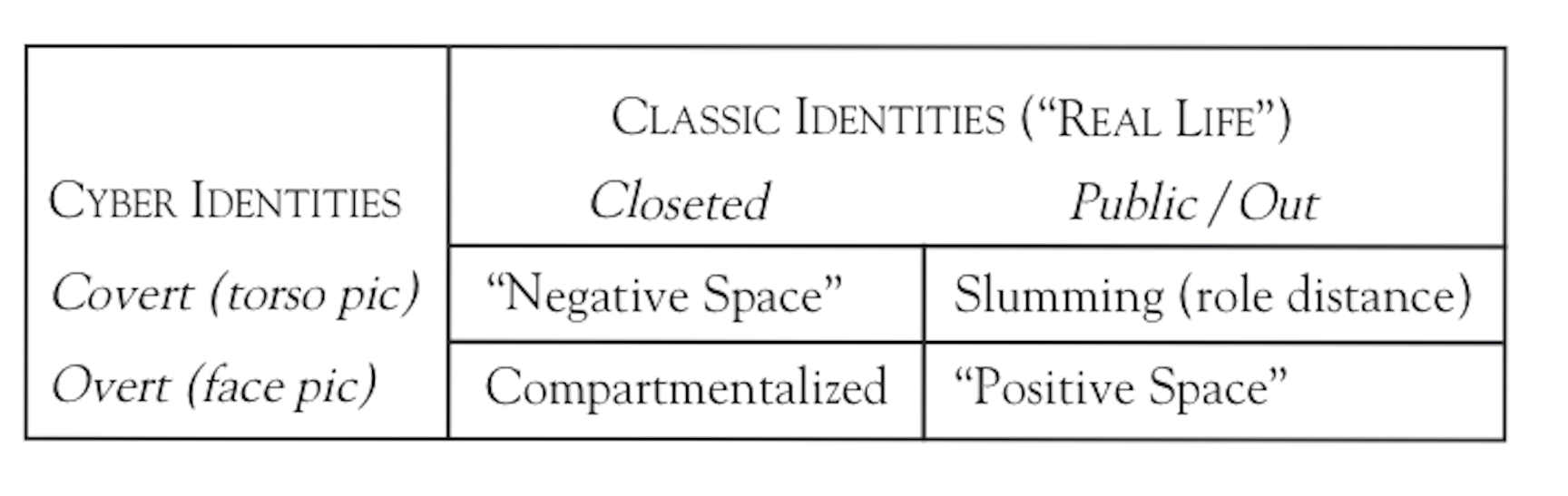
The four ideal types that I’ve suggested are formed by the intersection of real life spaces and the cyber world. The Internet allows GLBT individuals to put their identities into motion in varied and volitional ways: it provides a range of choices for how you will be identified and what version of yourself you will choose to put forward in the virtual world. The significant interplay between the Internet and GLBT culture has occurred due to precisely the duality inherent in both: secrecy versus openness, anonymity versus identity. Given the whole history of the closet and the concealment of one’s true nature, the dualities of social media encapsulate those of the GLBT community in a special and particular way. The importance of social media to modern gay identity is evident every time you sign in to your favorite mobile dating application: for better or worse, this is where much of the cultivation of personal identity takes place in the digital age.
Krishen Samuel is a writer and speech pathologist based in Johannesburg, South Africa. He can be reached at krish-s@hotmail.com.

