Showing posts with label fiction. Show all posts

Tuesday, August 12, 2025

The very gay life of writer Edmund White

 By Aaron Hicklin

The New York Times, June 7-8, 2025

Edmund white might have invented the unapologetic queer on the page. At least, he did for me. Nothing coded gay, vaguely tragic; nothing furtive or metaphorical or obscure behind the billowing curtains of literary flounciness.

I can still recall the thrill of spotting the cover of his 1983 novel "A Boy's Own Story" in a rotating rack of paperbacks in a bookstore in my dull, conservative hometown, Marlborough, England. I must have been about 15. It was the mid-1980s, the thick of the AIDS plague, and gay men were being cast as vectors of their own destruction.

It was a complicated time to be thinking about coming out. But here was a novel with a boy on the cover who looked close to my age, his thick glossy hair gently ruffled by the wind, his lips plump, his jaw strong. His tank top revealed the slope of his shoulders, the contours of his biceps.

I'd never seen a cover or read a book that spoke to me like that. The fact that a gay teenager could exist in fiction blew my mind. The fact that one, like me, could exist in the world did, too. "A Boy's Own Story" was daring not just because it placed a queer adolescent at its center, but also because it did so with sophistication, introspection and horniness. The narrator --clearly, as with all of his narrators, based on him-- is vividly real.

Ed White and I were later to become friends, when I had  moved to New York and was editing Out magazine. This was not a surprise: Ed, who died on Tuesday [June 3] at 85, was always very open to meeting young literary men. He was a raconteur and had stories for miles. I lapped them up. We all did.

Talking frankly about sex was a hallmark of his writing. (Among his many nonfiction works was "The Joy of Gay Sex," a sex manual he co-wrote [with Dr. Charles Silverstein] in 1997.) He always saw himself as a gay writer for gay readers, the distinction he drew between his generation of queer writes and those who came earlier, like Gore Vidal and James Baldwin. They might write gay characters, but they never seemed to be writing for gay readers. Ed was.

The Stonewall riots of 1969, which he took part in, had reshaped him. Before Stonewall, "we had always thought of ourselves as a diagnosis, as a malady," he once told me, echoing the medical establishment's view of homosexuality. "Suddenly, it was all switched, and we were a minority. I saw myself as a freedom fighter. It mobilized my anger. I just think anger towards other people is better than self-hatred."

His most recent book, "The Loves of My Life: A Sex Memoir," published in January, continued that fight to just tell his story, both his own and also, though the details might vary, all queer people's. Ed had no patience for prudes, and he loved to talk about young lovers who were "gerontophiles," a word he clearly relished. He didn't care for respectability. "Gay men have seldom been candid about their sex lives and are even less so now they are getting married and fathering offsprings," he wrote in a rather salty forward to "The Loves of My Life."

Off the page, he was just as defiant. The British writer and playwright Neil Bartlett recalls attending a lavish soiree in Paris in 1984, hosted by Marie-Claude Brunhoff, a society fixture. Mr. Bartlett was Ed's companion for the night, and was, at Ed's insistence, seated next to the host despite his wearing eyeliner, a chain around his neck, and jeans peppered with so many holes you could see right through them. "I have never been prouder to be someone's piece of rough trade," Mr. Bartlett said.

One virtue of being a pioneer of autofiction: Everything is already out there. Ed never felt the need to censor himself. "From the beginning of his writing career, White enjoyed shocking readers in the spirit of Jean Genet. on whom White wrote a wonderful biography," said the writer and academic Blake Smith. "You can find basically every sexual scenario from incest to cuckoldry to hustling in his novels --and a lot of it in his memoirs as well!"

The last time I saw Ed was on April 7, in what would be the final on-camera interview for a documentary Brian Montopoli and I are making. Ed was eager to plumb his memories, even if the names sometimes took a little longer to surface. Sitting in his small apartment in Manhattan's Chelsea neighborhood, I felt that I had stepped into a vanished New York, one where books spilled from the shelves and the walls crowded with art from friends --including a portrait by Robert Mapplethorpe of Ed with Truman Capote.

Whenever I visited, I'd bring a cake or cookies, and we'd sit at the cluttered dining table, while Ed brought me up to speed on what he'd read, who had visited, and what he was working on. He was always working on something. That never changed. A new novel was underway, he told us; another had just been sent to his agent.

We talked a lot about the legacy of the Violet Quill, a group of seven gay writers that met irregularly in New York in 1980 and 1981 and that included Christopher Cox, Robert Ferro, Michael Grimley, Andrew Holleran, Felice Picano, Georgee Whitmore and Ed. Four died during the height of the AIDS epidemic. Mr. Picano died in March. Only Mr. Holleran now remains.

On that last visit, we landed on our documentary's working title: "The Winter of Edmund White," a nod to his age, but not to his spirit, which remained impish, magnetic and razor sharp. When the subject of death arose, he was characteristically unflinching. "The dying part I don't look forward to, but being dead is OK. It's like being asleep," he said. Then, with that sly, knowing smile of his, he added, "I guess I think if I keep writing, I won't die."

On that score, he was right. Through his books, Ed endures. He embraced the role of gay elder, guiding generations who came to him for direction and support. No one was better read or more willing to share what he had read. His apartment was a kind of salon, where he and his partner, the writer Michael Carroll, hosted a rotating cast of artists, writers and thinkers. He was so generous with his time, and endlessly curious.

So many younger writers owe their careers to his encouragement and support (he was prolific at writing blurbs for debut authors' books), and in a sense they could be called his progeny. "He was like my N.Y.C. parent," the writer Christopher Bollen replied when I texted him to commiserate. "I'm so heartbroken. But also so lucky."

A revelation from that last interview was that Ed still met weekly with a boyfriend from his teenage years. For someone who had lost so many friends and lovers, this struck me as profoundly poignant, but it also exemplified Ed's idea of queer or chosen family, long before the term became hackneyed. He had gone through AIDS, and contracted HIV in 1984. He understood that queer family was all he had.

Writing for Ed was a confessional. In more that 30 novels and memoirs he revisited much of the same territory, even when his books were set in the future, like his 2022 novel "A Previous Life," in which he explored a devastating affair with a young Italian aristocrat by imagining his former lover as a ridiculous old man looking back on a forgotten gay novelist called Edmund White. What an audacious move for an octogenarian novelist. He was also a stylist, one who cared about sentences, but he also liked to "roughen up beautiful surfaces," to quote the writer Garth Greenwell, another White protégé.

"If gays have gone from invisibility to ubiquity and from self-hatred to self-acceptance, we should recognize we are still being pushed off cliffs in Yemen --and from the top fronds of Florida palms, for all I know," he wrote in "The Loves of My Life."

Most important, he understood that our stories had to be written so they could not be undone, and that books were the last defense against erasure. That his death should come on the same day that Defense Secretary Pete Hegeseth has ordered the Navy to review the names of vessels honoring prominent civil rights leaders, including Harvey Milk, is the kind of bitter coincidence that probably would have made him laugh.

Not that he craved straight society's approval. Edmund White had no use for shame, and, in both life and work, he refused to sand down the edges of queer existence to make it palatable. Acceptance was never the point. Truth was.


Tuesday, April 29, 2025

Sense8_series

  • Sense8 tells the story of eight strangers played by an impressive cast of international actors and actresses: Will (Smith), Riley (Middleton), Capheus (Ameen), Sun (Bae), Lito (Silvestre), Kala (Desai), Wolfgang (Riemelt), and Nomi (Clayton). Each individual is from a different culture and part of the world. In the aftermath of a tragic death which they all experience through what they perceive as dreams or visions, they suddenly find themselves growing mentally and emotionally connected. While trying to figure how and why this connection happened and what it means, a mysterious man named Jonas tries to help the eight. Meanwhile, another stranger called Whispers attempts to hunt them down, using the same sensate power to gain full access to a sensate's mind (thoughts/sight) after looking into their eyes. Each episode reflects the views of the characters interacting with each other while delving deeper into their backgrounds and what sets them apart and brings them together with the others.

    This group of strangers are suddenly linked mentally, and must find a way to survive being hunted by those who see them as a threat to the world's order. They all experience a rebirth which inexplicably links them intellectually, emotionally and sensually. We are taken along their journey to discover exactly what they are going through, witnessing their interactions from face-to-face conversations from opposite sides of the world without the use of any devices, simply using each other's skills and abilities, learning about each other, all the while being pursued by a secretive group that wish to lobotomize them in order to prevent an evolutionary path they do not wish to become humanity's future. Written and directed by the Wachowski sisters, this is an un unmissable science-fiction drama series! A total visual treat. I recommend watching it with English subtitles on.


Thursday, January 30, 2025

Black Mirror_series


Black Mirror (Netflix) is a British science fiction television series written and created by Charlie Brooker and centered around dark and satirical themes that examine modern society, particularly with regard to the unanticipated consequences of new technologies, reminding us that to revere our digital gadgets is to become their pathetic slaves. Episodes are stand-alone works, usually set in an alternative present or in the near future. All genuinely unsettling and thought-provoking.

Stories tap into the collective unease about our modern world. Over the last fifteen years, technology has transformed almost every aspect of our lives before we've had time to stop and question it. In every home; on every desk; in every palm -a plasma screen, a monitor, a smartphone- a black mirror of our 21st Century existence. A must-watch series. Take my word for it.


Check the plot summary of Black Mirror's 34 episodes (7 seasons) on Wikipedia or on radiotimes.com only after you have watched an episode. I personally recommend the following stories:
The National Anthem
The Entire History of You
Nosedive
Shut Up and Dance
San Junipero
Hated in the Nation
Black Museum
Smithereens
Rachel, Jack and Ashley Too
Joan is Awful

Thursday, February 29, 2024

Breaking Bad, a masterpiece now, and a masterpiece a hundred years from now


Everything stands out, from the subtle details, to the unmatched writing and the perfect cast, to the very beautifully shot scenes. Breaking Bad, created by Vince Gillian, may very well be the best TV series out there. The story, even with some creative liberties, is well grounded, believable and feels very real. The show, unlike others, ages like fine wine. The more you watch and the longer you sink in, the better it gets. I can think of few series which grow stronger and better every season. It's not only worth sinking your teeth into, it's worth eating. Breaking Bad is a timeless piece and it will stand even long into the future, and will forever be one of the best TV shows to ever come out.

Definitely one of the greatest series ever. It just gets better as it goes along. The journeys of Walter White and Jesse Pinkman are something I will never forget. These are some of the best written characters to ever come from a pen hitting a paper. My praises for the acting and cinematography are unending. Some of the shots are intricate works of art, and in general the performances are just excellent. This makes all but the best movies look like utter dribble, and in terms of tone, every intense moment is executed with excellence, and always has the impact it's going for.

The plot of the series in the early seasons lacks a certain level of complexity, and the start is a bit slow paced, but nevertheless, this is an absolute must-watch, preferably one episode a day. If you have mixed feelings about Season 1, trust me, it's only uphill from there. If you want a series to call perfect; I think this might be it.

Wednesday, May 24, 2023

I AM (TV series)

I Am... is a female-led drama series of standalone stories produced by Channel 4. Each of the 7 episodes is developed and written by Dominic Savage in collaboration with a top British leading actress, and centres on a titular character which the episode is named after, with improvised dialogue and themes including relationships, mental health, and empowerment. Each 47-minute film follows different women as they experience moments that are emotionally raw, thought-provoking and utterly personal. The filmmakers wanted an intimate but cinematic look for the episodes. The whole series was shot hand-held, as though we are eavesdropping on the characters, in order to add to the documentary feel of the drama. Totally engaging to watch. Available on streaming at Theflixer.tv and on COSMO.

See related article: I am, Channel 4

Wednesday, March 22, 2023

The hidden gay lives finally being uncovered

In the past, the amazing stories of LGBTQ+ people were actively suppressed – which is why fiction writers are now diving into queer history and filling in the gaps, writes Matt Cain. 
15th June 2021 BBC Culture BOOKS

Earlier this year, the TV miniseries It's a Sin rightly won acclaim for its depiction of the Aids crisis in the UK during the 1980s and 1990s. But when I heard people raving about the show, written by Russell T Davies, I was struck by how many of them admitted to knowing little about the epidemic – and the destruction it wreaked among the gay community.

That’s because, even in today's much more accepting society, the history of the gay and lesbian community is largely a forgotten history. For a long time, the mainstream public didn't want to hear our stories. "I would venture to say that the public were disgusted and outraged," says author Crystal Jeans. She points to the response to the watershed lesbian novel The Well of Loneliness by Radclyffe Hall in the 1920s as just one famous example of the way authors have caused hysteria simply by acknowledging queer lives. Despite the book containing just two very mildly suggestive sexual references, "everyone went berserk and it was banned", she says.


Stephen Hornby, national playwright-in-residence for the UK's LGBT History Month, argues that our stories have long been actively suppressed. "The only interest used to be in censoring or denying any queer elements of the records of the past. So, things were kept from public display, passages were omitted from books and sexual relationships were presented as passionate friendships. That was wilful and deliberate distortion." But now society is becoming much more welcoming of queer people, there's a huge appetite to hear our stories. And there are so many amazing stories to tell. 

The range of queer stories

On the one hand, there are the tales of famous figures like Greta Garbo, Michelangelo, Leonardo da Vinci, Marlene Dietrich, Tchaikovsky, Josephine Baker and Hans Christian Andersen, all of whom experienced same-sex desire or engaged in same-sex activity in societies that didn't welcome it, often channelling their frustrations into creating remarkable work that went on, in some cases, to determine the course of Western culture. On the other hand are the invisible stories of the millions of everyday men and women whose lives made less of a mark but included events as dramatic as familial rejection, professional dismissal, social exclusion, blackmail, criminal conviction, imprisonment, torture, electric shock therapy, chemical castration, and execution.

Arguably, even the most ordinary queer person of a certain age has lived an extraordinary life. And, when you consider the impact that the challenges they faced must have had on their emotions and relationships, you have the ingredients for gripping, moving, rousing drama – and characters that modern-day audiences are now ready to root for.


This is what inspired me to write my latest novel, The Secret Life of Albert Entwistle. It's about a lonely, socially awkward and secretly gay postman living in a fictional town in the north of England who hits retirement, realising he wants to turn his life around and finally be happy – but to do this, he needs to find the love of his life, a man he hasn’t seen for nearly 50 years. His search for his lost love is interspersed with a series of flashbacks to his youth that gradually reveal the pressures their relationship found itself under as a result of the social climate of the late 1960s and early 1970s – and ultimately how these pressures tore them apart.


I'm not the only writer who's introducing queer history to a popular audience. My novel The Secret Life Of Albert Entwistle is riding on a wave of interest that dates back in the UK to 2017 and the 50th anniversary of the beginning of decriminalisation of homosexuality. That same year, the so-called "Alan Turing law" offered pardons to 49,000 British gay men who’d been convicted of homosexual acts – following a campaign arguably bolstered by the greater awareness brought about by The Imitation Game, the hit film that depicted the conviction and chemical castration of the Enigma-codebreaking computer scientist.

The increased interest in queer history is by no means limited to the UK. Loving by Hugh Nini and Neal Treadwell is a book of photos from the late 19th and early 20th Centuries (found in flea markets and car boot sales) that show men who appear to be in love. It was launched in the US and internationally in October 2020 – and is already entering its fifth print-run. Over on Instagram, The Aids Memorial shares photos and stories of people – predominantly gay men – who died of the disease, written by those who loved them. It now has 185,000 followers. Meanwhile, on Netflix, 2020 documentary A Secret Love tells the story of a US lesbian couple who kept their relationship secret from their families for nearly seven decades.


However, it's fiction that’s very much driving the phenomenon of bringing "lost" stories of gay life from the past to light. Over the last five years, a trio of Irish writers have delivered stunning gay-themed novels set predominantly in periods of history that didn't welcome them – John Boyne (The Heart’s Invisible Furies), Graham Norton (Home Stretch), and Sebastian Barry (the Costa Award-winning Days Without End). In the theatre, Matthew Lopez's exploration of gay male history The Inheritance triumphed in London before transferring to New York, where it opened the year after a well-received revival of Mart Crowley's seminal 1968 play Boys in the Band. Last year, the latter was remade as a film for Netflix by Ryan Murphy.

Indeed, Murphy has led the way with fictionalising queer history for a popular TV audience: having finished its third and final season last week, Pose blew open the drag ball culture scene of New York in the late 80s, and last year's Hollywood was a LGBTQ+-themed fantasy set in 1940s Los Angeles. Elsewhere on the small screen, It’s a Sin's five episodes have had a total of over 18 million views in the UK, while it earned near-universal raves on both sides of the Atlantic. Add to this recent queer-themed period films Carol and Call Me By Your Name, plus the French indie hit 120 Beats Per Minute, a love story set amongst the Aids activist movement of 1980s Paris, and it is clear that there is now a huge scope for telling queer stories in mainstream film and TV. Most recently, the internet exploded with behind-the-scenes photos of Harry Styles from the shoot of new film My Policeman, an adaptation of Bethan Roberts's 2012 novel starring the pop superstar as a closeted gay man in the 1950s.

Why fiction is leading the way

As a novelist, it interests me that fiction is at the forefront of this dissemination of queer history. This may be because any historians wanting to write about real-life characters are faced with a very serious problem. Most queer people from the past went to great lengths to conceal their identity – sometimes marrying and starting families, at the very least destroying all evidence. After their deaths, if families found letters, diaries or photos, they usually destroyed them (which explains why those photos featured in the picture book Loving come with no caption or explanation). This has made it all too easy for historians to erase our existence from the record and deny the contribution we’ve made to society.


Even when evidence does exist of same-sex relations – as is the case with 19th-Century Yorkshire landowner Anne Lister, the subject of BBC/HBO series Gentleman Jack, or Queen Anne, subject of Oscar-winning film The Favourite – this is often coded, covert or patchy. We have to rely on fiction to fill in the gaps.

"Filling the gaps in is my speciality," says British writer Patrick Gale, whose 2017 BBC TV drama Man in An Orange Shirt explored the fallout of same-sex desire echoing through three generations of one family. "In fact, I’m only drawn to fictionalising true-life material where there are gaps in what can be known or proved." Gale's 2015 novel A Place Called Winter saw him draw inspiration from the story of his great grandfather Harry, who left his family and emigrated to Canada in the early 20th Century. However, as a way of explaining the mystery surrounding why Harry left behind everything he knew, Gale imagined a situation in which he was forced to leave as a result of a gay affair being exposed. "[His story] had these echoing spaces in it which I could join by using my imagination and wondering how I’d have behaved in his position."

Gale is taking similar imaginative leaps with his next novel, which is about the British poet Charles Causley. "He was quite clearly queer – to judge from his private letters and diaries – and yet not remotely ready to be comfortable with admitting that, even to himself," he explains. "We know he was in the Navy and that he wrote poems which suggest his war experiences carried a powerful emotional charge; we know that he kept until his dying day a letter from a fellow officer with whom he seems to have had some kind of relationship. So what fiction can do, which a straightforward biography cannot, is to solve those mysteries in an emotional nourishing way. It doesn’t matter if it wasn’t true because it would have been true for other men in a similar situation."

The challenges in recounting the past

Crystal Jeans's latest novel is The Inverts, which tells the story of two best friends – one a lesbian, the other a gay man – who enter into a fake marriage in the 1920s. She believes that queer history offers writers a rich territory to mine but points out the constraints of working from real-life testimonies. "From what I’ve noticed our pool to fish from is a bit limited. Most original source material – diaries, books etc – was written by privileged people. White and wealthy. You’d not catch many queer coal miners jotting down their stream-of-consciousness memoirs between shifts. Vita Sackville West left us her letters. Gladys Bentley did not."

This was another reason I wrote The Secret Life of Albert Entwistle; I wanted to tell the story of one ordinary young gay man trying to express his love for another at a time when this would not have been accepted. But I also wanted to contrast this disturbing, sometimes horrifying picture with what life can be like for a gay man within today’s much more accepting society in the UK – and celebrate how much progress we’ve made. My inspiration was a series of interviews I conducted with older gay men whilst I was Editor-in-Chief of Attitude magazine, as part of our celebration of the 50th anniversary of the start of decriminalisation. I was stunned by the emotional impact and intensity of these stories of relentless persecution and oppression, of lives dogged by fear and shame. And I wanted to make sure stories like these weren’t lost – and reached as large an audience as possible.


When it comes to written – rather than verbal – evidence of working-class queer lives, this is often ambiguous. For Stephen Hornby's last play, The Adhesion of Love, he researched a group of working-class men from Bolton who set up a Walt Whitman appreciation society in the 1880s. They entered into regular correspondence with America’s great queer poet – and two of them even travelled to New York to visit him. In the play, Hornby has inferred that the men were what we'd now call gay. "If we look at the record that does exist of the Bolton men’s lives with the assumption that they were heterosexual," he says, "we're just left with a lot of puzzles and unanswerable questions. If we flip it, and assume they were interested in men sexually and emotionally, then all those puzzles disappear, and all the questions are answered."

But Hornby is careful to point out that before writing any play he carries out extensive research. "I've been working with the primary archival materials for weeks. I’ve read the contextual histories of sexuality in the period. I've visited the sites of the events. And then, crucially, I've made a homonormative assumption and told my story from that position."

As a fellow patron of the UK's LGBT History Month, creating an authentic fictional history is a responsibility I took equally seriously when writing The Secret Life of Albert Entwistle. I carried out extensive historical research into the context of the period I was exploring and returned to the interviews I conducted while at Attitude. I wanted to do justice to the men who'd lived through similar experiences but didn't survive or weren't able to make their stories heard. And while my hope is that I've created a story which straight people will find interesting, I'm aware that, for the LGBTQ+ community, the stakes are much higher. 

"What we see all through history is that people are denied their past as part of a way to control them," says Hornby. "The fascist playbook is always to destroy the history and culture of the minority it is repressing. History empowers us. At its most fundamental, it says, 'We have always been here. We have a place.'" For the LGBTQ+ community, telling our stories and knowing our history is a matter of both self-discovery and survival.

Thursday, January 26, 2023

It's A Sin: A series that will tug on your heartstrings

By KARINA SHAH

An unknown virus, misinformation and uncertainty about the future. No, we’re not talking about coronavirus for once. It’s A Sina new five-part miniseries from Channel 4, delicately tackles the HIV and AIDS epidemic of the 1980s, with the backdrop of queer London.

Created by Russell T Davies, who was also behind the series Queer as Folk and Years and Years, the show chronicles the lives of three gay men who set off from their hometowns to begin new lives at university. A seemingly light set-up, the story takes a turn for the worse as a deadly new virus is on the rise.

It’s A Sin opens in September 1981, with an outwardly perfect nuclear family sat around their dimly lit dining table, surrounded by retro lampshades and boldly printed curtains. We are introduced to 18-year-old Ritchie (Olly Alexander), the show’s protagonist, who is about to move to the big city: London.

His story really begins when he meets Roscoe (Omari Douglas) and Colin (Callum Scott Howells). As the three young men navigate the capital’s gay scene and university life in general, as members of a new family of their own choice,  they are introduced to a mysterious disease that seems to disproportionately affect gay men.

In the early 1980s, reports of severe immune deficiency began to rise around the world. Scientists were dumbfounded by this new disease, which worked by attacking the body’s immune system, weakening its ability to fight infections.

Navigating an increasingly homophobic society, Ritchie initially responds to this disease with denial. “I don’t believe it, I don’t believe a word of it,” he says in a monologue of denial, while the camera pans to him on the dance floor of Heaven, the iconic gay club in London. As the shadow of AIDS closes in, Ritchie and his friends tackle misinformation and stigma.

The miniseries scarily mirrors our current reality. Much like today’s coronavirus, there were many rumours circulating about HIV and AIDS, due to fear of the unknown. One of the most common misconceptions was that only gay people could contract the virus – it was even labelled the “gay plague”. This stigma cast a large shadow on the gay community, meaning that many people suffered in silence until their last days of life, as shown in It’s A Sin.

It’s A Sin presents a candid authenticity that could only be achieved by someone who has lived through and experienced the events themselves, which Russell T Davies did. The soundtrack especially gets an honourable mention – it features some of the biggest smash hits of the decade, including BlondieWham! Pet Shop Boys and Queen. Paired with the impeccable acting of the young and upcoming actors, many of whom weren’t even alive in the 1980s, we are transported back in time.

Davies preserves the joyous scenes of 1980s London, all while sensitively portraying the realities of the disease’s devastating progression. We see how HIV and AIDS affected the individuals themselves, their social circle and even families who discover their son’s sexuality through the most haunting circumstances. No spoilers, but keep your box of tissues close to hand. HIV and AIDS have claimed the lives of millions of people across the world – and this fictional telling is no exception.

It’s A Sin serves as a perfect reminder of the not-so-distant-past that burdened thousands of gay men. It is a poignant love letter to all those lost during the AIDS epidemic, and to those allies who unconditionally supported them.

Available worldwide on HBO.

Monday, May 02, 2022

Heartstopper_series

The story of two British teens, Nick Nelson and Charlie Spring, at an all-boys grammar school. Charlie, a high-strung, openly gay overthinker, and Nick, a cheerful, soft-hearted rugby player, one day are made to sit together in class. Their friendship quickly becomes something more for Charlie, but he initially does not believe he has a chance with Nick. But love works in surprising ways, and Nick is more interested in Charlie than either of them realized. Based on Alice Oseman's bestselling graphic novel series Heartstopper. Eight 25-minute episodes on Netflix. (UK, 2022) You will want to binge-watch it in one sitting. Tenderness is the word. A must-see, feel-good story.

Saturday, July 11, 2020

Th Boys in the Band's 50th Anniversary

The Boys in the Band, one of the first plays to portray gay life, opened off-Broadway in 1968 and became a film in 1970, directed by William Friedkin. As the LGBTQ rights movement grew, the work received criticism for depicting gay and bisexual men as self-loathing, but it was groundbreaking for its time.
Written by Mart CrowleyBoys first premiered off-Broadway in 1968, and a film version featuring its cast was released in 1970. The 2018 revival, marking its 50th anniversary, was staged at the Booth Theatre in New York City for a 15-week run that broke sales records. 
The Broadway play — a revival of the 1968 gay classic about a queer dinner party that goes off the rails — was produced with an all-star cast of out actors. The production won a Tony for Best Revival of a Play, and is being adapted into a film by Netflix and produced by Ryan Murphy.
While some of the content of Boys felt dated to some viewers — particularly the portrayal of the intense self-hatred of queer men in that era — other themes of stigma resonated with modern-day audiences. The groundbreaking play has undoubtedly retained its power.
Crowley was a well-known Hollywood raconteur and friend to many stars, including Natalie Wood, who encouraged him to write The Boys in the Band. He wrote several other plays, including a sequel, The Men From the Boys, and worked on the television series Hart to Hart.
"The Broadway cast of Boys was so important to me, and as equally groundbreaking as Mart Crowley's seminal work," Murphy wrote in the caption of the Instagram post. "Everyone in the cast was out and proud...and feeling so blessed to mark the 50th anniversary of Mart's landmark play." (Source: The Advocate)
Mart Crowley at left with the cast of the 1970 film of The Boys in the Band
The original film The Boys in the Band can be watched online at nuevatematica.men 

Monday, July 09, 2018

The Young Pope_series

The Young Pope review – stunning, thoughtful and visually arresting


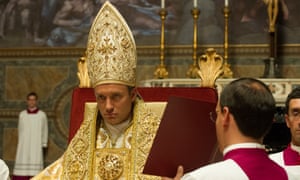
Jude Law as the young pontiff
 Jude Law as the young pontiff wrestling with his belief in God. Photograph: ©Gianni Fiorito
Jude Law is excellent as Pius XIII, oscillating between vindictive authoritarian and wounded man-child with surprising charm. A TV review by REBECCA NICHOLSON, The Guardian, December 16, 2016
What a gorgeous and gripping series The Young Pope (Sky Atlantic H) has been. It is not surprising, coming from the director of such visually arresting films as Youth and The Great Beauty, but Oscar-winner Paolo Sorrentino’s first adventure on the small screen has been far more than just a pretty picture. It could have been overwhelmed by its splashy premise: Jude Law is Lenny Belardo, now Pius XIII, an ultra-conservative, manipulative new American pontiff. He has serious doubts about whether he believes in God, drinks Cherry Coke Zero for breakfast and smokes more than the cast of Mad Men combined. But The Young Pope was stunning, thoughtful and dreamlike, and even though key players have been strategically shifted to dioceses around the globe, its well-earned second series can’t come soon enough.
Lenny, or Pius to his Vatican pals, has spent much of the first season establishing just what kind of Holy Father he intends to be. He was anointed on the misguided promise that he would be a pliable looker who might boost the church’s coffers by allowing his handsome image to appear on a few plates in the gift shop. But Lenny is no patsy; his idea of reforming Catholicism has been to crack down on moral transgressions and to channel Daft PunkBanksy and JD Salinger – his own points of reference – by hiding his face from public view, so that everyone can get back to the business of learning how to be Godly again. It is as effective a marketing technique as it is a point of principle.
There was a thriller-like tautness to Gutiérrez’s eventual capture of brazen paedophile Archbishop Kurtwell – and how wonderful that The Young Pope did not shy away from covering child abuse in the church – in New York. Kurtwell tried to destroy Pius’s reputation by releasing his old love letters to the press, but their publication in the New Yorker served to boost his popularity by showing his human side, even if it was against a backdrop of global protests over his stance on abortion. (The image of the naked women, each daubed in blood with a letter from the word BASTARD, is one of many unforgettable scenes, dropped in confidently and casually.) But, eventually, Kurtwell was reeled in and banished to Alaska – a poetic fall from grace for a man once so powerful, if not perhaps the most effective punishment for a habitual paedophile.
Sorrentino has said that it is no coincidence that Pius begins as an ultra-hardline pope in an era where the real pontiff is pursuing a more liberal papacy than his predecessors. What has been fascinating about this series is how well it has demonstrated the subtleties of change and growth. Early on, Pius boots out a cardinal for admitting his homosexuality, and insists it is incompatible with the teachings of the church. But, by the season finale, his greatest ally is Gutiérrez (Javier Cámara, conveying both compassion and pain with just a flicker of his eyes), who tells him his alignment of paedophilia and homosexuality is wrong. Pius admits he may be revising his views. Besides, he has a lot of mummy (and daddy) issues to deal with before he gets on to working out whether he believes in God.
Law has been excellent as Pius, oscillating between vindictive authoritarian and wounded man-child with surprising charm. And so, after his substitute parents leave him – James Cromwell’s Spencer finally dies, and he sends Diane Keaton’s Sister Mary off to work with children in Africa – we end with a road trip to Venice, where Pius hopes he might find those hippy parents who abandoned him and don’t seem to be particularly interested that their son is now the global head of the Catholic church.
In St Mark’s Square, he finally reveals his identity to the assembled crowd. Imagine wondering what the Pope looked like for months, and then finding out he has the face of Law. Sorrentino goes all out for the final scenes, which are as intricate as the Pope’s finest robes. Pius delivers a barnstorming address, then looks at the smiling faces in the crowd through a telescope Gutiérrez picked up at the service station on the way. He sees his parents, older, disappointed, leaving. I was left unsure if it was real or a vision; there is something Sopranos-like in The Young Pope’s ease with a dream sequence. As Pius collapses, we pull back to a wide shot, of the crowd, then of the city, then of the world. It’s so assured, so sumptuous, so well done, that it can absolutely get away with a gesture as grand as this.

Tuesday, December 27, 2016

Ficciones de televisión recomendadas para hacer oído y aprender inglés

Entender una película o una serie en versión original puede a veces ser un tormento. Pero no hay que desesperar. Un comunicador, un escritor, una cantante, un profesor, un catedrático y este bloguero recomiendan emisiones para iniciarse o perfeccionar el inglés.

Jorge Carrión, autor de Teleshakespeare. "Yo recomendaría la última temporada de Homeland , porque, al pasar en Berlín, con personajes norteamericanos y alemanes, puede verse la diferencia entre acentos autóctonos y extranjeros. Es importante educar el oído en esos contrastes. En series como Mad Men o Suits , por ejemplo, los personajes británicos subrayan una distancia fonética que también existe entre los personajes norteamericanos que provienen de estados o clases sociales distintas. En El ala oeste de la Casa Blanca hablan muy rápido. Es solo para quienes tengan voluntad de perfeccionamiento".

Michael Robinson, exfutbolista y comunicador. "Para empezar, opto por algo muy básico como Barrio Sésamo. Hay otra muy buena llamada Luther, que trata sobre un policía que a veces recurre a técnicas no muy honradas para conseguir buenos fines y que también aconsejo ver. Aunque, sin ninguna duda, lo ideal sería aprender con los informativos de la BBC, que ofrecen el inglés más correcto y la mejor pronunciación posibles. Para los que presumen de saber inglés y querer perfeccionarlo, les pediría que vieran la serie de la BBC Only Fools and Horses que trata de dos hermanos que trabajan en un mercadillo de Londres. Usan todo el tiempo el dialecto cockney. Consiste en reemplazar una palabra que se usa normalmente por otra que forma parte de una frase hecha con la que rima. Algo muy complicado. Si son capaces de entenderlo, dominarán el inglés." 
Nick Flynn, responsable del área de idiomas de la carrera de Derecho de Esade. "Lo mejor son series cortas como Modern Family y Como conocí a vuestra madre. Puedes mirar mil horas de vídeo y no aprender nada, es decir, rendimiento cero. Pero si te centras en emisiones más breves, la manera de escuchar es muy diferente. Yo creo que se podrían ver los capítulos una primera vez para pasarlo bien y después elegir una escena y escucharla las veces que haga falta para entender todo. Te fijarás en las palabras que no acabas de comprender bien y esto ayudará a la comprensión oral. Aparte de eso y entrando en un apartado más específico, a mis alumnos de Derecho les pongo en clase Suits, que trata del mundo de la abogacía".


'FRIENDS' Y 'LOS SIMPSON' SON LAS FAVORITAS


La academia internacional Kaplan publicó en 2012 una encuesta sobre qué ayudaba a los estudiantes a la hora de aprender inglés. Un 82% aseguró que ver series les fue muy útil. De ese porcentaje, un 26% eligió Friends como la mejor. En segundo lugar, aunque a mucha distancia, quedaron Los Simpson con un 8%. En la lista también aparecían Cómo conocí a vuestra madre , CSI , Padre de familia , House, Big Ban Theory y Gossip Girl . En el mismo estudio, un 79% señaló que las películas también constituían una gran ayuda. En este caso, la ganadora fue Harry Potter , con un 24%. Compartió podio con Titanic , con un 11% y Toy Story , de la que un 7% de los encuestados aseguró que le había resultado de utilidad.
Annie B Sweet, cantante y compositora. "Ante todo he de decir que lo que más recomiendo es hablar. Si tengo que elegir, me inclino por Mad Men o Fargo. Creo que la primera tiene un vocabulario sencillo pero también usa léxico más especializado que se puede entender, como es el léxico de una agencia de publicidad. Ambas son norteamericanas. No sé por qué pero creo que se entiende mejor ese acento y a mí siempre me han dicho que mi forma de hablar en inglés se asemeja más a la de Estados Unidos. También voy a nombrar una inglesa, diría Little Britain, que también es fácil de entender, y al ser una comedia se hace más llevadero".
Celestino Deleyto, catedrático de Filología Inglesa de la Universidad de Zaragoza. "Mi consejo es que vean Curb your Enthusiasm. Fue creada y protagonizada por Larry David, creador de Seinfeld. La serie tiene un humor típicamente judío neoyorquino, aunque la acción tiene lugar en Los Ángeles en el mundillo de Hollywood. Para el aprendizaje del inglés está bien porque los personajes hablan bastante despacio y utilizan un vocabulario coloquial pero bastante rico, y, además, parte del humor radica en la utilización de modas lingüísticas. Outnumbered también está bien para este propósito. Es más reciente aunque con un formato y sentido del humor más tradicional de sitcom británica. Versa sobre las vicisitudes de una familia londinense de clase media. Los personajes hablan con un acento británico muy reconocible, propio del sur de Inglaterra. Hablan más deprisa y utilizan una forma de hablar muy contemporánea sin ser afectada, tanto los padres como los hijos. Tan buena para practicar el inglés como para aprender sobre la cultura cotidiana del Reino Unido a través del lenguaje.

Por su parte, este bloguero recomienda la espléndida serie de ciencia-ficcion Sense8, escrita y dirigida por las hermanas Wachowski y emitida por Netflix, una historia global de ocho ciudadanos anónimos que se ven conectados mental, sensual y espiritualmente desde distintos lugares del planeta, un alarde visual con una puesta en escena deslumbrante. Recomendable verla subtitulada en inglés:


Synopsis: One gunshot, one death, one moment out of time that irrevocably links eight minds in disparate parts of the world, putting them in each other's lives, in each other's secrets, in each other's minds, putting them in terrible danger. Ordinary people suddenly reborn as "Sensates."