This historical political cartoon by Tom Wilson was published by The Washington Post in November 1980, in the aftermath of ultra-conservative Ronald Reagan's landslide victory in the US presidential election. What happened afterwards is in the public domain.
This blog is an online publication of words, sounds, pictures and moving images, launched to increase your exposure to the English language and/or supplement your in-person English course with language structures, challenging new readings, TED talks, trailers, quality videos, thought-provoking posts, reliable news, quotations, food for thought and icon links to related websites or to the cloud.
Tuesday, January 29, 2019
Sunday, January 20, 2019
Friday, January 18, 2019
TV or not TV? The impact of subtitling on English skills
English is the language of the globalized world, and the lingua franca for the international communities in, among others,
science, business, finance, advertising, tourism, and technology. Sixty-eight percent of citizens in the EU rate English as the
most useful foreign language – far above the second position of French with 25% (European Commission, 2006).
Not surprisingly, English is the most widely learned foreign language, and this trend is expected to continue growing fast
in the coming decades (Graddol, 2006). Graddol (1997) estimates that about one billion people are currently learning English
worldwide, with 200 million in China alone. More than 80% of the EU’s school students learn English. The duration of
foreign language as a compulsory subject ranges between six and 13 years in the non-English-speaking EU (Eurydice, 2005).
The general message in this study is simple. Continuous exposure to English-language media contents help people learn English and, thus, the citizens of countries where foreign films and programs are shown in their original version in television will likely speak, on average, better English than those that live in countries where television is dubbed. This is relevant because previous studies have shown that better English language skills improve economic performance.
Dubbing countries in our sample invest the same in education as the subtitling countries. Yet subtitling countries score 3.4 points higher in the TOEFL exams. We show that the television translation methods can explain part of the skills gap. We identify a subtitling effect equivalent to 16.9% of the overall TOEFL score. We also analyze the differential impact of subtitling by type of English skill (listening, speaking, reading, and writing). We find that the strongest effect is for listening (19.4%).
Our results are robust to the inclusion of other determinants of language skill including language proximity, demographic indicators and proxies for the quality of the education system. Interestingly, the choice of translation technology at the time of sound cinema diffusion did (could) not take into account the benefits of improved English skills. In fact, subtitling may have appeared undesirable at first because it forced audiences to read, but it turned out to be beneficial ex-post in terms of English proficiency (and audiences got used to subtitling). This paper thus shows that how countries adopt foreign “cultural” products matters in the long term.
Excerpts from: A. Rupérez Micola, A. Aparicio Fenoll and A. Banal-Estañol et al., TV or not TV? The impact of subtitling on English skills, Journal of Economic Behavior and Organization, https://doi.org/10.1016/j.jebo.2018.12.019
Get
The general message in this study is simple. Continuous exposure to English-language media contents help people learn English and, thus, the citizens of countries where foreign films and programs are shown in their original version in television will likely speak, on average, better English than those that live in countries where television is dubbed. This is relevant because previous studies have shown that better English language skills improve economic performance.
Dubbing countries in our sample invest the same in education as the subtitling countries. Yet subtitling countries score 3.4 points higher in the TOEFL exams. We show that the television translation methods can explain part of the skills gap. We identify a subtitling effect equivalent to 16.9% of the overall TOEFL score. We also analyze the differential impact of subtitling by type of English skill (listening, speaking, reading, and writing). We find that the strongest effect is for listening (19.4%).
Our results are robust to the inclusion of other determinants of language skill including language proximity, demographic indicators and proxies for the quality of the education system. Interestingly, the choice of translation technology at the time of sound cinema diffusion did (could) not take into account the benefits of improved English skills. In fact, subtitling may have appeared undesirable at first because it forced audiences to read, but it turned out to be beneficial ex-post in terms of English proficiency (and audiences got used to subtitling). This paper thus shows that how countries adopt foreign “cultural” products matters in the long term.
Excerpts from: A. Rupérez Micola, A. Aparicio Fenoll and A. Banal-Estañol et al., TV or not TV? The impact of subtitling on English skills, Journal of Economic Behavior and Organization, https://doi.org/10.1016/j.jebo.2018.12.019
Get
Thursday, January 17, 2019
Watch TV series with subtitles
TV series in English recommended by teachers according to your level
Watching series in English improves your comprehension skills, but first you need to choose the right ones

Estar al día de todas las series de moda puede ocuparte muchas horas semanales pero, si las ves en versión original, al menos tienes una buena excusa: estás perfeccionando tu inglés. Según un estudio publicado el pasado diciembre en Journal of Economic Behavior and Organization, los países de habla no inglesa en los que las series y programas de televisión se emiten en versión original subtitulada tienen mejor nivel de inglés que los países que los doblan. Sin embargo, debido al vocabulario, a la personalidad de los personajes, las tramas o los acentos, no todas las series pueden ayudarte del mismo modo. Hemos preguntado a cinco profesores de inglés —españoles y extranjeros— por cuáles son sus recomendaciones dependiendo de tu nivel.
Antes de empezar a devorar capítulos (queremos decir, aprender idiomas), tienes que tener en cuenta que la elección de las series no depende solo del nivel, sino de tus gustos personales. “Nosotros, como profesores, podemos dar muchas pistas de cómo aprovechar mejor el visionado de una serie [para aprender inglés], pero es algo muy personal”, cuenta a Verne Christina Anastasiadis, directora académica para alumnos adultos de International House Madrid. “Lo más importante es ver algo que te interese y te motive, porque así es como se presta atención. No basta con ponérsela y esperar aprender inglés por ósmosis”, bromea.
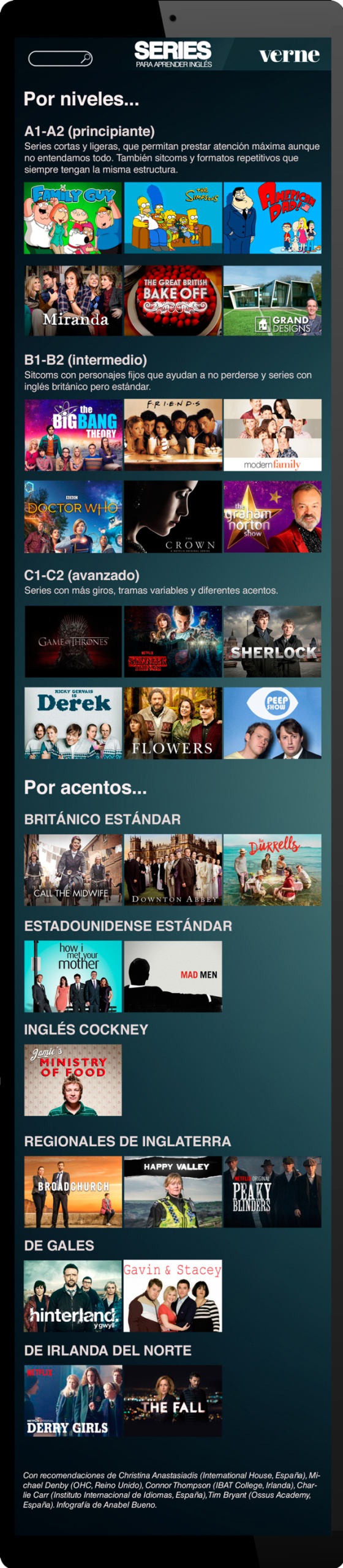
Para que tengas dónde elegir, hemos preparado esta infografía con diferentes opciones, según cuál sea tu nivel y tus gustos:
De las sitcoms a las series complejas
Si te fijas en la infografía, verás que uno de los géneros más recomendados para los niveles principiante e intermedio son las comedias de situación como Los Simpson o Friends. “Son series de capítulos cortos, por lo que es fácil mantenerse atento”, cuenta Anastasiadis. Además, “son bastante repetitivas, por lo que es más fácil seguir una trama cuando ya conocemos a sus personajes y sabemos cómo suelen reaccionar”. Por el mismo motivo, también pueden ser muy útiles los programas de televisión temáticos de subastas, reformas del hogar o concursos de cocina. Además de las que aparecen en la infografía, los profesores también nos han recomendado la edición británica de Masterchef, Love it or List it, The World's Most Extraordinary Homes o The Tudors.
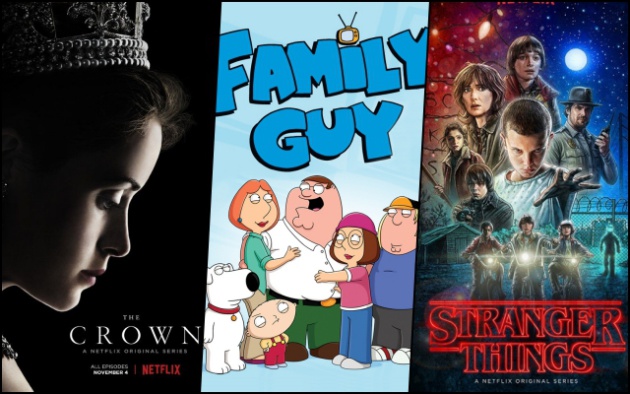
Las sitcoms también son recomendables para niveles intermedios, pero pueden probarse formatos más largos y empezar a poner el oído en los acentos. Una de las más recomendadas por los profesores y profesoras consultadas es The Crown. “La pronunciación es difícil al principio, pero te acostumbras. Es el típico acento británico, muy correcto y clásico”, explica a Verne Charlie Carr, profesor del Instituto Internacional de Idiomas.
Para niveles avanzados, los profesores recomiendan series más complejas, en las que las tramas tienen más giros. También series con acentos complicados —varios han citado Peaky Blinders por su inglés de Birmingham— o con humor basado en el lenguaje y los juegos de palabras, como Flowers. “Es una comedia abstracta típicamente inglesa que exige un alto nivel de inglés para entender no solo el vocabulario, sino el humor inglés y la cultura británica”, cuenta Carr. Además de las que aparecen en la infografía, los profesores también nos han recomendado Call the Midwife, Peaky Blinders, Billions, Sense8 o Black Mirror.
(Verve, 17.01.2019)Friday, January 11, 2019
Campus europeos
La Unión Europea refuerza los lazos entre universidades de países distintos con un plan para compartir alumnos, profesores, títulos y proyectos
Las universidades europeas han cambiado mucho desde que empezó hace veinte años el plan Bolonia. Son cada vez más los estudiantes que viajan al exterior para formarse, existen propuestas de títulos dobles y planes de colaboración —en másteres, en doctorados, en investigación— entre centros de países distintos. El programa Erasmus ha sido eficaz a la hora de fomentar y consolidar esa familiaridad entre jóvenes de ciudades distantes que tanto aporta al proyecto de una Europa común. El plan que ahora ha puesto en marcha la Unión, dotado con 30 millones de euros, para que en 2025 existan 20 campus transnacionales va en esa misma dirección. La idea de que hasta tres universidades de países distintos creen consorcios para compartir alumnos y planes científicos y de investigación representa un paso más para romper con esa percepción que tanto ha calado de que Europa está lejos de sus ciudadanos.
A finales de febrero termina el plazo para que las alianzas se presenten al programa piloto, y a partir de ahí se irán estableciendo los procedimientos para la convalidación de estudios y otras complicaciones burocráticas. Una de las rémoras principales de las universidades españolas es precisamente su falta de internacionalización, y por eso el Gobierno ha convertido este factor en una de las tres patas que están orientando la nueva ley universitaria en la que trabaja. Por eso mismo, este nuevo plan constituye un estímulo más para abrir una universidad en la que sólo el 1,8% de sus profesores es extranjero. La Autónoma de Madrid, Salamanca, Complutense, Granada y Pompeu Fabra participan ya en consorcios.
Sea como sea, la propuesta europea no debería servir en ningún caso de cortina de humo para que la universidad española se desentienda de los problemas que sigue arrastrando desde lejos. El viejo nepotismo ha adoptado nuevas formas en la selección del personal, la calidad y orginalidad en la investigación deja que desear, hay demasiadas diferencias entre unos centros y otros, está la vergonzosa sombra de los másteres regalados a políticos, y hace falta mejor financiación, mayor autonomía, y más competencia y autoridad en quienes la dirigen. (El País, 8.1.19)
Saturday, January 05, 2019
130 Years of National Geographic_exhibition
Protecting the environments become the most important crossroad of our time. Our existence depends on the conservation of the planet. Therefore, the research projects whose purpose is to guarantee this survival are key to our very own future as a species.
130 years ago, there was an identical desire to learn about our environment in order to improve it. This brought together 33 scholars including natural scientists, geographers, cartographers, educators, lawyers, and fom the military, to create an entity which would contribute to extending the boundaries of knowledge of geography. Thus was born the National Geographic Society, founded on a cold day, 27 January 1888 in Washington D.C. by this heterogeneous group of wise men, among which were philanthropist Gardiner Greene Hubbard, the first President of the Society, and his son-in-law, British inventor, scientist, and speech therapist Alexander Graham Bell, who succeeded him as President.
Since then, National Geographic has become the most important non-profit institution in the world, and an absolute reference when it comes to exploration and research.
Under the protection of the yellow frame of its iconic logo, in the last century and a half the National Geographic Society has supported the careers of scientists and researchers from all around the world. Figures such as the North Pole explorer Robert E. Peary, or the man who discovered the city of Machu Pichu, Hiram Bingham, as well as those who are closer to our contemporary period. This is the case of the primatologists Jane Goodall and Diane Fossey; the oceanographer and marine archaeologist who discovered the remains of the Titanic, Robert Ballard; film-maker James Cameron; Spanish marine biologist, Enric Sala; and the recent winner of the 2018 Princess of Asturias Award, also a marine biologist, Sylvia Earle.
"A Window to the World. 130 Years of National Geographic" shows not only the history of the Society and its legacy, but also the evolution of an institution that has been capable of adapting to the times, and to vary the definitions of its main missions according to the demands of the said missions. Although when it started out the goal of the 33 founders was to explore the geography of the world and search for places that were still unknown to man, the challenges have varied according to the times to accommodate other priorities. Geography has given way to exploration of other worlds: space, with articles and documentaries about NASA missions and unknown universes such as Mars, and the oceans, the latest current frontier, source of life from the beginning of our planet, and one of the main conservation missions in order to guarantee the survival of our species. In the words of Sylvia Earle, "No Blue, No Green," in reference to how much we depend on the sustainability of the seabed in order to recover the environmental balance.
Through photographs, videos, and iconic objects, the exhibition delves into these issues, presented in five sections, through which we will learn more about the early days, but especially about the present and future of National Geographic, its missions and their meaning. Visitors will begin their journey in Terra incognita, where we celebrate the birth of the Society and the age of expeditions. In Origin, visitors will learn about the explorations that have contributed to discovering our development as a species. In De Profundis, we propose a look at this essential underwater world, with the presence of the Pristine Project, the mission set up by Enric Sala in 2008 to explore the last wild underwater enclaves. In The Future at Stake we look towards space, but also to the challenges that we have as a species to reverse the degradation of our natural environment, and finally, the Coexistence section shows us other challenges that National Geographic also currently addresses, such as gender and racial diversity in our global society, the most relevant issues of the present.
The exhibition A Window to the World. 130 Years of National Geographic is on at the Espacio Telefónica in Madrid (Fuencarral, 3) until February 24th, 2019.
Through photographs, videos, and iconic objects, the exhibition delves into these issues, presented in five sections, through which we will learn more about the early days, but especially about the present and future of National Geographic, its missions and their meaning. Visitors will begin their journey in Terra incognita, where we celebrate the birth of the Society and the age of expeditions. In Origin, visitors will learn about the explorations that have contributed to discovering our development as a species. In De Profundis, we propose a look at this essential underwater world, with the presence of the Pristine Project, the mission set up by Enric Sala in 2008 to explore the last wild underwater enclaves. In The Future at Stake we look towards space, but also to the challenges that we have as a species to reverse the degradation of our natural environment, and finally, the Coexistence section shows us other challenges that National Geographic also currently addresses, such as gender and racial diversity in our global society, the most relevant issues of the present.
The exhibition A Window to the World. 130 Years of National Geographic is on at the Espacio Telefónica in Madrid (Fuencarral, 3) until February 24th, 2019.
Thursday, January 03, 2019
Monday, December 17, 2018
Children Are Quick :)
TEACHER: Maria, go to the map and find North America.
MARIA: Here it is.
TEACHER: Correct. Now class, who discovered America?
CLASS: Maria.
________________________________________
TEACHER: John, why are you doing your math multiplication on the floor?
JOHN: You told me to do it without using tables.
___________________________________________________
TEACHER: Glenn, how do you spell "crocodile"?
GLENN: K-R-O-K-O-D-I-A-L'
TEACHER: No, that's wrong.
GLENN: Maybe it is wrong, but you asked me how I spell it.
___________________________________________________
TEACHER: Donald, what is the chemical formula for water?
DONALD: H I J K L M N O
TEACHER: What are you talking about?
DONALD: Yesterday you said it's H to O.
___________________________________________________
TEACHER: Winnie, name one important thing we have today that we didn't have ten years ago.
WINNIE: Me!
___________________________________________________
TEACHER: Glen, why do you always get so dirty?
GLEN: Well, I'm a lot closer to the ground than you are.
___________________________________________________
TEACHER: Millie, give me a sentence starting with "I."
MILLIE: I is ...
TEACHER: No, Millie... Always say, "I am."
MILLIE: All right... "I am the ninth letter of the alphabet."
___________________________________________________
TEACHER: George Washington not only chopped down his father's cherry tree, but also admitted it. Now, Louie, do you know why his father didn't punish him?
LOUIS: Because George still had the axe in his hand.
___________________________________________________
TEACHER: Now, Simon, tell me frankly, do you say prayers before eating?
SIMON: No sir, I don't have to. My Mum is a good cook.
___________________________________________________
TEACHER: Clyde, your composition on "My Dog" is exactly the same as your brother's. Did you copy his?
CLYDE: No, sir.. It's the same dog. ___________________________________________________
TEACHER: Harold, what do you call a person who keeps on talking when people are no longer interested?
HAROLD: A teacher.
___________________________________________________
Pass it around and make someone laugh! Laughter is the soul's medicine. 😄
MARIA: Here it is.
TEACHER: Correct. Now class, who discovered America?
CLASS: Maria.
________________________________________
TEACHER: John, why are you doing your math multiplication on the floor?
JOHN: You told me to do it without using tables.
___________________________________________________
TEACHER: Glenn, how do you spell "crocodile"?
GLENN: K-R-O-K-O-D-I-A-L'
TEACHER: No, that's wrong.
GLENN: Maybe it is wrong, but you asked me how I spell it.
___________________________________________________
TEACHER: Donald, what is the chemical formula for water?
DONALD: H I J K L M N O
TEACHER: What are you talking about?
DONALD: Yesterday you said it's H to O.
___________________________________________________
TEACHER: Winnie, name one important thing we have today that we didn't have ten years ago.
WINNIE: Me!
___________________________________________________
TEACHER: Glen, why do you always get so dirty?
GLEN: Well, I'm a lot closer to the ground than you are.
___________________________________________________
TEACHER: Millie, give me a sentence starting with "I."
MILLIE: I is ...
TEACHER: No, Millie... Always say, "I am."
MILLIE: All right... "I am the ninth letter of the alphabet."
___________________________________________________
TEACHER: George Washington not only chopped down his father's cherry tree, but also admitted it. Now, Louie, do you know why his father didn't punish him?
LOUIS: Because George still had the axe in his hand.
___________________________________________________
TEACHER: Now, Simon, tell me frankly, do you say prayers before eating?
SIMON: No sir, I don't have to. My Mum is a good cook.
___________________________________________________
TEACHER: Clyde, your composition on "My Dog" is exactly the same as your brother's. Did you copy his?
CLYDE: No, sir.. It's the same dog. ___________________________________________________
TEACHER: Harold, what do you call a person who keeps on talking when people are no longer interested?
HAROLD: A teacher.
___________________________________________________
Pass it around and make someone laugh! Laughter is the soul's medicine. 😄
Tuesday, December 11, 2018
People of the Year: Journalists Fighting for Truth
For taking great risks in pursuit of greater truths, for the imperfect but essential quest for facts that are central to civil discourse, for speaking up and for speaking out, the Guardians—Jamal Khashoggi, the Capital Gazette, Maria Ressa, Wa Lone and Kyaw Soe Oo—are TIME’s Person of the Year 2018.
Sunday, December 09, 2018
We Can Not Afford Silence
Why Chimamanda Adichie Will Not 'Shut Up'
The following is a transcript of Chimamanda Ngozi Adichie's powerful speech delivered on October 9, 2018, at the opening press conference of the Frankfurt Book Fair, in which the acclaimed novelist talks about why this is a time for new voices, boldness in storytelling, and why literature today matters more than ever. By Chimamanda Ngozi Adichie
I was raised Roman Catholic. As a child, I loved going to church. My family went every Sunday to St Peter’s Chapel, which was a tall white building on the campus of the University of Nigeria, where I grew up.
The parish priest was a University lecturer. And as far as a Roman Catholic Church could go, it was an open, progressive, welcoming place. The Sunday sermons were benignly boring.
Years later, I heard that the church had changed hands and that the new parish priest was a man who was singularly focused on women’s bodies. He appointed a religious police, a brigade of boys, whose job it was to stand at the door of the church, and examine each woman and decide who could enter and who could not. Grandmothers were turned away because their dresses were ostensibly low-cut.
After I’d been away for years, I went home to visit my parents. And I went to church. I wore a long skirt and a short-sleeved blouse in traditional print—an ordinary, commonly-worn outfit. At the entrance of the church, a young man stood in my way. His expression was a contrived mask of righteousness, which I would have found, in different circumstances, very funny. He asked me to turn back. My sleeves were too short, he said. I was showing too much arm. I could not go into the church unless I wrapped a shawl around my shoulders.
I was enraged. This church was part of my happy childhood, part of my memories of a time filled with joy. And now it had become a place that treated women not as human beings but as bodies that had to be controlled and harassed. And for what? To protect men from themselves.
So I decided to write an article about this incident in a widely read Nigerian newspaper. I thought that the article would trigger action, that the university community would finally rise up and say “enough” and petition the Bishop or the Pope or whoever made these decisions, and get this priest thrown out and restore the church to a welcoming place, free of misogyny.
But that did not happen. Instead, I was astonished by the hostile reception the article received. The summary of which was: SHUT UP. How dare you, a young woman, challenge a man of God?
I found it interesting that both the response to my article and the priest’s attitude toward women came from a similar impulse—the need to control women. And this impulse to deny women full autonomy over their own bodies, this inability to see women as full human beings, exists everywhere in the world—the woman in the Middle East who does not want to but is forced to cover herself, the woman in the West who is slut-shamed for being a sexual being, the woman in Asia who is secretly videotaped in a public bathroom.
And this impulse also exists in the liberal literary world, where women writers are expected to make their female characters ‘likeable’, as though the full humanity of a female person must, in the end, fit the careful limitations of likeability.
And, to end the story of what happened in church that day, obviously my reaction was based on principle—just as men could decide what to wear in church, women, too, should be able to. But more practically, it was a hot day and the fans in the church were not working and the last thing I wanted to do was to wrap an itchy shawl around my shoulders.
Courtesy the Frankfurt Book Fair
And so I brushed aside the religious police and I walked in and sat down. The priest was informed of a stubborn person who had forced her way into the church, and was guilty of showing too much arm. The priest scolded me from the altar, and after mass, words were exchanged and to say that the words were unpleasant would be putting it very mildly indeed.
That experience made me let go of my own foolish, romanticized idea that “speaking out” comes with the certainty of widespread support. But it clarified for me the importance of speaking out about what matters—one must speak out not because you are sure you will get support but because you cannot afford silence. I knew what the church once was, and I saw what it had become, and I could not keep silent.
I am sometimes called an activist. And I often feel a tug of reluctance, a resistance in my spirit, because it is not a word I would ever use to describe myself. Perhaps because I grew up in Nigeria and I saw what I consider to be real activists, people who give their lives for causes, people who showed the kind of uncommon dedication that I can only aspire to.
I see myself as a writer, a storyteller, an artist. Writing is what gives my life meaning. It’s what makes me happiest when it is going well. It’s what makes me saddest when it is not.
But I am also a citizen. My responsibility as an artist is to my art. My responsibility as a citizen is to the truth and to justice.
This distinction between the artist and the citizen was recently made clear to me by an acquaintance who, in response to Nigerian hostility about something I had said about feminism, told me “Nigerians don’t have a problem with your books; they have a problem with your politics. They just want you to shut up and write.
A few years ago, the Nigerian government passed a law that makes homosexuality a crime, a law I find not only deeply immoral but also politically cynical. It was this same acquaintance who told me that he didn’t understand why I would choose to speak out about my opposition to this law that many Nigerians actually happened to support. “You have nothing to gain,” he told me. “And potentially a lot to lose.”
He meant well. He was trying in his own way to protect me. But he was wrong about my not having anything to gain. Because to live in a society that treats every citizen in a just and equal manner is an advantage. If I can change one mind, if I can get one person to think critically and oppose the law, then I have gained plenty, because I have contributed to one small step in the long journey towards progress.
This is a Time for Courage…
Courtesy the Frankfurt Book Fair
Art can illuminate politics. Art can humanize politics. But sometimes, that is not enough. Sometimes politics must be engaged with as politics. And this could not be more urgent today.
The world is shifting; it’s changing; it’s darkening. We can no longer play by the old rules of complacency. We must invent new ways of doing, new ways of thinking. The most powerful country in the world today feels like a feudal court full of intrigues, feeding on mendacity, drowning in its own hubris. We must know what is true. We must say what is true. And we must call a lie a lie.
This is a time for courage, and my understanding of courage is not the absence of fear. It is the resolve to act while also being afraid.
This is a time for more complex stories: it is not enough to know about how refugees suffer or how they do not fit into a new society; we must also know about what hurts their pride, what they aspire to, and who arms the wars that made them refugees in the first place, who bears responsibility.
This is a time to proclaim that economic superiority does not mean moral superiority.
This is a time to parse the subject of immigration, to be honest about it. To ask whether the question is about immigration or whether it is about immigration of specific kinds of people—Muslims, black people, brown people.
This is a time for boldness in storytelling, a time for new storytellers. It is important to have a wide diversity of voices-not because we want to be politically correct, but because we want to be accurate. We cannot understand the world if we continue to pretend that a small fraction of the world is representative of the whole world.
This is a time to revisit how we think about stories. The question of human rights is not just about the big stories of government repression. It is also about the intimate stories. Domestic violence is as much a question of human rights as refugee asylum. Eleanor Roosevelt said of human rights: “Without concerted citizen action to uphold them close to home, we will look in vain for progress in the larger world.”
A Time for Women’s Voices…
All over the world today, women are speaking up, but their stories are still not really heard. It is time for us to pay more than lip service to the fact that women’s stories are for everyone, not just women. We know from studies that women read books by men and women, but men read books by men. It is time for men to read women. It is time to bring an end to that question “what do women want,” because it is time for all of us to know that women simply want to be full members of the human family.
There is a big gap in the imaginative space of so many people in the world today. There is an inability to feel empathy for women because the stories of women are not truly familiar; the stories of women are not yet seen as universal. This to me is why we seem to live in a world where many people believe that large numbers of women can simply wake up one day and make up stories about having been assaulted. I know many women who want to be famous. I don’t know one single woman who wants to be famous for having been assaulted. To believe this is to think very lowly of women.
“
There is an inability to feel empathy for women because the stories of women are not truly familiar; the stories of women are not yet seen as universal.
”
The American Supreme Court justice Ruth Bader Ginsburg has spoken of how she was once asked “how many justices of the Supreme Court would need to be women for it to seem fair to you?” And her response was “all nine of them.”
And she said people were often shocked, and people would say “oh, but that’s not fair.” But of course, for many years all nine justices were men, and it seemed normal. Just as it seems normal today that most positions of real power in the world are occupied by men.
Women are still invisible. Women’s experiences are still invisible. It is time for all of us to be unabashed in recognizing that, in the words of Pablo Neruda, “we belong to this great humanity, not to the few but to the many.”
I’m sometimes known as a feminist icon. I have a hat that says “feminist icon,” but I didn’t bring it with me today. But being a feminist icon means that people often turn to me to talk about feminism. I am bilingual; I speak both Igbo and English. And with my family and friends, we often speak two languages at the same time. And so a close friend of mine had told me that she had gone to see a consultant. And she said this in English. Igbo, I should say, does not have gender-specific pronouns, so the same word is the pronoun used for men and woman. And so my friend said “I went to see a consultant”, and I switched to English and said “what did he say”?
And my friend started laughing. She said: “you lecture us all the time about not assuming things, but you just assumed the consultant was a man. In fact, the consultant was a woman.” And so I hung my head in great shame. But it also made me realize how deeply embedded patriarchy is in our social DNA.
Why Literature Matters…
Courtesy the Frankfurt Book Fair
Literature is my religion. I have learned from literature that we are all flawed—all of us humans are flawed. But I have also learned that we are capable of goodness. That we do not need first to be perfect before we can do what is right and just.
I have two homes, in Nigeria and in the US. I used to roll my eyes at people who, when they were asked where they lived, would name two places. But I have become one of those people—and sometimes I roll my eyes at myself.
But when I first came to the U.S. to attend college more than twenty years ago, I discovered that I had a new identity. In Nigeria I had thought of myself in terms of ethnicity and religion—I was Igbo, and I was a Christian. But in America I became a new thing: I became black.
I don’t often transplant scenes from my life into my fiction but I once did with a particular scene in which I first started to understand what it meant to be black. An editor told me that the scene was completely unbelievable. It had been staged so that I could say something about race. She said, “It would never happen like that in real life.”
I wanted to tell her, actually, it did happen like that. But I didn’t tell her that. Because when I teach creative writing, I tell my students “you cannot use real life to justify your fiction.” If your fiction is unbelievable to the reader, then you, the writer, have failed at your art, which is to use language to achieve the suspension of disbelief.
I tell my students this because I used to believe this. But increasingly I find myself questioning it. Because what we believe or what we don’t believe, what we find believable, or what we find unbelievable, is itself a framework of our own experiences.
How many black people did that editor know? How many honest experiences of black people had she heard? On what basis did she decide what to believe and what not to believe?
It is time to expand our boundaries, widen the framework, know that what already exists can sometimes be too narrow to fit the complex multiplicity of human experiences.
I think that we need more stories that are overtly political, more stories that look the world in the face. But I also think that we need stories that are not overtly political.
I teach a writing workshop in Lagos every year. And I make a conscious effort, when selecting the final participants, to have a diversity of voices—a diversity of class, of region, of religion.
Two years ago, a young man called Kelechi came to the workshop. He was working class, intelligent, a journalist. During the workshop, one of the participants wrote a story—a story without a plot, a celebration of language, a meditation on growing up. I found the story beautiful. Kelechi was perplexed by it.
“But nothing happens in this story. And it doesn’t teach us anything,” he said.
“Well”, I said, “I am sorry the story does not teach you how to how to build a house and how to get a job.”
Now that I think back on it, I am ashamed of my response to him. My response, in its shameful snobbery, was shaped by a fashionable idea among those who make literature, who teach it, and who promote it, that to question the usefulness of literature is philistinism in its purest form. Later, in thinking about it, what Kelechi was asking that day was a much bigger and much more important question: Does literature matter? Is literature useful?
We can continue to talk about literature as a cult that cannot be questioned, or we could soften the edges of our definitions. What does it mean to be useful? Does usefulness end in the concrete?
We humans are not a collection of logical bones and flesh. We are emotional beings as much as we are physical beings. Usefulness should relate to all the parts that make us human.
I wish I had told Kelechi that day what I now think—which is that our definition of useful is too narrow.
Literature does teach us. Literature does matter. I read to be consoled, I read to be moved, I read to be reminded of grace and beauty and love but also of pain and sorrow. And all of these matter—all of these are useful lessons.
Editor's note: You can watch a video of Adichie's speech here.
Saturday, December 08, 2018
Wednesday, November 21, 2018
Traffic Warden_short film
There is nothing like a good short film. A simple plot, spoken words gone, this film proves why short films are still the best and most complete art form. Director Donald Rice portrays love at first sight wonderfully and proves that this simple plot is such a universal, if not dreamy, understanding amongst everyone, no matter who they are. Words then become useless, and any little push the audience needs in the right direction is shown written, on signs along the way. People like twists on old favourites, and that is what makes this film so charming.
Tuesday, November 20, 2018
El móvil en el aula: ¿ayuda o interferencia?
Por MILAGROS PÉREZ OLIVA
El curso ha comenzado en Francia bajo el síndrome de una nueva ley que prohíbe el uso del móvil en los centros de educación infantil, primaria y secundaria. En los institutos, la decisión queda en manos de cada centro. Desde 2010 estaba prohibido el uso del móvil en clase, pero ahora se extiende al patio y a las actividades extraescolares. La medida fue aprobada en la Asamblea Nacional en medio de una fuerte controversia. El mismo debate se repite en otros países donde también se discute si aplicar o no medidas similares. En España no hay una norma general, pero muchos centros prohíben el uso del móvil en clase, aunque no fuera de ella.
La decisión plantea hasta qué punto podemos y debemos modular el uso de las nuevas tecnologías. Y en el caso concreto de la educación, hasta qué punto o de qué forma esas tecnologías pueden convertirse en una ayuda o en un elemento perturbador. Tanto el presidente, Emmanuel Macron, que llevaba la prohibición en su programa electoral, como el ministro de Educación, Jean Michel Blanquer, lo tienen muy claro: el móvil, las tabletas o los relojes inteligentes con capacidad de conexión son un elemento perturbador, interfieren en el proceso de aprendizaje y por eso deben ser apartados del alumno.
En el aula, está claro que tener la tentación en el bolsillo resulta irresistible para unos niños que han hecho de la conectividad su principal herramienta de relación y diversión. ¿Qué tiene el móvil para ejercer ese poderoso influjo sobre nuestra atención? Si en los mayores, que supuestamente tenemos más autocontrol ocurre lo que ocurre, qué no será en el caso de los niños. Solo hay que pararse en pensar cuántas veces lo abrimos y lo consultamos en una hora. O cómo nos comportamos y qué hacemos cuando lo olvidamos.
La parte perturbadora del móvil en la escuela tiene que ver con que es una puerta abierta a las redes sociales. Lo que perturba es su capacidad para estimular y satisfacer la curiosidad innata, la misma curiosidad que nos hacer mirar por la ventana cuando oímos gritos, o detenernos a mirar en la carretera cuando ha ocurrido un accidente. Tener una ventana al lado desde la que siempre se oyen gritos puede ser bastante incompatible con la atención que requieren, por ejemplo, un problema de matemáticas, o una estructura sintáctica en inglés. Pero no solo en el aula modula el comportamiento. También en el patio. Los niños que tienen móvil tienden a comunicarse a través del móvil, a jugar con el móvil y pueden acabar prefiriendo las relaciones virtuales que el contacto personal.
Aprender requiere esfuerzo. Las nuevas tecnologías pueden ayudar, por supuesto, pero siempre que su uso esté dirigido por el profesor y para tareas determinadas. Los móviles y tabletas pueden ser muy útiles, obviamente, en la búsqueda de materiales e información. El problema se plantea cuando disponer de los dispositivos induce a utilizarlos de una manera que interfiere con el proceso de aprendizaje. Las nuevas tecnologías pueden y deben incorporarse a las tareas educativas. Pero estar abiertos a las nuevas tecnologías no significa quedar prisioneros de ellas. Y mucho menos sucumbir al poder adictivo que tienen como herramienta de entretenimiento. ¿Significa eso que lo mejor es la prohibición? No está claro. Habrá que ver qué pasa en Francia. El País. 05.09.18
En el aula, está claro que tener la tentación en el bolsillo resulta irresistible para unos niños que han hecho de la conectividad su principal herramienta de relación y diversión. ¿Qué tiene el móvil para ejercer ese poderoso influjo sobre nuestra atención? Si en los mayores, que supuestamente tenemos más autocontrol ocurre lo que ocurre, qué no será en el caso de los niños. Solo hay que pararse en pensar cuántas veces lo abrimos y lo consultamos en una hora. O cómo nos comportamos y qué hacemos cuando lo olvidamos.
La parte perturbadora del móvil en la escuela tiene que ver con que es una puerta abierta a las redes sociales. Lo que perturba es su capacidad para estimular y satisfacer la curiosidad innata, la misma curiosidad que nos hacer mirar por la ventana cuando oímos gritos, o detenernos a mirar en la carretera cuando ha ocurrido un accidente. Tener una ventana al lado desde la que siempre se oyen gritos puede ser bastante incompatible con la atención que requieren, por ejemplo, un problema de matemáticas, o una estructura sintáctica en inglés. Pero no solo en el aula modula el comportamiento. También en el patio. Los niños que tienen móvil tienden a comunicarse a través del móvil, a jugar con el móvil y pueden acabar prefiriendo las relaciones virtuales que el contacto personal.
Aprender requiere esfuerzo. Las nuevas tecnologías pueden ayudar, por supuesto, pero siempre que su uso esté dirigido por el profesor y para tareas determinadas. Los móviles y tabletas pueden ser muy útiles, obviamente, en la búsqueda de materiales e información. El problema se plantea cuando disponer de los dispositivos induce a utilizarlos de una manera que interfiere con el proceso de aprendizaje. Las nuevas tecnologías pueden y deben incorporarse a las tareas educativas. Pero estar abiertos a las nuevas tecnologías no significa quedar prisioneros de ellas. Y mucho menos sucumbir al poder adictivo que tienen como herramienta de entretenimiento. ¿Significa eso que lo mejor es la prohibición? No está claro. Habrá que ver qué pasa en Francia. El País. 05.09.18
Tuesday, November 06, 2018
Friday, October 26, 2018
Listen to James Rhodes
In times of superficiality and exteriority we need to learn to look into ourselves, and truly listening to classical music is a great way of doing this. Music is a trustable friend that can save you even in your darkest moments. Listen to James Rhodes for 10 minutes. This is music that refreshes your soul. It will make your day!
Monday, September 24, 2018
If you feel like letting go, hold tight_(advert)
The Bank of Australia and New Zealand has revealed a moving ad campaign, encouraging gay couples to keep holding hands, even in the face of uncertainty. It has released the ad as part of its sponsorship of Sydney’s Gay and Lesbian Mardi Gras, and Auckland's Pride.
The company says that "even in 2017, the simple act of holding hands is still difficult for some people – let’s change that and #HoldTight."
The ad shows couples holding hands in different social scenes - such as on a date to the cinema or going out to a restaurant - and then quickly dropping them when they encounter someone they are not sure will accept them. In the final scene, after hesitating, the couple decides to hold each other even tighter.
The ANZ bank hopes the clip will empower couples so that “when you feel like letting go, hold tight”, showing couples standing defiant against societal prejudices and fighting for their safety.
PS: I find this advert highly educational, both for gay and for straight people. Pass it on.
Monday, September 03, 2018
Paintings That Describe Everything Wrong with the World Today
Polish artist Pawel Kuczynski creates satyrical paintings filled with thought-provoking messages about the world today. From politics and war to social media and screen addiction, Pawel's work covers a wide range of issues. He is widely considered to be one of the most influential contemporary artists in his genre and has received more than 100 awards and distinctions. Check out some of his best works below. A few of them might be hard to decode, which in my opinion, makes them even more compelling.
Sunday, September 02, 2018
Spanish government to spearhead efforts to find Civil War victims
Spain’s Justice Minister Dolores Delgado on Wednesday announced that the government will spearhead the search for people who went missing under the regime of Spanish dictator Francisco Franco, and whose bodies are still lying in mass graves and by roadsides. Until now, this recovery effort had been a private initiative led by relatives and volunteers.
The Socialist Party (PSOE) government will also create an official census of victims of the Civil War (1936-1939) and the subsequent dictatorship, which ended with Franco’s death in 1975.
Privatizing the exhumations was a policy that was doomed to have poor results
PABLO DE GREIFF, EX-UN RAPPORTEUR
The Pedro Sánchez administration additionally wants to reform existing historical memory legislation to cancel rulings that were handed down by Francoist courts, and to create a truth commission. Officials are also considering outlawing associations that “glorify Francoism,” such as the Franco Foundation.
“It is not acceptable that people who are over 90 years old are in despair thinking that they will never recover their parents’ remains, or are faced with a ‘no’ from a judge or an arbitrary decision made by a local government,” said Minister Dolores Delgado on Wednesday in Congress. “It is unacceptable for Spain to continue to be the second country after Cambodia with the largest number of missing people.”
There are still more than 1,200 mass graves left to open in Spain, according to a map available at the Justice Ministry.
During the administration of PSOE Prime Minister José Luis Rodríguez Zapatero, which passed the Historical Memory Law in 2007, the executive gave grants to victims’ associations to help fund their search for mass graves with help from hired professionals. When Mariano Rajoy of the Popular Party (PP) came to power, this funding was slashed and the graves were opened thanks to donations from Norwegian electricians’ unions, prize money from the United States, and orders issued by courts in Argentina, 10,000 kilometers from the scene of the crimes.
FRANCO FOUNDATION
The Spanish government is also considering ways of outlawing “associations or organizations that glorify Francoism.” The National Francisco Franco Foundation, which lays fresh flowers on the dictator’s grave every day of the year, keeps archival material and publishes online articles praising Franco and minimizing the harsh repression that followed the war, and which the historian Paul Preston has described as “the Spanish Holocaust.” One of the options is to include “glorifying Francoism” in the criminal code, and another is to amend existing association and foundation laws. The Franco Foundation has not received state funds for years, but its members get tax breaks.
The new PSOE administration now wants to lead all the steps of the process through a newly created agency that will answer to the Justice Ministry. Authorities said they will draft a national plan to locate missing persons and will enlist experts in the fields of archeology, law and forensic medicine, as well as representatives from victims’ associations.
As for the victim census, it will be Spain’s first. Until then, the closest thing continues to be a list drawn up by former investigating Judge Baltasar Garzón, who began probing Franco-era crimes before being disbarred for 11 years in 2012.
At her congressional appearance, Minister Delgado mentioned a “damning” report by the United Nations rapporteur Pablo de Greiff, who visited Spain in 2014 and lamented that Franco’s victims were being ignored by the Spanish state.
“I think this is wonderful news,” said De Greiff, who left his UN position a month ago. “Privatizing the exhumations was a policy that was doomed to have poor results. These are difficult processes: Argentina and Chile have achieved great things, but 30 years later than they thought. This should be a state policy, it benefits everyone.” El País, 12.07.18
Subscribe to:
Posts (Atom)