Sunday, September 02, 2018

Spanish government to spearhead efforts to find Civil War victims


By NATALIA JUNQUERA
Spain’s Justice Minister Dolores Delgado on Wednesday announced that the government will spearhead the search for people who went missing under the regime of Spanish dictator Francisco Franco, and whose bodies are still lying in mass graves and by roadsides. Until now, this recovery effort had been a private initiative led by relatives and volunteers.
The Socialist Party (PSOE) government will also create an official census of victims of the Civil War (1936-1939) and the subsequent dictatorship, which ended with Franco’s death in 1975.

Privatizing the exhumations was a policy that was doomed to have poor results
PABLO DE GREIFF, EX-UN RAPPORTEUR

The Pedro Sánchez administration additionally wants to reform existing historical memory legislation to cancel rulings that were handed down by Francoist courts, and to create a truth commission. Officials are also considering outlawing associations that “glorify Francoism,” such as the Franco Foundation.
“It is not acceptable that people who are over 90 years old are in despair thinking that they will never recover their parents’ remains, or are faced with a ‘no’ from a judge or an arbitrary decision made by a local government,” said Minister Dolores Delgado on Wednesday in Congress. “It is unacceptable for Spain to continue to be the second country after Cambodia with the largest number of missing people.”
There are still more than 1,200 mass graves left to open in Spain, according to a map available at the Justice Ministry.
During the administration of PSOE Prime Minister José Luis Rodríguez Zapatero, which passed the Historical Memory Law in 2007, the executive gave grants to victims’ associations to help fund their search for mass graves with help from hired professionals. When Mariano Rajoy of the Popular Party (PP) came to power, this funding was slashed and the graves were opened thanks to donations from Norwegian electricians’ unions, prize money from the United States, and orders issued by courts in Argentina, 10,000 kilometers from the scene of the crimes.


FRANCO FOUNDATION


The Spanish government is also considering ways of outlawing “associations or organizations that glorify Francoism.” The National Francisco Franco Foundation, which lays fresh flowers on the dictator’s grave every day of the year, keeps archival material and publishes online articles praising Franco and minimizing the harsh repression that followed the war, and which the historian Paul Preston has described as “the Spanish Holocaust.” One of the options is to include “glorifying Francoism” in the criminal code, and another is to amend existing association and foundation laws. The Franco Foundation has not received state funds for years, but its members get tax breaks.

The new PSOE administration now wants to lead all the steps of the process through a newly created agency that will answer to the Justice Ministry. Authorities said they will draft a national plan to locate missing persons and will enlist experts in the fields of archeology, law and forensic medicine, as well as representatives from victims’ associations.
As for the victim census, it will be Spain’s first. Until then, the closest thing continues to be a list drawn up by former investigating Judge Baltasar Garzón, who began probing Franco-era crimes before being disbarred for 11 years in 2012.
At her congressional appearance, Minister Delgado mentioned a “damning” report by the United Nations rapporteur Pablo de Greiff, who visited Spain in 2014 and lamented that Franco’s victims were being ignored by the Spanish state.
“I think this is wonderful news,” said De Greiff, who left his UN position a month ago. “Privatizing the exhumations was a policy that was doomed to have poor results. These are difficult processes: Argentina and Chile have achieved great things, but 30 years later than they thought. This should be a state policy, it benefits everyone.” El País, 12.07.18

Saturday, September 01, 2018

Big Brother is watching (from China):

Photo: Gilles Sabrie/The New York Times/Laif 2018

The Pitfalls of Late-night Snacking

By ANNABEL O'CONNOR
The New York Times, August 10th 2018

Nutrition scientists have long debated the best diet for optimal health. But now some experts believe that it’s not just what we eat that’s critical for good health, but when we eat it. A growing body of research suggests that our bodies function optimally when we align our eating patterns with our circadian rhythms, the innate 24-hour cycles that tell our bodies when to wake up, when to eat and when to fall asleep. Studies show that chronically disrupting this rhythm — by eating late meals or nibbling on midnight snacks, for example — could be a recipe for weight gain and metabolic trouble. 

That is the premise of a new book, “The Circadian Code,” by Satchin Panda, a professor at the Salk Institute and an expert on circadian rhythms. Dr. Panda argues that people improve their metabolic health when they eat their meals in a daily 8- to 10-hour window, taking their first bite of food in the morning and their last bite early in the evening. 

This approach, known as early timerestricted feeding, stems from the idea that human metabolism follows a daily rhythm, with our hormones, enzymes and digestive systems primed for food intake in the morning and afternoon. Many people, however, eat from roughly the time they wake up until shortly before they go to bed. Dr. Panda has found in his research that the average person eats over a 15-hour or longer period each day, starting with something like milk and coffee shortly after rising and ending with a glass of wine, a late-night meal or a handful of chips, nuts or some other snack shortly before bed. 

That pattern of eating, he says, conflicts with our biological rhythms. Scientists have long known that the human body has a master clock in the brain, located in the hypothalamus, that governs our sleep-wake cycles in response to bright-light exposure. A couple of decades ago, researchers discovered that there is not just one clock in the body but a 

collection of them. Every organ has an internal clock that governs its daily cycle of activity. During the day, the pancreas increases its production of the hormone insulin, which controls blood sugar levels, and then slows it down at night. The gut has a clock that regulates the daily ebb and flow of enzymes, the absorption of nutrients and the removal of waste. The communities of trillions of bacteria that comprise the microbiomes in our guts operate on a daily rhythm as well. These daily rhythms are so ingrained that they are programmed in our DNA: Studies show that in every organ, thousands of genes switch on and switch off at roughly the same time every day. 

“We’ve inhabited this planet for thousands of years, and while many things have changed, there has always been one constant: Every single day the sun rises and at night it falls,” Dr. Panda said. “We’re designed to have 24-hour rhythms in our physiology and metabolism. These rhythms exist because, just like our brains need to go to sleep each night to repair, reset and rejuvenate, every organ needs to have down time to repair and reset as well.” 

Most of the evidence in humans suggests that consuming the bulk of your food earlier in the day is better for your health, said Dr. Courtney Peterson, an assistant professor in the department of nutrition sciences at the University of Alabama at Birmingham. Dozens of studies demonstrate that blood sugar control is best in the morning and at its worst in the evening. We burn more calories and digest food more efficiently in the morning as well. 

At night, the lack of sunlight prompts the brain to release melatonin, which prepares us for sleep. Eating late in the evening sends a conflicting signal to the clocks in the rest of the body that it’s still daytime, Dr. Peterson said. “If you’re constantly eating at a time of day when you’re not getting brightlight exposure, then the different clock systems become out of sync,” she said. “It’s like one clock is in the time zone of Japan and the other is in the U.S. It gives your metabolism conflicting signals about whether to rev up or rev down.” Most people know what happens when we disrupt the central clock in our brains by flying across multiple time zones or burning the midnight oil: Fatigue, jet lag and brain fog set in. Eating at the wrong time of day places similar strain on the organs involved in digestion, forcing them to work when they are programmed to be dormant, which can increase the risk of disease, said Paolo Sassone-Corsi, the director of the Center for Epigenetics and Metabolism at the University of California, Irvine. “It’s well known that by changing or disrupting our normal daily cycles, you increase your risk of many pathologies,” said Dr. Sassone-Corsi, who recently published a paper on the interplay between nutrition, metabolism and circadian rhythms. 

In 2012, Dr. Panda and his colleagues at the Salk Institute took genetically identical mice and split them into two groups. One had round-the-clock access to high-fat, high-sugar food. The other ate the same food but in an eight-hour daily window. Despite both groups’ consuming the same amount of calories, the mice that ate whenever they wanted got fat and sick while the mice on the timerestricted regimen did not: They were protected from obesity, fatty liver and metabolic disease. 

While studies suggest that eating earlier in the day is optimal for metabolic health, it does not necessarily mean that you should skip dinner. It might, however, make sense to eat relatively light dinners. One group of researchers in Israel found in studies that overweight adults lost more weight and had greater improvements in blood sugar, insulin and cardiovascular risk factors when they ate a large breakfast, modest lunch and small dinner compared to the opposite: A small breakfast and a large dinner. Dr. Peterson said it confirms an age-old adage: Eat breakfast like a king, lunch like a prince and dinner like a pauper.

Tuesday, August 14, 2018

Afraid? Weak? Egotistical? Attack!

By CHARLES M. BLOW
The New York Times, August 1st, 2018

It is simply not healthy for the country to have a president stuck perpetually in attack mode, fighting enemies real and imagined, pushing a toxic agenda that mixes the exaltation of grievance and the grinding of axes.
The president’s recent rallies have come to resemble orgies for Donald Trump’s ego, spaces in which he can receive endless, unmeasured adulation and in which the crowds can gather for a revival of an anger that registers as near-religious. They can experience a communal affirmation that they are not alone in their intolerance, outrage and regression.
At these moments, the preacher and the pious share a spiritual moment of darkness.
Such was the case again this week at a Trump rally in Florida, at which his supporters aggressively heckled and harassed the free press that Trump incessantly brands with the false descriptor of “fake news.”
In fact, there is no such thing as fake news. If something isn’t true, it isn’t news. Opinions, like mine here, are also not news, even if printed in a newspaper or broadcast by a news station. There may be news in such opinions, but the vehicle is by definition subjective and a reflection of the writer’s or speaker’s worldview.

This “fake news” nonsense isn’t really about the dissemination of false information. If it were, the administration could demand a correction and would receive one from any reputable news outlet.
No, Trump has made a perversion of the word “fake,” particularly among his most ardent supporters, so that it has come to mean news stories he doesn’t like, commentary that is unflattering to him and inadequate coverage of what he views as positive news about him and his administration.
Trump doesn’t want a free press; he wants free propaganda.
He gets it from his friends at Fox News, but that isn’t enough. This wannabe authoritarian needs two scoops. So he uses the power of the presidency to produce his own propaganda, to invent facts and twist news.
This seems to work mostly among his own Republican base, but for him that’s the point. The entire Trump presidency is about repayment to the most devout: the white nationalists, the Christian nationalists, the ethnonationalists.
They believe that America was founded as a white, Christian nation and should be governed as one. They pine over lost culture and lost heritage. They rage against blossoming minority groups and immigrants.

This is a Republican base governed by fear, and it has found its perfect apostle in Trump — a man who sells fear, gorges on it, bathes in it.
Trump and his base are like two mirrors facing each other.
Trump has killed the traditional Republican Party and raised and animated in its corpse a soulless, mindless monstrosity, loyal only to him. The moderating forces in the party have either been sidelined or subdued.
Trump, feeling both unassailable among the poltroons who are Republican lawmakers and buoyed by his spellbound base, has moved further and further into his own alternate universe and away from acceptable norms and conventions.
He is attacking the Robert Mueller investigation as a “witch hunt.”
He is attacking the FBI as a whole.
He is attacking our international allies.
He is attacking celebrities and athletes.
He is attacking immigrants.
He is attacking the press.
He is attacking the truth.
He does none of this because he is brave and strong, but rather precisely because he isn’t. His attacks are a compensatory disguise for his own fear and insecurity.
Trump is weak. Very weak. Unbelievably weak. But he knows now that his weakness is bolstered by the incredible power of the presidency and the overwhelming economic and military power of the country.

Monday, July 09, 2018

The Young Pope_series

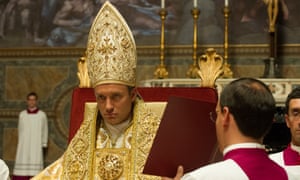
The Young Pope review – stunning, thoughtful and visually arresting


Jude Law as the young pontiff
 Jude Law as the young pontiff wrestling with his belief in God. Photograph: ©Gianni Fiorito
Jude Law is excellent as Pius XIII, oscillating between vindictive authoritarian and wounded man-child with surprising charm. A TV review by REBECCA NICHOLSON, The Guardian, December 16, 2016
What a gorgeous and gripping series The Young Pope (Sky Atlantic H) has been. It is not surprising, coming from the director of such visually arresting films as Youth and The Great Beauty, but Oscar-winner Paolo Sorrentino’s first adventure on the small screen has been far more than just a pretty picture. It could have been overwhelmed by its splashy premise: Jude Law is Lenny Belardo, now Pius XIII, an ultra-conservative, manipulative new American pontiff. He has serious doubts about whether he believes in God, drinks Cherry Coke Zero for breakfast and smokes more than the cast of Mad Men combined. But The Young Pope was stunning, thoughtful and dreamlike, and even though key players have been strategically shifted to dioceses around the globe, its well-earned second series can’t come soon enough.
Lenny, or Pius to his Vatican pals, has spent much of the first season establishing just what kind of Holy Father he intends to be. He was anointed on the misguided promise that he would be a pliable looker who might boost the church’s coffers by allowing his handsome image to appear on a few plates in the gift shop. But Lenny is no patsy; his idea of reforming Catholicism has been to crack down on moral transgressions and to channel Daft Punk, Banksy and JD Salinger – his own points of reference – by hiding his face from public view, so that everyone can get back to the business of learning how to be Godly again. It is as effective a marketing technique as it is a point of principle.
There was a thriller-like tautness to Gutiérrez’s eventual capture of brazen paedophile Archbishop Kurtwell – and how wonderful that The Young Pope did not shy away from covering child abuse in the church – in New York. Kurtwell tried to destroy Pius’s reputation by releasing his old love letters to the press, but their publication in the New Yorker served to boost his popularity by showing his human side, even if it was against a backdrop of global protests over his stance on abortion. (The image of the naked women, each daubed in blood with a letter from the word BASTARD, is one of many unforgettable scenes, dropped in confidently and casually.) But, eventually, Kurtwell was reeled in and banished to Alaska – a poetic fall from grace for a man once so powerful, if not perhaps the most effective punishment for a habitual paedophile.
Sorrentino has said that it is no coincidence that Pius begins as an ultra-hardline pope in an era where the real pontiff is pursuing a more liberal papacy than his predecessors. What has been fascinating about this series is how well it has demonstrated the subtleties of change and growth. Early on, Pius boots out a cardinal for admitting his homosexuality, and insists it is incompatible with the teachings of the church. But, by the season finale, his greatest ally is Gutiérrez (Javier Cámara, conveying both compassion and pain with just a flicker of his eyes), who tells him his alignment of paedophilia and homosexuality is wrong. Pius admits he may be revising his views. Besides, he has a lot of mummy (and daddy) issues to deal with before he gets on to working out whether he believes in God.
Law has been excellent as Pius, oscillating between vindictive authoritarian and wounded man-child with surprising charm. And so, after his substitute parents leave him – James Cromwell’s Spencer finally dies, and he sends Diane Keaton’s Sister Mary off to work with children in Africa – we end with a road trip to Venice, where Pius hopes he might find those hippy parents who abandoned him and don’t seem to be particularly interested that their son is now the global head of the Catholic church.
In St Mark’s Square, he finally reveals his identity to the assembled crowd. Imagine wondering what the Pope looked like for months, and then finding out he has the face of Law. Sorrentino goes all out for the final scenes, which are as intricate as the Pope’s finest robes. Pius delivers a barnstorming address, then looks at the smiling faces in the crowd through a telescope Gutiérrez picked up at the service station on the way. He sees his parents, older, disappointed, leaving. I was left unsure if it was real or a vision; there is something Sopranos-like in The Young Pope’s ease with a dream sequence. As Pius collapses, we pull back to a wide shot, of the crowd, then of the city, then of the world. It’s so assured, so sumptuous, so well done, that it can absolutely get away with a gesture as grand as this.

Monday, July 02, 2018

Soccer and Doping? Don't Ask, Don't Tell.

By MUSA OKWONGA
The New York Times, June 25, 2018

Like the consumers of fast-food chicken nuggets, football fans may be less than comfortable knowing how our fun is made.

The World Cup continues to thrill, with exhilarating wins by England, Germany, Belgium and Colombia, and an equally exciting draw between Japan and Senegal. Away from the field, though, an old controversy has once again rumbled into view: doping.

The Mail on Sunday, a British newspaper, reported over the weekend that a Russian player, Ruslan Kambolov, who was excluded from his country’s World Cup squad because of injury, had tested positive for performance-enhancing drugs 18 months ago. And according to the paper, it gets worse: Both the Russian authorities and FIFA kept this information quiet.

FIFA has swiftly rejected this version of events, stating that “insufficient evidence was found to assert an antidoping rule violation by any footballer.” But in some ways, it doesn’t matter. Even before FIFA’s denial, the story attracted little scandal. Among football fans these days, reports of doping are generally met with a shrug.

Why? Well, for one thing, drug use isn’t new to football. In a 2013 interview, Johnny Rep, who starred for Ajax and Holland in the 1970s, said that it was common to take amphetamines before matches. More recently, there were allegations that Spanish players had enhanced their performance by receiving artificially oxygenated blood. FIFA itself has expelled players from the World Cup for drug use: Willie Johnston of Scotland in 1978 and most infamously Argentina’s Diego Maradona in 1994.

Given all of that, and the steady stream of doping stories across professional sports in recent years, many fans may at this point have anger fatigue. On some level, maybe we’ve just accepted that drug use is an inevitable part of elite sports.
It’s not hard to reach this conclusion. Football, for one, is astonishingly competitive, and it’s getting faster all the time. The margins for success are getting smaller and smaller. As Amit Katwala has noted, “In 2006, when Germany finished third in the World Cup, their players spent an average of 2.9 seconds on the ball each time they had it. By 2014, when they won, that had fallen to just 0.9 seconds.” In other words, footballers at the highest level now have much less time to pass the ball before they are tackled.

What’s more, the sheer number of games that teams must play means that there is an extraordinary toll taken on players’ endurance. Each infinitesimal advantage counts, and unfathomable amounts of money and prestige are at stake. It’s hardly surprising that the pressure to seek illegal advantage, through artificially increasing stamina, may at times feel overwhelming.

And yet it sometimes seems that football and its fans have a “Don’t ask, don’t tell” policy in place when it comes to doping. Like the consumers of delicious fast-food chicken nuggets, we may be less than comfortable knowing how our meal has been produced.

There may come a time when authorities take a more pragmatic view, assume that doping has become an inescapable part of the game, and seek not to outlaw it but to regulate it. Until then, though, it looks as if we may have to maintain the veil of innocence around the beautiful game, even as it continues to unravel.

Mr. Okwonga is a writer, poet and football fanatic. He has published two books on the sport.


Wednesday, June 27, 2018

Thursday, June 14, 2018

Portrait of two men with their son

A samesex couple posing with their son in Bristol, UK. Photo: MARTIN PARR / MAGNUM
HAPPY PRIDE

Why the humanities are as important as engineering

 By Vivek Wadhwa 12 June 2018
Earlier in my academic career, I used to advise students to focus on science and engineering, believing that they were a prerequisite for success in business. I had largely agreed with Bill Gates’s assertions that America needed to spend its limited education budgets on these disciplines, because they produced the most jobs, rather than the liberal arts and humanities. This was in a different era of technology and well before I learned what makes the technology industry tick.

In 2008, my research teams at Duke and Harvard surveyed 652 U.S.-born chief executives and heads of product engineering at 502 technology companies. We found that they tended to be highly educated, 92 percent holding bachelor’s degrees and 47 percent holding higher degrees. Hardly 37 percent held degrees in engineering or computer technology, and just 2 percent did in mathematics. The rest had degrees in fields as diverse as business, accounting, health care, and arts and the humanities.

We learned that though a degree made a big difference in the success of an entrepreneur, the field it was in and the school that it was from were not significant factors. YouTube chief executive Susan Wojcicki, for instance, majored in history and literature; Slack founder Stewart Butterfield in English; Airbnb founder Brian Chesky in the fine arts. And, in China, Alibaba chief executive Jack Ma has a bachelor’s in English.

Steve Jobs touted the importance of liberal arts and humanities at the unveiling of the iPad 2: “It’s in Apple’s DNA that technology alone is not enough — it’s technology married with liberal arts, married with the humanities, that yields us the result that makes our heart sing, and nowhere is that more true than in these post-PC devices.” With this focus, he built the most valuable company in the world and set new standards for the technology industry.

Logitech CEO Bracken Darrell, who majored in English, also emphasized this. I recently asked him how he turned his company around and caused its stock price to increase by an astonishing 450 percent over five years. He said that it was through relentlessly focusing on design in every product the company built; that engineering is important but what makes a technology product most successful is its design.

The key to good design is a combination of empathy and knowledge of the arts and humanities. Musicians and artists inherently have the greatest sense of creativity. You can teach artists how to use software and graphics tools; turning engineers into artists is hard.

And now, a technological shift is in progress that will change the rules of innovation. A broad range of technologies, such as computing, artificial intelligence, digital medicine, robotics and synthetic biology, are advancing exponentially and converging, making amazing things possible.

With the convergence of medicine, artificial intelligence and sensors, we can create digital doctors that monitor our health and help us prevent disease; with the advances in genomics and gene editing, we have the ability to create plants that are drought resistant and that feed the planet; with robots powered by artificial intelligence, we can build digital companions for the elderly. Nanomaterial advances are enabling a new generation of solar and storage technologies that will make energy affordable and available to all.

Creating solutions such as these requires a knowledge of fields such as biology, education, health sciences and human behavior. Tackling today’s biggest social and technological challenges requires the ability to think critically about their human context, which is something that humanities graduates happen to be best trained to do.

An engineering degree is very valuable, but the sense of empathy that comes from music, arts, literature and psychology provides a big advantage in design. A history major who has studied the Enlightenment or the rise and fall of the Roman Empire gains an insight into the human elements of technology and the importance of its usability. A psychologist is more likely to know how to motivate people and to understand what users want than is an engineer who has only worked in the technology trenches. A musician or artist is king in a world in which you can 3D-print anything that you can imagine.

When parents ask me now what careers their children should pursue and whether it is best to steer them into science, engineering, and technology fields, I tell them that it is best to let them make their own choices. They shouldn’t, I tell them, do what our parents did, telling us what to study and causing us to treat education as a chore; instead, they should encourage their children to pursue their passions and to love learning.

To create the amazing future that technology is enabling, we need our musicians and artists working hand in hand with our engineers. It isn’t either one or the other; we need both the humanities and engineering.

Vivek Wadhwa is a Distinguished Fellow at Harvard Law School.

Sunday, June 10, 2018

HAPPY PRIDE 2018 from Seville


This year's Seville Gay Pride poster celebrates the 40th anniversary of the first rally for equality in Andalusia. Artist Ángel Pantoja has designed a gay choreography of sorts in which all march and dance with joy, celebrating love and the happiness of living. For once in an iconic work of art produced in Andalusia, no crying virgins, or crucified men in a valley of sorrows, but men and women on a bucolic green prairie indulging in sensuality and freedom, as a means of diminishing the anguish and loneliness that many homosexual men and women have suffered since their childhood. Pantoja's intention is to provide an antidote to sadness and pain. Baroque classicism on a background inspired by Wedgwood china, designed for the viewer to enjoy finding hidden icons: a closet opened by David Bowie's lightening bolt; a dragonfly ejected towards a Space Oddity admired by a Pink Narcissus frolicking on the Chapina gardens; Hercules and Julius Cesar on the Alameda columns; Carmen, the tobacco worker, attending a dance with lesbians, and 90s local queen Capi dancing with his extravagant fan trying to refresh the air in the hot skies of a Poseidón Club full of astronauts and unicorns. Plus Rainbow flags, elephants, Roman soldiers, the peace symbol, and our much-cherished Teddy Bear. This camp poster celebrates freedom in all its forms and is a call to all gays and lesbians not to become indifferent to the fight still ahead or to let their guard down. HAPPY PRIDE. cmg

Saturday, June 09, 2018

Razones para prohibir los móviles en las aulas

Por ROSARIO G. GÓMEZ

El teléfono móvil se ha hecho tan imprescindible en esta sociedad moderna que parece haberse convertido en un apéndice humano. Y regular su uso (su abuso) se ha transformado en una necesidad para algunos Gobiernos. Francia, entre ellos. El primer ejemplo lo ha dado el presidente de la República, Emmanuel Macron, que ha prohibido los celulares en las reuniones del Consejo de Ministros. Antes de iniciar las deliberaciones, los miembros del Ejecutivo depositan sus celulares en las taquillas. Ni se consulta el correo ni se repasa el Twitter ni se mandan wasaps mientras los ministros consideran atenta y detenidamente los pros y contras de una decisión antes de adoptarla.  

Con el precedente del Consejo de Ministros, Macron quiere ampliar la prohibición de los teléfonos móviles a otros ámbitos. El principal: la escuela. Los alumnos adictos a los móviles tendrán que aprender a desenganchar al menos durante su estancia en el centro. No solo en las aulas sino también en el recreo. Francia presenta esta medida como una “desintoxicación”. Favorecerá la atención a las explicaciones del profesorado, combatirá el bullying y mitigará la ansiedad de esos adolescentes esclavos de la tecnología.

Los estudios demuestran que los móviles acentúan el ciberacoso entre los escolares, facilitan su acceso a la pornografía y contribuyen a su aislamiento social. Son una nueva forma de adicción (bautizada como nomofobia). En defensa de que se prohíba por ley su uso, el ministro francés de Educación, Jean-Michel Blanquer, ha dicho de los celulares: “Son un avance tecnológico, pero no pueden monopolizar nuestra vida. No se puede progresar en un mundo de tecnología si no sabes leer, escribir, contar, respetar a otros y trabajar en equipo”.

Si prosperan los planes de Macron en el próximo curso quedarán proscritos estos aparatos en los colegios. La medida tendrá gran impacto (el 90% de los niños de 12 años o más tienen móvil), aunque muchos dudan de que se pueda llevar a cabo eficazmente. Sus detractores aseguran que el proyecto de ley es una mera “operación de comunicación” que no tendrá efectos puesto que la mitad de los centros escolares ya prohíben los smartphones en sus instalaciones.

Queda por ver si los colegios que no respeten la ley serán sancionados y cómo se arbitrarán los sistemas para que los docentes la hagan cumplir a rajatabla. Si Francia aprueba este difícil examen, con el que quiera lanzar un mensaje “de salud pública”, países como Reino Unido e Irlanda podrían seguir el mismo camino.

El País, 9.6.2018

Friday, June 08, 2018

Travel Tips


These websites might help you plan your trip or find some good offers. Travelzoo (www.travelzoo.es) offers its registered users (registration is free)  a selection of the best 20 travel offers on the Internet at the time every week. Villanao (www.villanao.es) puts together on one single website more than 100,000 deals from real estate agencies, holiday resorts and lodging companies, as well as apartments form private owners. Trivago (www.trivago.es) searches and compares hotel prices (applying 250 selecting criteria and data from more than 30 travel agencies and hotel chains). Tripadvisor (www.tripadvisor.es) compiles and publishes online more than 30 million opinions and recommendations from travellers around the world about accommodation, organized tours and guides. 
Trabber (www.trabber.com) and Mirayvuela (www.mirayvuela.com) track hundreds of traditional and low-cost airlines to offer you the best deal. Finally, the Official Travel Guide (www.officialtravelguide.com) lists 1,200 official tourist offices, with links to their websites. But before your book your flight, check out the latest online travelling tool: Google Flights. Bon voyage!

Thursday, May 24, 2018

Provincianos y cosmopolitas

Por RAFAEL ARGULLOL

Viajar mucho sin llegar a conocer nada, tener acceso a gran cantidad de información pero permanecer desinformado y tratar de unificar todo bajo una sola lengua no hace a nadie más universal. Todo lo contrario.

En 1794 el escritor saboyano, aunque ruso de adopción, Xavier de Maistre escribió un delicioso relato, Viaje alrededor de mi habitación, en el que se describe de modo autobiográfico la vida de un oficial que, obligado por una convalecencia a permanecer 42 días encerrado en su cuarto, viaja con su imaginación por un territorio riquísimo en referencias y en pensamientos. El protagonista del texto es un verdadero cosmopolita, un ciudadano del mundo en el sentido literal, a pesar de que está recluido entre cuatro paredes. Me acuerdo con frecuencia del libro de Xavier de Maistre cuando escucho los balances que muchos hacen de sus travesías del mapamundi en viajes organizados, y en los que se plantea una situación inversa a la del argumento literario de aquél: recorren vastos espacios pero su imaginación —o su falta de imaginación— los atrapa en un territorio pobrísimo, tanto en referencias como en pensamientos. Consumen grandes cantidades de kilómetros aunque, como viajeros, atesoran una escasa experiencia de sus viajes. Son, por así decirlo, la vanguardia de los provincianos globales y, en ningún caso, al contrario del oficial convaleciente de Xavier de Maistre, son cosmopolitas ni aspiran a serlo.


El provinciano global es una figura representativa de una época, la nuestra, que empuja al cosmopolita hacia una suerte de clandestinidad. El cosmopolita, personaje en extinción, o quizá provisionalmente retirado a las catacumbas del espíritu, es alguien que desea habitar la complejidad del mundo. Es un amante de la diferencia, ansioso siempre de explorar lo múltiple y lo desconocido para volver a casa, si es que vuelve, con el bagaje de los sucesivos saberes que ha adquirido. El cosmopolita, al no soportar la excesiva claustrofobia de la identidad propia, busca en el espacio absorto de lo ajeno aquello que pueda enriquecer su origen y sus raíces. El hijo pródigo de la parábola bíblica encarna a la perfección ese anhelo: el conocimiento de los otros es finalmente el conocimiento de uno mismo. El cosmopolita quiere saber.

El provinciano global quiere acumular mientras, simultáneamente, elimina o aplana las diferencias. Hay muchos signos en nuestro tiempo que señalan en esa dirección, sin que se adivine cómo el que todavía posee la vieja alma del cosmopolita pueda oponerse. Por su espectacularidad y por su carácter reciente el turismo de masas es, sin duda, uno de esos signos. Cada vez se elevan más voces proclamando el carácter pandémico de un fenómeno que, paradójicamente, en sus inicios se consideró liberador porque el igualitarismo del viaje parecía la continuación lógica de la creencia ilustrada en el igualitarismo de la educación. Sin embargo, cualquiera que se pasee por las antiguas ciudades europeas o, con otra perspectiva, por las zonas aún consideradas exóticas del planeta, puede percibir con facilidad el alcance de una plaga que está solo en sus comienzos. Los centros históricos de las urbes ya son casi todos idénticos, como idénticos son los resorts en los que se albergan los huéspedes de los cinco continentes. La diferencia ha sido aplastada, dando lugar al horizonte por el que se mueve con comodidad el provinciano global.

Con respecto a la información —otra de nuestras deidades, si no la principal— Heráclito, hace 2.500 años, ya dejó dicho que no proporcionaba la comprensión. No parece probable que variara de posición, deslumbrado por nuestras tecnologías. La misma paradoja que afecta al turismo masivo, enfermo de velocidad y cuantificación, afecta a esa humanidad más informada que nunca pero proclive a la amnesia. Como lo demuestran hechos recientes, tal las guerras de Siria o de Ucrania, es imposible que la llamada opinión pública sepa tan poco de aquello que debería saber tanto en la era de la información total. El provinciano global quiere disponer de resortes informativos, si bien es dudoso que quiera saber. Quizá tampoco está en condiciones de hacerlo. Aquellos que detentan el poder, dirigentes políticos y económicos, están en la misma situación. Cuando a menudo nos lamentamos de la falta de estatistas en la política mundial aludimos, en realidad, al dominio del provincianismo global.

La desfiguración de la cultura cosmopolita puede ser clave a la hora de entender buena parte del desconcierto actual. Lo que hemos denominado globalización, vinculada a las grandes migraciones y a las nuevas tecnologías, ha sido, en parte, un fenómeno fructífero, al poner en relación tradiciones ajenas entre sí y al facilitar nuevas posibilidades frente a la desigualdad; no obstante, paralelamente, ha supuesto una devastación cultural de grandes proporciones al destrozar buena parte del sutil tejido de la diferencia. La uniformidad socava los alicientes que alberga toda visión cosmopolita.

Una de las grandes metáforas de este proceso en nuestra época es la rápida, universal y consentida mutilación de centenares de idiomas en favor de un idioma avasalladoramente hegemónico. Con toda probabilidad, hace solo tres décadas, nadie se hubiese aventurado a insinuar que para participar en un congreso en Lisboa sobre Camões —poeta nacional portugués— había que intervenir en inglés, o que en cualquiera de nuestras universidades se puede asistir al espectáculo de que un profesor explique a Baudelaire o a Goethe en medio inglés a un público estudiantil que entiende el inglés a medias. Y aún menos, desde luego, se hubiese podido imaginar que se llegaría a la situación de que un entero país —Corea del Sur— pretenda alcanzar a poseer el inglés, como nueva lengua propia, mediante el ingenioso método de llevar a las embarazadas a clases en aquel idioma, de modo que el feto pueda ya adaptarse a lo que prima en el cada vez más reducido universo lingüístico. Obviamente no tengo nada contra lo que los cursis llaman “lengua de Shakespeare” sino contra el reduccionismo que, al maltratar a todos los demás idiomas, también empobrece a la propia lengua inglesa: recientemente, un catedrático de Oxford me contaba que, mientras la mayoría de sus colegas apenas conocen otros idiomas que no sean el suyo, los escritores británicos contemporáneos utilizan una lengua drásticamente empobrecida.

Este sería un buen retrato del provinciano global: aquel que aspira a hablar un solo idioma, lo más utilitario posible, sin importarle la destrucción de los mundos que habitan en los otros idiomas; aquel que se mueve continuamente de aquí para allá, obseso coleccionista de imágenes, al tiempo que es incapaz de fijar la mirada, y no digamos el pensamiento, en paisaje alguno; aquel que está permanentemente informado con aludes de noticias y mensajes que sepultan su capacidad de comprensión. Es posible que un individuo de tal naturaleza se considere a sí mismo un cosmopolita. Pero vive en una pequeña aldea que ha confundido con el mundo.
El País, 2 de enero de 2016. Rafael Argullol es escritor.